Introduction
Priscilla Presley’s New Memoir Opens the Door to the Life She Lived After Elvis

There are some women in American cultural memory who seem forever frozen in a single image. Priscilla Presley is one of them: the young woman beside Elvis, beautiful, composed, and forever linked to one of the most famous love stories in music history. But her new memoir, Softly, As I Leave You: Life After Elvis, asks readers to look again. Published on September 23, 2025, the book shifts the focus away from myth and toward the long, complicated emotional life that followed the end of her marriage to Elvis Presley.
That alone gives the memoir unusual weight. For decades, the public has viewed Priscilla through the lens of Elvis—first as his young bride, then as the keeper of a legacy too large for any one person to carry lightly. But this book is not presented as another retelling of celebrity glamour. It is framed instead as a story of what came after: self-discovery, grief, motherhood, survival, and the difficult work of becoming a whole person after living for years in the shadow of someone the world treated almost like a myth.
Priscilla herself has described the memoir as a deeply personal reckoning. In coverage around the book’s release, she spoke of remembering Elvis through what she called a “tender haze,” a phrase that says almost everything about the emotional tone of the story. This is not the language of scandal. It is the language of memory—softened by time, still carrying love, but no longer pretending love erased pain. In interviews tied to the memoir, she has also said she was “very much in love” with Elvis and remains, in some sense, emotionally connected to him, even while insisting she had to leave because she “couldn’t live the life.”
For older readers especially, that tension may feel achingly familiar. The great loves of a lifetime are rarely simple. They are not easily sorted into success or failure, romance or regret. They often remain both blessing and wound. That seems to be one of the memoir’s most powerful undercurrents: the idea that a marriage can end, a life can change, and yet the emotional bond can remain, not as fantasy but as part of one’s inner landscape. Priscilla writes not as a young woman in the middle of the storm, but as an 80-year-old looking back across decades of joy, grief, and reinvention.
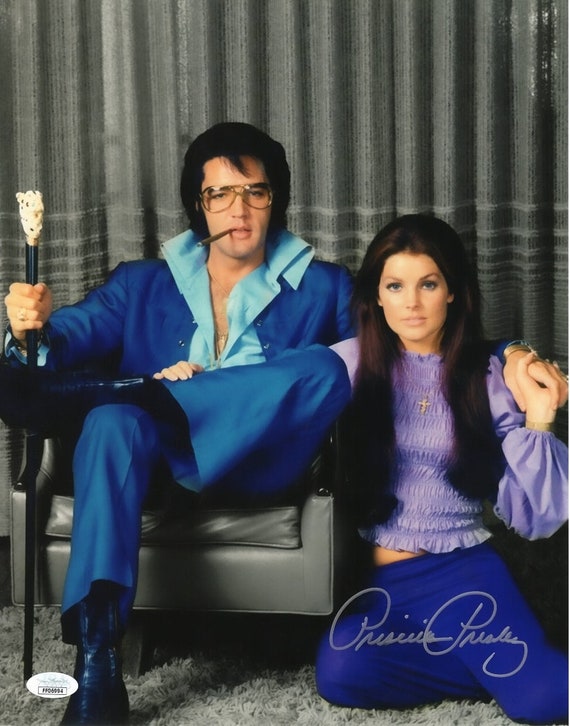
Her life beyond Elvis is, in many ways, its own remarkable American story. Born Priscilla Ann Beaulieu on May 24, 1945, in Brooklyn, New York, she met Elvis in Germany when she was only 14 and he was serving in the Army. They married in Las Vegas in 1967, welcomed Lisa Marie the next year, and divorced in 1973. Yet even after the marriage ended, their connection did not disappear into bitterness or silence. Publicly and privately, Priscilla has continued to speak of Elvis not merely as a cultural giant, but as the love that shaped the emotional architecture of her life.
What makes her story especially compelling now is that she did not remain only a footnote in someone else’s legend. After Elvis’s death, she became a central force in preserving and expanding his legacy. Biography notes that she helped guide Graceland into becoming a major public attraction and built Elvis Presley Enterprises into a successful business. That transformation matters. It reveals a woman who moved from being seen primarily as “Elvis’s wife” to becoming a serious business figure in her own right—one who understood that memory, too, must be stewarded with discipline and vision.
And yet her story has never been solely about business triumph or public image. The memoir arrives after years marked by profound family loss, including the death of Lisa Marie Presley in January 2023 and the earlier loss of grandson Benjamin Keough in 2020. Coverage of the book emphasizes that it deals not only with Elvis and separation, but also with grief, endurance, and the trauma of surviving those closest to her. That context gives the memoir a gravity that goes far beyond celebrity recollection. It becomes, instead, a meditation on what it means to keep living after the roles that once defined you have changed or vanished entirely.

There is another reason the book is likely to resonate so deeply with mature readers: it speaks to identity. In a CBS interview around the memoir, Priscilla reflected that she had been “living Elvis’ life” and had to ask herself who she was outside that role. That question is not unique to celebrity. Many women of her generation will recognize it instantly. It echoes through marriages, motherhood, caregiving, widowhood, and every season in which a woman is expected to serve a life larger than her own. To hear Priscilla ask it so plainly, so late in life, gives the memoir an unexpectedly universal force.
Of course, the public will always be drawn to the Elvis details. That is inevitable. But the deeper significance of Softly, As I Leave You may be that it repositions Priscilla Presley not as a decorative figure from rock-and-roll history, but as a woman who endured fame, heartbreak, reinvention, and sorrow—and kept going. She acted in Dallas and the Naked Gun films, authored earlier memoirs, and continued shaping her public life long after the marriage that first made her famous ended. This new book seems to gather all of that into one final, reflective statement.
In the end, that may be why this memoir matters. Not because it adds one more chapter to Elvis lore, but because it offers something rarer: the sound of a woman reclaiming the emotional truth of her own life. After all the headlines, all the photographs, all the decades of being seen and interpreted by others, Priscilla Presley is speaking again in her own voice. And for readers old enough to know how hard-won such a voice can be, that may be the most moving part of the story