Introduction
Elvis Presley’s Last Night on Stage: The Concert Critics Questioned, Fans Defended, and History Never Forgot
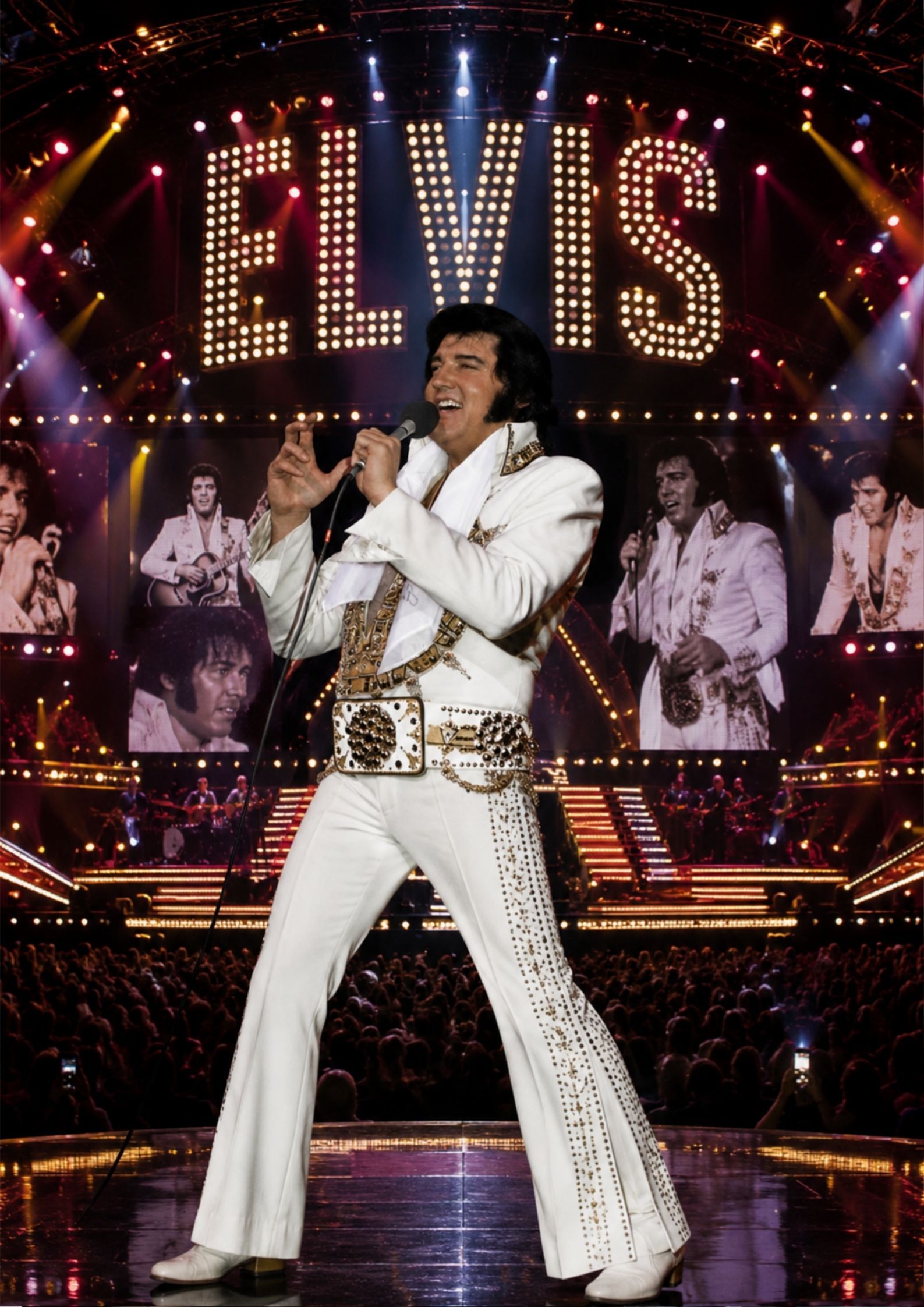
Elvis Presley’s Last Night on Stage: The Concert Critics Questioned, Fans Defended, and History Never Forgot
On June 26, 1977, nearly 18,000 fans filled Market Square Arena in Indianapolis to see Elvis Presley perform. To them, it was another chance to stand in the same room as the King of Rock ‘n’ Roll — the man whose voice, style, and presence had helped change popular music forever. But history would later give that night a meaning no one in the arena could fully understand at the time. It became Elvis Presley’s final public performance, the last concert before he returned to Graceland, where he would die less than two months later on August 16, 1977.
What makes that final concert so haunting is not simply that it was the end. It is that people saw different versions of Elvis that night, depending on where they stood emotionally. For devoted fans, he was still the King. For skeptical critics, he was a faded superstar whose show had become uneven and overpackaged. For historians looking back now, he was something far more complicated: a tired but still magnetic performer carrying the impossible weight of his own legend.
The evening began with anticipation and delay. The concert was scheduled for 8:30 p.m., but Elvis Presley did not take the stage until around 10 p.m. Before him came the usual supporting acts — vocal groups, comedy, and stage business designed to build suspense. Some critics later complained that the buildup felt excessive, even carnival-like. But for many in the audience, the waiting only intensified the emotion. They had come for Elvis, and nothing else truly mattered.

When he finally appeared in a gold and white jumpsuit with white boots, the arena exploded. The response was immediate, loud, and deeply emotional. Elvis opened with “C.C. Rider,” and for a moment, the years seemed to fall away. Flashbulbs popped. Hands clapped. Fans screamed as if they were greeting not merely a singer, but a piece of their own youth.
Yet the night was not simple.
Local press coverage revealed the divided reaction surrounding Elvis in his final years. Rita Rose of The Indianapolis Star offered a sympathetic view, acknowledging concerns about his health and appearance while emphasizing that he still delivered a performance “in true Presley style.” Her review captured the relief many fans felt when Elvis appeared with more energy than expected. She praised moments like “It’s Now or Never,” “This Time You Gave Me a Mountain,” “Jailhouse Rock,” and the communal energy of “Amen.”
In contrast, Zach Dunkin of The Indianapolis News was far harsher. He criticized the structure of the show, the souvenir selling, the opening acts, and Elvis himself. Yet even he admitted that Elvis could still sing when he truly tried, pointing to “Hurt” and “Bridge Over Troubled Water” as stronger moments. That contradiction is important. Even critics who doubted the show could not completely deny the remaining force of Elvis’s voice.
For older listeners, this tension may be the most revealing part of the story. By 1977, Elvis Presley was no longer only an entertainer. He was a national memory under public examination. Audiences wanted the impossible from him. They wanted the young rebel of the 1950s, the movie star of the 1960s, the black-leather comeback figure of 1968, and the powerful Las Vegas vocalist of the early 1970s — all at once. No human being could remain every version of himself forever.

And yet, Elvis tried.
During that 80-minute performance, he moved through a setlist that reflected the broad emotional range of his career. “Jailhouse Rock” and “Hound Dog” brought back the fire of his early years. “Love Me Tender” and “Can’t Help Falling in Love” reminded fans of his romantic warmth. “Hurt,” “Bridge Over Troubled Water,” and “This Time You Gave Me a Mountain” carried something heavier — the sound of a man singing through weariness, memory, and private struggle.
Those later songs now feel almost prophetic. “Hurt” allowed Elvis to pour anguish into a dramatic ballad. “Bridge Over Troubled Water” showed his ability to transform another artist’s song into something deeply personal. “This Time You Gave Me a Mountain” sounded like a man acknowledging burdens too large to easily describe. In hindsight, these performances became emotional documents, not just concert selections.
The final number, “Can’t Help Falling in Love,” has become inseparable from the sadness of that night. It was a familiar closing song for Elvis, one fans had heard many times before. But in Indianapolis, it became his final farewell without anyone knowing it. After the song, he reportedly told the audience, “We’ll meet you again. God bless, adios.” Then he left the stage.

That phrase now carries a terrible tenderness.
At the time, fans walked out believing they had seen another Elvis concert — imperfect perhaps, but still filled with moments of power, charm, and connection. Critics filed their reviews. Souvenirs were taken home. The arena emptied. Life continued. But only weeks later, after Elvis died at Graceland, the meaning of that night changed forever.
Suddenly, every detail mattered. The delay. The jumpsuit. The applause. The divided reviews. The final song. The last words. The crowd that did not know it was saying goodbye.
That is why Elvis Presley’s last concert in Indianapolis remains so powerful. It was not the flawless ending of a carefully written legend. It was messier, more human, and more heartbreaking than that. It showed an artist still loved by thousands, still criticized by the press, still capable of vocal greatness, and still trapped inside expectations no person could fully satisfy.
In the end, the final concert was not only about the King leaving the building. It was about the man behind the crown standing one last time before the people who never stopped loving him. And whether critics questioned the performance or fans defended it, history remembers the deeper truth: Elvis Presley gave his final bow in Indianapolis, and the world did not realize it until he was gone.