Introduction
Barry Gibb’s Greatest Honor: The Bee Gees Legend Who Stood Before Royalty Carrying the Voices of His Brothers

When Sir Barry Gibb stood before Prince Charles to receive the honor of knighthood, the moment was more than a royal ceremony. It was the closing of one circle and the opening of another. For millions of fans who grew up with the Bee Gees, this was not simply a famous musician being recognized by the British establishment. It was a deeply emotional tribute to a lifetime of melody, brotherhood, endurance, and loss. Barry Gibb was being honored for his services to music and charity, but in that room, he was also carrying the memory of Robin and Maurice, the two brothers whose voices had shaped his life and helped define one of the most recognizable sounds in modern popular music.
There was a touch of humor in the moment, too. Barry admitted that after kneeling to be knighted, he was not entirely sure he could rise again. Decades of performing, moving, touring, and giving his body to the rhythm of the stage had left their mark. It was a charmingly human confession from a man whose voice once seemed almost untouchable. The same artist who helped bring the world to its feet during the disco era now found himself joking about the simple challenge of standing back up. Yet that small detail made the honor feel even more meaningful. It reminded fans that legends age, bodies tire, and even the brightest careers are lived by real people.
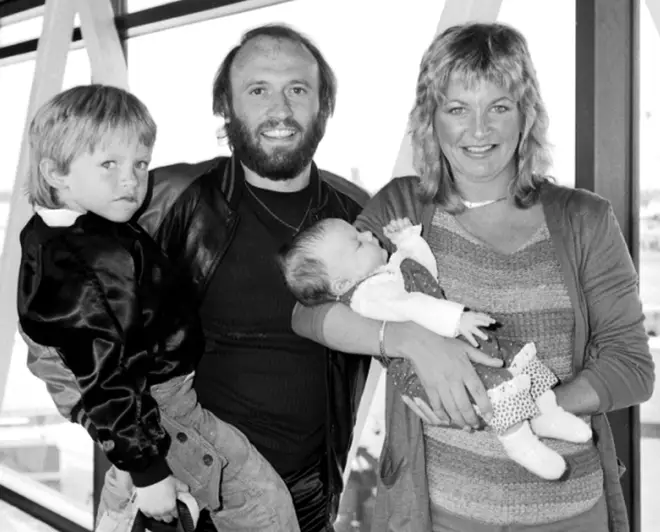
The Bee Gees’ story began long before the glittering lights of Saturday Night Fever. Barry, Robin, and Maurice Gibb founded the group in 1958, building their sound through persistence, family instinct, and an extraordinary understanding of harmony. Their first major UK success, “Massachusetts,” arrived a decade later and announced that the brothers were more than another pop act. They had a gift for writing songs that felt both intimate and grand, simple enough to hum yet deep enough to remain in memory for a lifetime.
Their path was not always smooth. The Bee Gees split, reformed, changed direction, and reinvented themselves in ways that few groups could have survived. Then came the 1970s, and with them, the soundtrack that would transform their place in history. Saturday Night Fever did not merely make the Bee Gees popular again; it turned them into cultural architects. The soundtrack sold around 40 million albums and became a defining sound of an era. Its songs were not just hits. They became part of the emotional architecture of a generation.
Still, for all the fame, Barry’s knighthood carried a sadness that could not be ignored. The Bee Gees had previously been awarded the CBE, but they collected that honor in 2004 shortly after Maurice’s death. Robin later died in 2012, leaving Barry as the last surviving brother of the group. That is why his words on the day of his knighthood felt so powerful: without them, he said, he would not be there. He felt their presence, as he always did.

That single sentiment reveals the heart of Barry Gibb’s legacy. He has never presented himself as a solo survivor standing apart from the Bee Gees. Instead, he has remained the keeper of a shared dream. Every honor given to Barry is also, in spirit, an honor given to Robin and Maurice. Every applause that greets his name carries an echo of the harmonies they created together.
The Bee Gees became one of the top-selling artists of all time, with more than 200 million records sold worldwide. Across six decades, they achieved major number-one hits in America and Britain, while also writing unforgettable songs for artists such as Diana Ross, Barbra Streisand, and Dolly Parton. Their influence reached far beyond one genre, one decade, or one fashion. They understood the emotional power of a song better than almost anyone.
That is why Barry’s knighthood feels so special. It is not simply a medal, a title, or a formal recognition. It is a public acknowledgment that the Bee Gees changed music history. It is a tribute to the long road from childhood ambition to global fame, from family harmony to heartbreaking absence, from youthful energy to elder statesmanship.
For older listeners especially, Barry Gibb’s honor may feel personal. His songs were there during first dances, long drives, family gatherings, lonely evenings, and moments of celebration. The Bee Gees gave the world music that could move the body and touch the heart at the same time. And now, as Sir Barry Gibb looks back on a career full of high notes, this royal honor stands as one of the most moving of all.
Not because it belongs to him alone.
But because, in his heart, his brothers were standing there with him.