Introduction
Four Years Before the World Lost Elvis, “I’ll Remember You” Sounded Like a Farewell No One Recognized
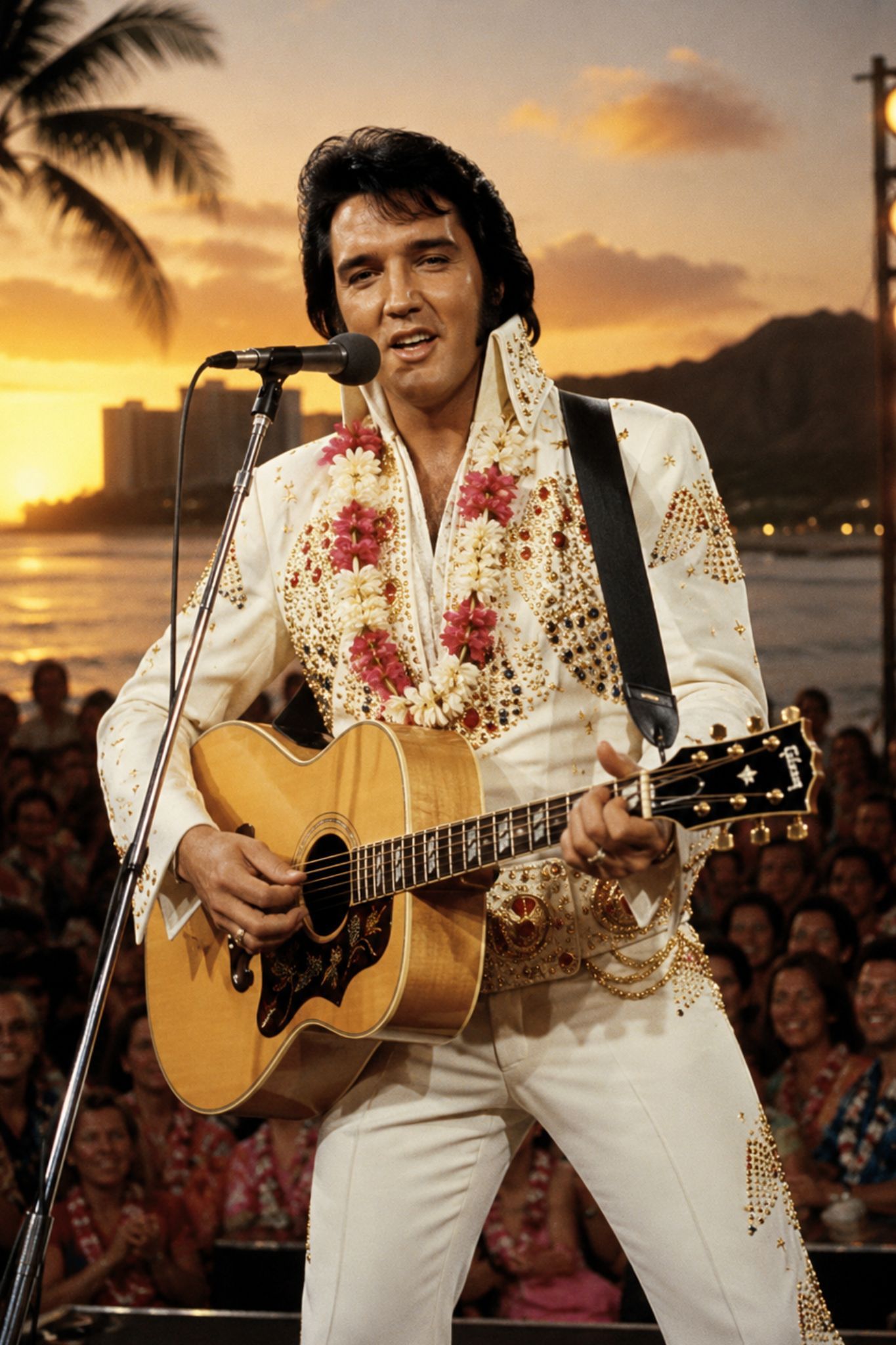
Some performances are remembered because they capture an artist at the height of his power. Others remain with us because, many years later, they appear to contain a meaning that nobody in the original audience could possibly have understood. When Elvis Presley sang “I’ll Remember You” during the historic 1973 Aloha from Hawaii concert, he was standing before one of the largest audiences of his career, dressed in white beneath the brilliant lights of Honolulu. He looked every inch the international superstar: confident, commanding, and almost untouchable. Yet as the first gentle notes began, something in his expression changed, and the famous figure seemed to disappear behind the deeply human voice of a man singing about memory, absence, and the promise that someone would never be forgotten.
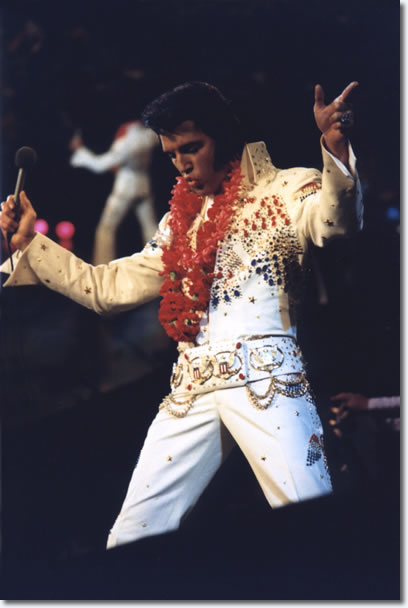
The evening had all the scale and ceremony expected of a landmark television event. Elvis stood at the centre of an enormous production, surrounded by accomplished musicians and watched by admirers far beyond the concert hall. His image had become one of the most recognizable in modern culture, and his arrival in the white American Eagle jumpsuit carried the grandeur of a king stepping before his people. However, “I’ll Remember You” required none of the dramatic movement or playful confidence that often defined his stage appearances. It asked him to become still, to trust the melody, and to allow the emotional meaning of the lyrics to carry the performance.
The song had been written by Kui Lee, the gifted Hawaiian songwriter whose life ended tragically young. Elvis’s performance therefore already carried the dignity of remembrance. He was not merely offering another romantic ballad to please the crowd. He was honouring a writer whose music had continued speaking after his voice had been silenced. That knowledge gave the song a special place within the Honolulu concert, connecting the spectacular international broadcast to the quieter story of a local artist whose work had touched countless lives.

Yet time has added another layer to the performance—one that makes it increasingly difficult to watch without emotion. Four years after Elvis sang “I’ll Remember You,” the world was forced to remember him. He died in 1977 at the age of only 42, leaving behind a vast musical legacy and millions of listeners struggling to understand how someone who had seemed so permanent could suddenly be gone. Because we know what followed, every tender phrase from that Honolulu stage now seems to carry an unintended farewell.
This does not mean Elvis knew what lay ahead. There is no reason to believe that he approached the song as a final message to the world. He was performing a beautiful composition within an extraordinary concert, drawing upon the interpretive gifts that had made him one of the finest emotional singers of his generation. Nevertheless, great performances often outgrow the intentions of the moment in which they were created. History changes the way we hear them, and loss gives familiar words meanings they did not originally possess.
That is precisely what happened to Elvis Presley’s “I’ll Remember You.”
As he sang, his voice did not depend upon vocal force or theatrical display. It softened. The rougher edges gave way to restraint, and each line seemed carefully shaped by someone who understood that remembrance is not loud. It lives in small details, familiar images, and promises quietly repeated after another person has gone. Elvis possessed the rare ability to make a song feel as though he had discovered its meaning only seconds before singing it. Even when the lyrics were written by someone else, he could inhabit them so completely that they appeared to reveal something private.
During the final portion of the performance, his eyes seemed to hold a distant and thoughtful expression. He was still standing before an enormous audience, yet for a few moments he appeared emotionally alone within the song. The applause, cameras, costumes, and scale of the event no longer seemed important. What remained was the voice—a little weary, deeply tender, and filled with an emotion that resisted easy explanation.
For older listeners who remember the original broadcast, the performance may awaken memories of an entirely different world. Elvis was still alive, his concerts remained major events, and the possibility of losing him so soon seemed almost unimaginable. He had already lived through several remarkable career chapters, from the revolutionary recordings of the 1950s to Hollywood films, the celebrated television comeback, and his renewed triumph as a live performer. Although time had changed him, the audience still saw a man with many years ahead.
That expectation makes the passage of four years feel especially cruel.
By the time the world learned of Elvis Presley’s death at 42, the youthful rebel and the white-clad performer from Honolulu had become parts of the same unfinished story. His passing transformed countless recordings into memorials. Songs about loneliness, homecoming, regret, faith, and remembrance suddenly seemed to speak about the singer himself. Listeners returned to old performances searching for clues, final messages, or moments that might explain the distance between the brilliant public image and the private struggles that later became part of his history.
Among those performances, “I’ll Remember You” at Aloha from Hawaii possesses an especially haunting beauty. The title alone now feels inseparable from Elvis’s legacy. For decades, fans have continued to remember him through recordings, films, photographs, personal stories, and pilgrimages to places connected with his life. His voice remains present in homes across the world, passed from one generation to the next. People who never witnessed him during his lifetime still respond to the vulnerability in his singing, proving that remembrance can create a connection across time.
The song’s promise also reflects the relationship between Elvis and his audience. He gave listeners more than entertainment. His voice became associated with moments in their own lives: first records, family gatherings, long car journeys, dances, celebrations, and quiet evenings when a familiar song brought unexpected comfort. When he sang that he would remember someone, he could not have known that millions would later make the same promise to him.
What makes the performance so powerful is the absence of exaggeration. Elvis does not behave as though he is delivering a historic farewell. He does not draw attention to his own emotion or attempt to turn the song into a grand dramatic statement. He simply sings with care. That restraint allows modern listeners to bring their own knowledge and grief to the performance. We hear not only the tribute to Kui Lee, but also the echo of the tribute Elvis would soon require.
There is an important distinction between prophecy and emotional truth. Elvis was not knowingly saying goodbye, yet the performance feels like a farewell because his interpretation reaches beyond the immediate occasion. He understood the emotional language of loss, even if he could not have predicted how closely that language would later become connected to his own name. The finest singers do not need to experience every detail of a song literally. They recognize the universal feeling within it and offer that feeling back to the audience.
Elvis’s gift was his ability to turn vulnerability into sound. He could approach a lyric about remembrance and make it feel both personal and shared. The listener was not observing a distant celebrity performing beneath stage lights; the listener was being addressed directly. That intimacy remains extraordinary when we consider the enormous scale of Aloha from Hawaii. The production was global, but the emotion felt private.
The visual contrast deepens the impact. Dressed in radiant white, Elvis appeared almost symbolic—a figure built from fame, light, and public expectation. Yet his voice carried the weariness and tenderness of an ordinary man who understood how fragile human connections can be. The costume suggested permanence, but the song acknowledged that everything changes. The image promised immortality, while the lyrics spoke about separation.
Today, the most moving approach is to watch his face during the final notes. His expression does not provide a simple answer. There is professionalism, concentration, gentleness, and perhaps a trace of sadness. Modern viewers may see more because they know more, but that does not make the response false. Art continues changing after the artist has left it behind. Each generation discovers its own meaning, and each loss alters the emotional landscape.
This was more than a beautiful ballad. It was a moment in which Elvis Presley briefly stepped away from the mythology surrounding him and allowed the song to reveal the sensitive interpreter beneath the famous image. Four years later, the performance became something nobody had intended: a reminder of how quickly a living legend can become a cherished memory.

The world did remember Elvis.
It remembered the young man whose sound unsettled convention, the performer whose charisma transformed popular entertainment, and the mature singer who could stand almost motionless and make a single lyric feel unbearably personal. It remembered the laughter, the generosity, the contradictions, and the sadness that became part of his story. Most importantly, it remembered the voice.
Nearly every great artist hopes that the work will remain after the applause has ended. In Elvis’s case, that hope became reality on a scale few could have imagined. “I’ll Remember You” continues to survive not merely as a song from a famous concert but as a quiet exchange between the past and the present. Elvis sang it for an audience in 1973, but its emotional meaning now belongs to everyone who has returned to his music after losing him.
Beneath the blazing Honolulu lights, he could not know how little time remained. He could not know that the words would later sound as though they had been written for him, or that audiences decades into the future would study his expression and hear an accidental goodbye. He was simply singing with the honesty that had always distinguished his finest work.
That is what makes the moment so devastating—and so beautiful.
Elvis sang “I’ll Remember You,” and four years later, the world kept its promise.