Introduction
THE DAY ELVIS PRESLEY TRADED THE CROWN FOR A UNIFORM: THE TWO ARMY YEARS THAT QUIETLY CHANGED THE KING FOREVER
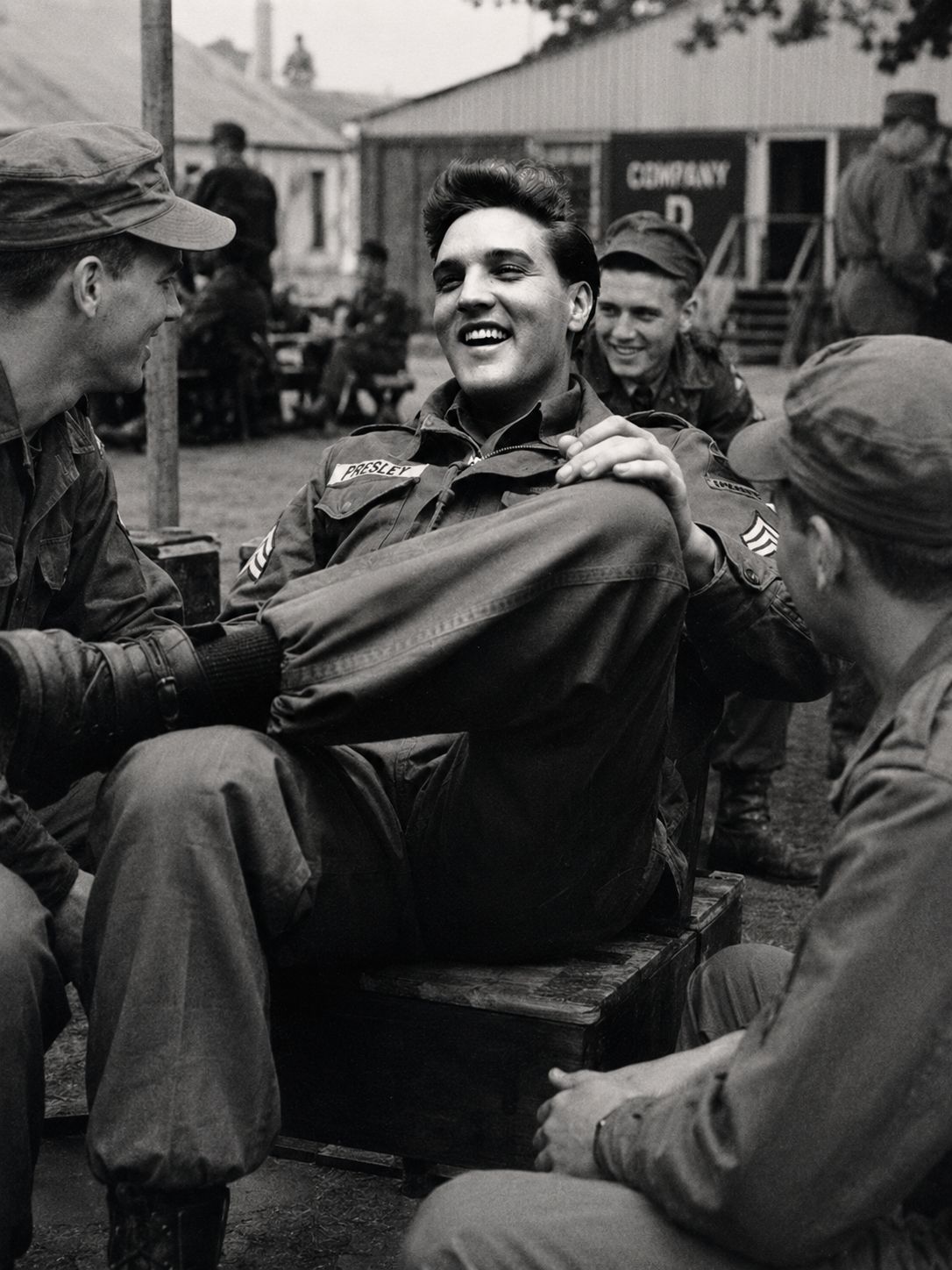
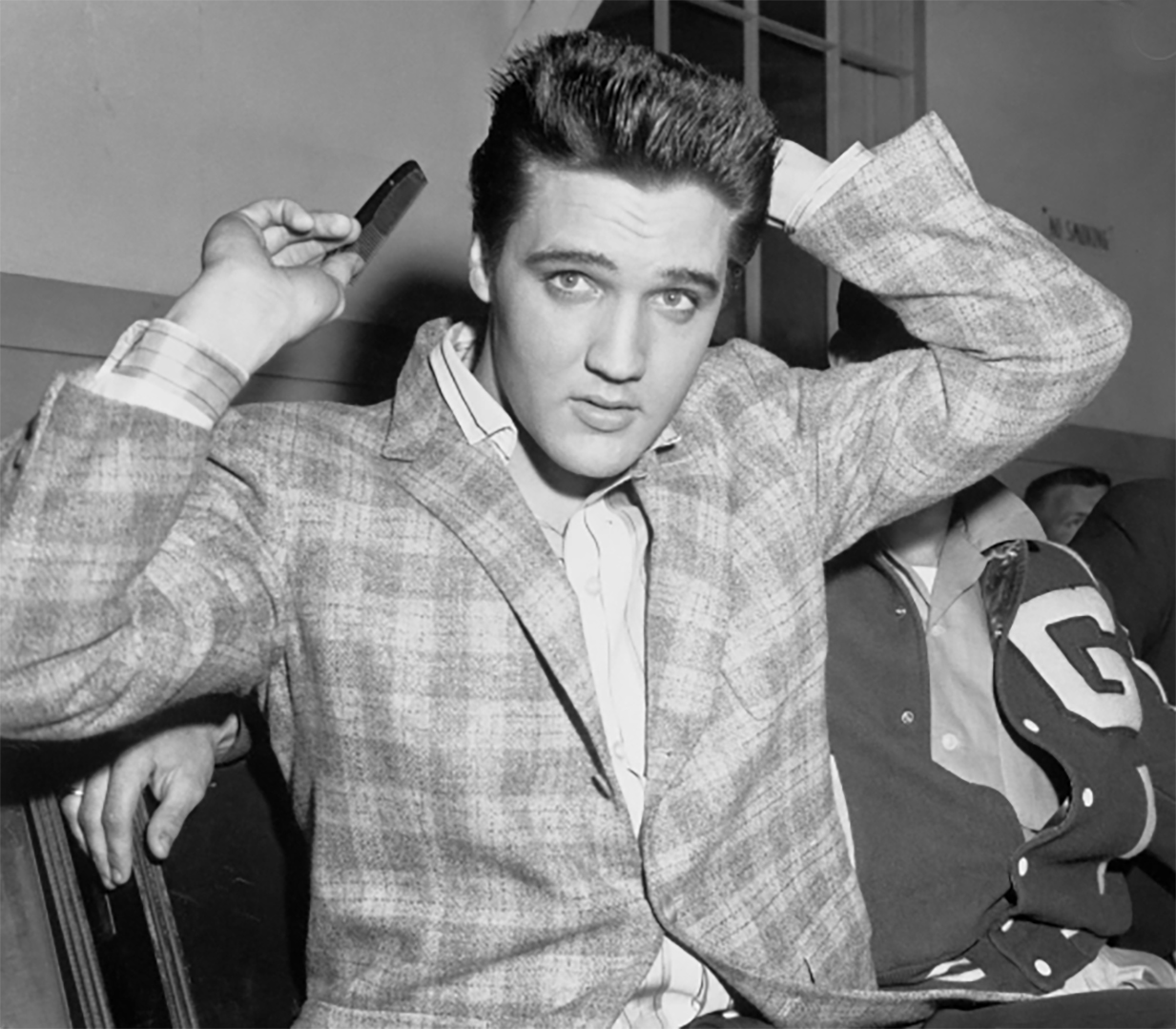
There was a moment in Elvis Presley’s extraordinary life when the screaming crowds, movie cameras, recording studios, tailored jackets, and glittering promise of American stardom suddenly gave way to something far more ordinary: an Army uniform, military discipline, early mornings, field exercises, and orders that had nothing to do with the entertainment business. On March 24, 1958, at the very height of his growing fame, Elvis Presley was inducted into the United States Army. He was assigned the service number 53310761, received his famous military haircut the following day at Fort Chaffee, Arkansas, and soon traveled to Fort Hood, Texas, where the young man who had become a cultural phenomenon began learning what it meant to live as a soldier rather than a celebrity.
To understand the importance of this chapter, one must remember just how remarkable Elvis’s position was in 1958. He was not an unknown young recruit searching for direction. He had already become one of the most recognizable entertainers in America. His records had transformed popular music, his television appearances had made him a household name, and his films had expanded his fame beyond the recording studio. Yet when the Army called, the public saw something few had imagined only a few years earlier: Elvis Presley standing in line with other young servicemen, wearing the same uniform and entering a system where fame did not automatically place him above everyone else. The National Archives records that his induction created extraordinary public attention, including letters from worried fans asking government officials to bring him home early. The Army’s position, however, remained clear: Presley would not be released differently from other inductees serving overseas.
That decision became an important part of the Elvis military story. Instead of allowing his celebrity to completely separate him from ordinary military life, his service placed him inside the routines and expectations faced by thousands of other young American men of his generation. After arriving at Fort Hood on March 28, 1958, Elvis went through basic training and remained there for roughly six months. Even during this period, the music business had not forgotten him. During leave after basic training, he returned to the recording studio on June 10, 1958, recording material that included “A Big Hunk O’ Love.” It would be his final recording session until he returned from military service in 1960.
But behind the photographs of uniforms and military vehicles, Elvis was entering one of the most emotionally difficult periods of his life. During the summer of 1958, his mother, Gladys Presley, became seriously ill. Elvis was granted emergency leave and returned to Memphis on August 12. Two days later, on August 14, 1958, Gladys died at the age of 46. Graceland’s historical account describes Elvis as devastated by the loss. After attending to his family responsibilities and mourning his mother, he returned to Fort Hood on August 24. For anyone examining Elvis beyond the mythology, this moment is essential. The young star who would soon sail for Europe was no longer simply leaving America as a famous entertainer serving his country. He was leaving while carrying an enormous personal grief that would remain part of his life long after the uniform was put away.
On September 19, 1958, Elvis began the journey east, eventually sailing aboard the USS Randall and arriving in West Germany on October 1. He would spend approximately 18 months stationed in Friedberg, West Germany, serving with the 3rd Armored Division. Photographs preserved by the U.S. National Archives reveal an Elvis very different from the carefully posed movie star remembered by popular culture. They show him studying maps, checking equipment, participating in reconnaissance exercises, working alongside other soldiers, and facing the same cold landscapes and demanding field conditions that defined military training in Europe during that era.
These images matter because they reveal something that recordings alone cannot. Elvis the soldier was not merely a publicity photograph created for newspapers. During major field exercises, he took responsibility within reconnaissance teams and participated in demanding maneuvers with the 32nd Armor. National Archives photographs from the 1960 Winter Shield exercise show Sergeant Presley directing a three-man reconnaissance team, studying terrain, checking equipment, and coordinating with fellow American and German soldiers. Beneath the familiar face was a serviceman learning responsibility in an environment where discipline, cooperation, and reliability mattered more than applause.
Over time, Elvis advanced through the ranks. His military service eventually carried him to Sergeant, a promotion dated January 20, 1960, with his full sergeant’s stripes received on February 11. That achievement may seem modest when placed beside gold records and sold-out performances, but it holds a different kind of significance. It represented progress earned inside an institution that operated according to standards far removed from Hollywood or the record charts. Decades later, the U.S. Army would still point to Presley as one of the famous Americans who answered the call to serve, noting that he completed basic training, served with the 3rd Armored Division in Germany, and finished his active-duty career as a sergeant.
Meanwhile, something unusual was happening back home: Elvis Presley remained a major star even while largely absent from the American entertainment scene. His management and record company continued releasing previously recorded material, while public curiosity surrounding him hardly disappeared. Graceland’s official history notes that Colonel Tom Parker continued promotions and record releases throughout Elvis’s overseas service. In an industry where long absences can easily cause an artist to be forgotten, Elvis instead became a strangely powerful presence through absence. Fans waited. Newspapers followed his military life. Photographs of him in uniform circulated around the world. The silence from the concert stage did not erase him; in some ways, it expanded the mythology.
That is why the Army years of Elvis Presley deserve to be remembered as more than an unusual footnote in the biography of a famous singer. They reveal a moment when one of the most celebrated figures in American popular culture stepped away from the machinery of fame and entered a world built around duty and routine. The experience did not erase Elvis Presley the entertainer. It added another layer to him. Behind the records, films, stage lights, and enduring legend stood Sergeant Elvis Presley, a young man who once traded the spotlight for military fatigues and discovered that history sometimes changes a person most profoundly when the music temporarily stops.