Introduction
BARRY GIBB STEPPED ASIDE—AND ROBIN’S VOICE RETURNED: THE FAMILY DETAIL THAT CHANGES EVERYTHING
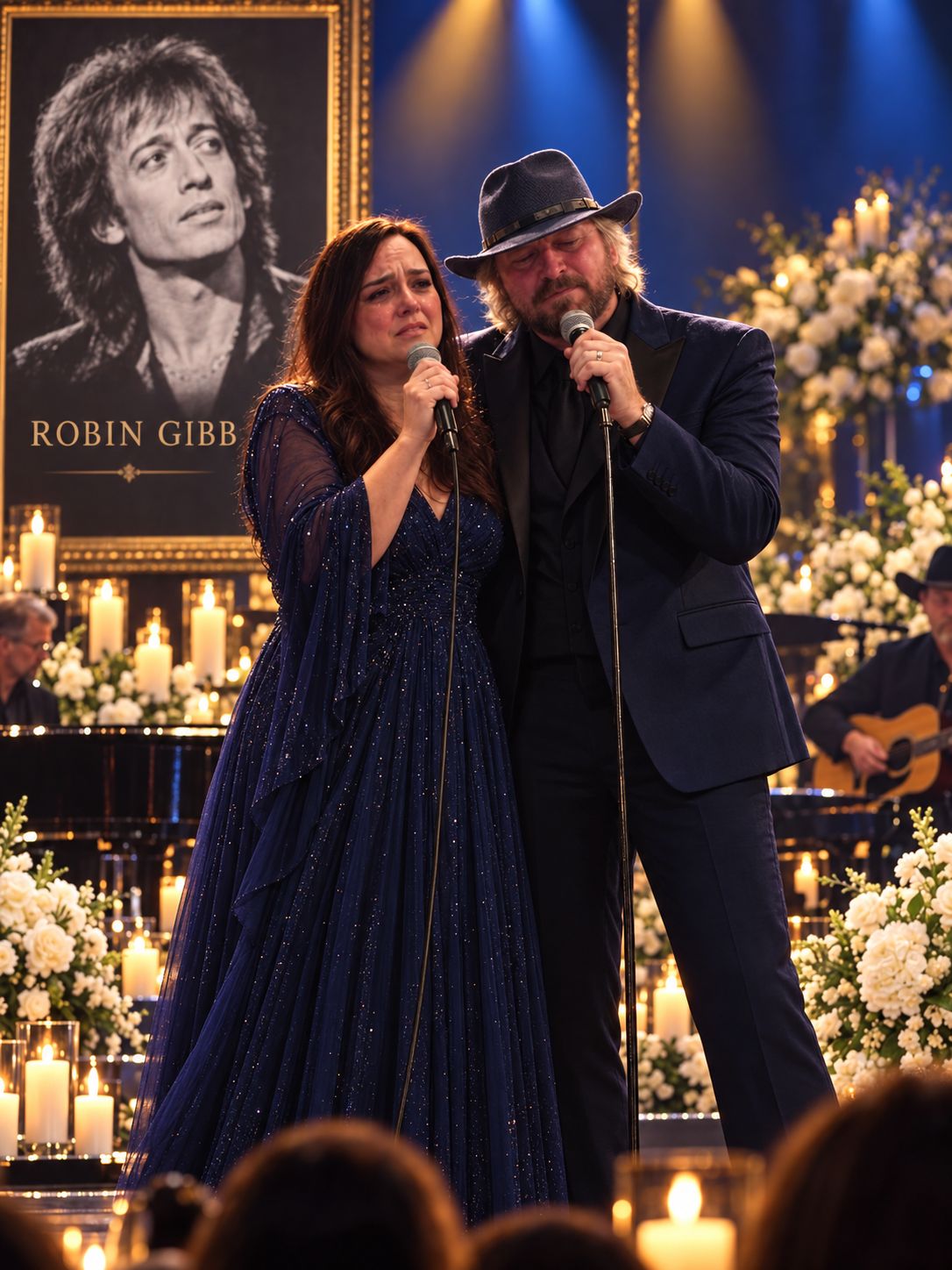
For an instant, Barry Gibb was no longer the voice at the center of the song. During his Mythology tour, an image of Robin Gibb appeared above the stage, and Robin’s recorded voice joined the music. To an audience that had spent decades hearing the brothers sing together, the effect was startling. Barry was still there, yet the performance made room for someone who could never walk onstage beside him again. It was a moment built from memory and recording, and it carried a force that no speech could easily match.
A circulating headline describes Barry appearing with “his daughter” to honor Robin, then stepping away from the microphone and leaving the room stunned. The documented family performance tells a different, more intricate story. The woman who sang with Barry on the Mythology tour was Samantha Gibb, the daughter of his late brother Maurice. She is Barry’s niece. Barry’s son Stephen Gibb also played guitar in the band. That distinction matters because three branches of the family were present in a show shaped by the absence of the brothers who had made its songs famous.
Consider what Barry was asking of himself on that tour. The Bee Gees’ music had been formed through the particular balance of Barry, Robin, and Maurice: voices that could move together so closely they seemed to share one breath, then separate into lines no one else would have chosen. By 2014, Barry was carrying those songs before an audience without either brother beside him. He told Time that he could still imagine them standing there when he was onstage, especially when he remembered the three of them gathered around a single microphone. It is a remarkably precise image of musical grief. The microphone remained; the places around it had changed.
At the Hollywood Bowl, the show found ways to let the family speak across those empty places. Samantha harmonized with Barry on “How Can You Mend a Broken Heart,” while Stephen played in the band. Later, Robin appeared on a large screen during “I Started a Joke,” his recorded vocal entering the live performance. The effect did not depend on pretending Robin was physically present. Everyone knew what they were seeing. Barry and the musicians played in the present; Robin’s voice arrived from another time. For a few minutes, the song held both.

There is a reason “I Started a Joke” could bear that weight. Its melody leaves room for Robin’s unusual phrasing, the slight turns that made him recognizable almost immediately. Played after his death, the song invites listeners to notice details they might once have taken for granted: the way a line rises, the pause before its answer, the vulnerability beneath a polished recording. Hearing that voice while Barry stood onstage must have brought many listeners back to their own histories with the Bee Gees. A record heard in youth can carry the memory of an entire household decades later.
Samantha’s presence offered a different kind of continuity. She was honoring Maurice, her father, through a song whose title became painfully apt for the family on that tour. Stephen’s guitar supplied another living connection. Neither was there to replace Robin or Maurice. Their participation showed what a family can do with a musical inheritance: learn it, bring their own abilities to it, and keep performing it before people who remember its beginnings. Barry could share the stage with the next generation while allowing his brothers’ voices and songs to remain distinct.
The image promised by the headline—Barry deliberately stepping away from the microphone at a Robin tribute—has a cinematic pull, but I could not verify that precise action or the claim that it stunned an entire room. The documented performance offers something stronger than a scene embellished after the fact. Robin’s recorded voice was heard during “I Started a Joke.” Maurice’s daughter sang with Barry. Barry’s son played alongside them. Those details are enough to understand why the evening stayed with people who heard it.
When a singer loses the people with whom he built his sound, the next performance asks a difficult question: who carries the harmony now? Barry’s answer on the Mythology tour was heard in several places at once—in his own voice, in Robin’s recording, and in the family members willing to stand beside him. The stage could not bring the brothers back. For the length of a song, it could let an audience hear how much of them remained.