Introduction
BEFORE “JAILHOUSE ROCK” SHOOK AMERICA: The Quiet MGM Photograph That Captured Elvis Presley Just Before Hollywood Realized What It Had
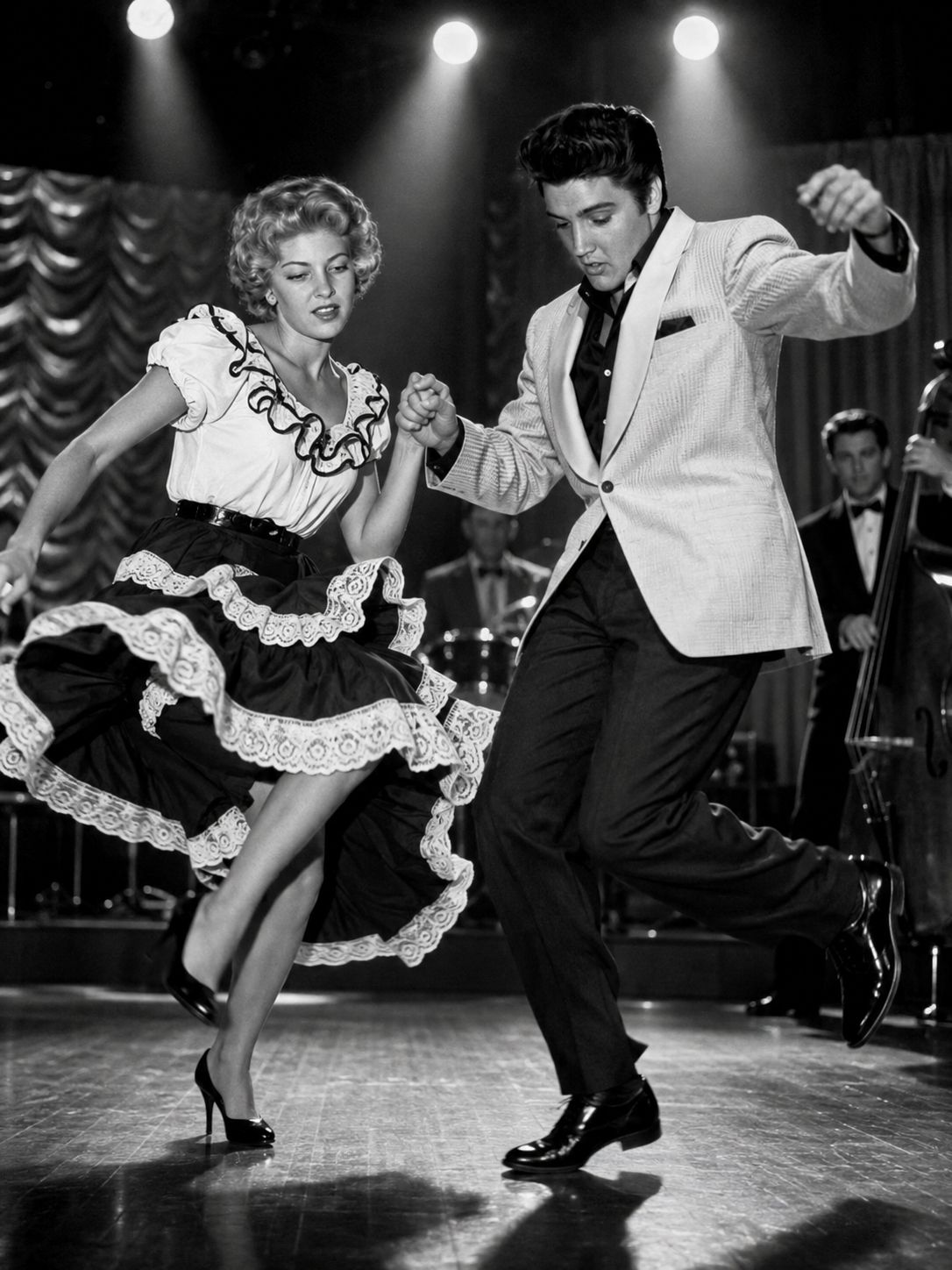
There are photographs of Elvis Presley that announce themselves immediately: the raised microphone, the famous curl of his lip, the stage lights, the screaming crowds, the unmistakable silhouette that became part of American popular culture. And then there are photographs like the one taken at MGM on June 6, 1957—quiet, almost ordinary, yet extraordinary precisely because of what it does not show. Elvis is seen with actress Anne Neyland, studying the script for Jailhouse Rock, apparently caught during one of those unguarded intervals when nobody was performing for an audience. There are no thousands of admirers beyond a barricade, no gold records arranged ceremonially behind him, and no carefully constructed image of “the King.” Instead, we are given something rarer: Elvis Presley at work, preparing for a movie that would eventually help define not only his film career but the visual language of rock ’n’ roll itself.
By the summer of 1957, Elvis was only 22 years old, yet America had already been forced to reconsider what a popular entertainer could look and sound like. His records were selling spectacularly, television appearances had made him impossible to ignore, and Hollywood recognized that the young singer from Memphis possessed something the camera could not easily manufacture. Jailhouse Rock became his third feature film, following Love Me Tender and Loving You, and MGM gave him the role of Vince Everett, a troubled young man whose musical ability eventually carries him toward fame. The film was directed by Richard Thorpe, produced by Pandro S. Berman, and featured a cast that included Judy Tyler, Mickey Shaughnessy, Dean Jones, Jennifer Holden, and Anne Neyland, who played Laury Jackson. Yet statistics and cast lists explain only part of its enduring fascination. Something was changing in front of the camera, and Hollywood was beginning to understand that Elvis was more than a singer temporarily visiting the movies.
That is why the photograph of Elvis and Anne Neyland reading through the material feels unusually revealing today. Neyland, who was born in Mississippi and raised in Dallas, Texas, had worked as a model before pursuing acting and was among MGM’s emerging young performers of the period. She would become best remembered for her role as Laury Jackson in Jailhouse Rock. In the stillness of that MGM moment, however, neither performer appears to be participating in the mythology that would later surround the film. They look like two young professionals concentrating on the work in front of them. For admirers who have spent decades seeing Elvis represented through spectacular concerts and carefully preserved publicity images, such a scene can feel almost startling. The legend momentarily disappears, and the working actor becomes visible.
And Jailhouse Rock demanded something especially interesting from him. Vince Everett was not simply another pleasant singing hero. The character was ambitious, difficult, emotionally guarded, and transformed by success. TCM has noted that MGM moved Elvis away from the comparatively agreeable screen image of his previous film and toward a harder, more rebellious characterization. That distinction matters because the film gave audiences an opportunity to see shades of personality that were more complicated than the smiling publicity photographs suggested. Elvis was still developing as an actor, but his presence already possessed a peculiar immediacy: when the camera found him, viewers watched. The film understood that power and built some of its most memorable moments around it.
Today, Jailhouse Rock survives not merely because Elvis Presley became one of the most famous entertainers of the twentieth century, but because the film captured a particular moment when American music, youth culture, Hollywood, and television-era visual style were rapidly colliding. Its title song became one of Presley’s defining recordings, while the film itself preserved the energy of an artist who had not yet settled into the monumental status history would assign him. Looking back at that June 1957 photograph, there is something almost cinematic about knowing what comes next. The young man reading pages at MGM cannot see the decades ahead: the concerts, the records, the military years, the comeback, Las Vegas, the worldwide fame, Graceland becoming a place of pilgrimage, and generations still discussing his performances long after his lifetime.
Perhaps that is what makes this seemingly simple backstage image so powerful. Before the dance sequence became iconic, before “Jailhouse Rock” became inseparable from Elvis Presley, and before history transformed a 22-year-old singer into an enduring American legend, there was a script sitting quietly in his hands. Beside him was Anne Neyland, another young performer helping bring the picture to life, and around them stood the machinery of MGM preparing its next movie. Nobody in that room could have fully known how long audiences would remember what they were creating. Nearly seven decades later, the photograph remains a small window into that extraordinary threshold—the moment before the cameras rolled, before the music exploded, and before Elvis Presley turned a Hollywood movie set into one of rock ’n’ roll’s most unforgettable stages.