Introduction
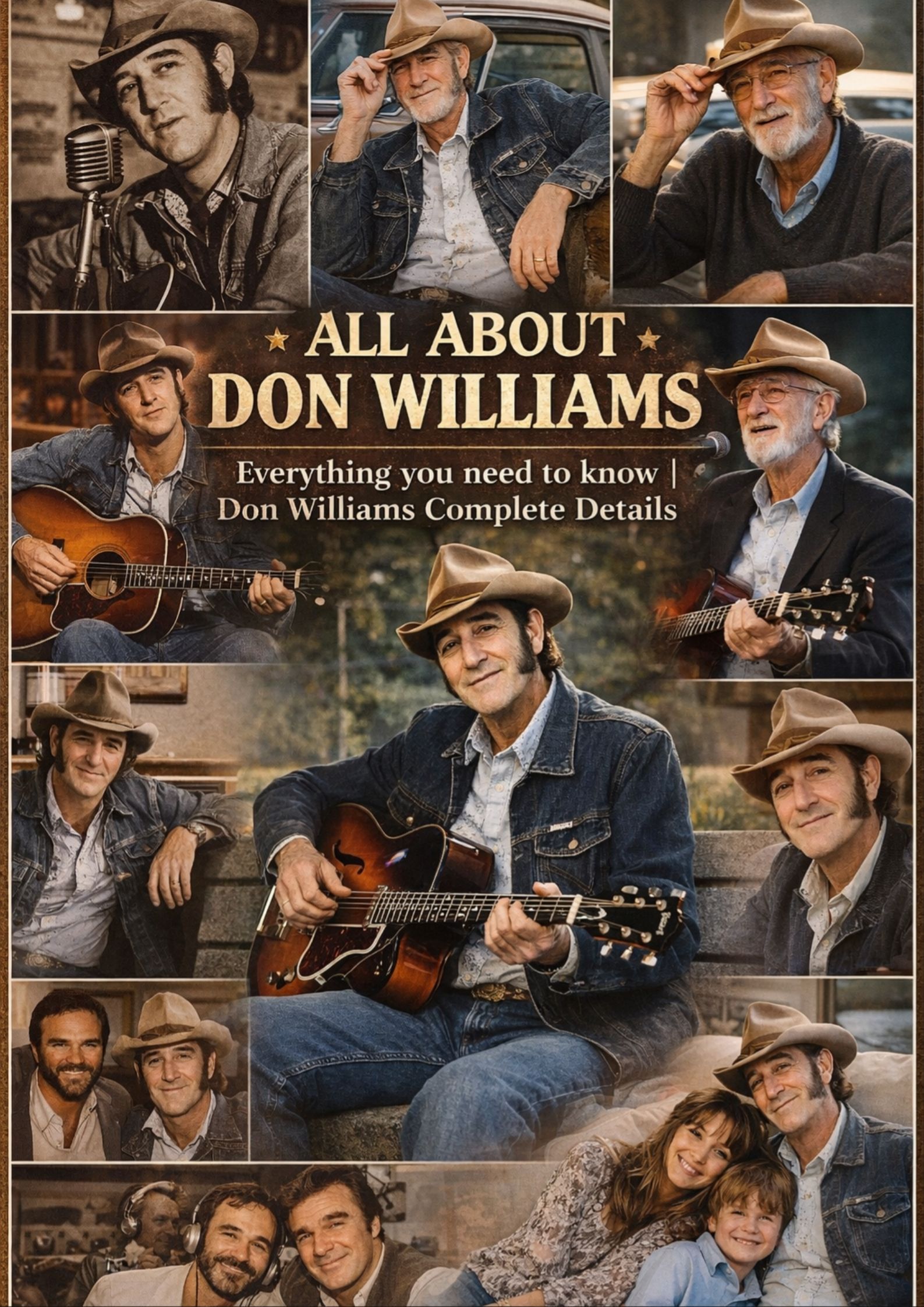
Don Williams: The Gentle Giant Whose Voice Still Feels Like Home
There are certain voices in country music that do more than sing songs—they calm the room. When Don Williams stepped to a microphone, audiences did not brace themselves for fireworks or spectacle. Instead, they leaned in. His voice carried a rare quality that few artists ever achieve: quiet authority. It did not demand attention; it earned it. And decades after his passing, that calm and comforting voice continues to resonate with listeners around the world.
Born Donald Ray Williams on May 27, 1939, in Floydada, Texas, he would grow into one of the most beloved figures in country music history. His journey, however, began far from the spotlight.
Williams grew up in Portland, Texas, in a household where creativity quietly lived alongside everyday work. His father, James Andrew Williams, worked as a mechanic, while his mother, Loveta Mae, possessed a different kind of talent—she was an amateur magician. It was she who first placed a guitar in young Don’s hands, teaching him the basics of music and encouraging him to perform. In fact, she entered him into a local talent competition when he was just three years old.
Those early experiences planted seeds that would eventually grow into a lifelong career in music.
By the time he graduated from Gregory-Portland High School in 1958, Williams had already absorbed a wide range of musical influences. Like many young Americans of the era, he admired the emerging energy of rock and roll, particularly artists such as Elvis Presley and Chuck Berry. Yet the storytelling tradition of country music also held his attention. That blend of styles would later shape his musical identity—simple, honest, and deeply rooted in American tradition.
Before fame arrived, however, Williams lived a life that many ordinary Americans would recognize. After high school, he served two years in the U.S. Army, fulfilling his duty before returning home to Texas. Like countless young veterans of the time, he took whatever work he could find. Over the years he worked as a truck driver delivering freight, a debt collector, and even an oil field worker.
Yet music never left him.
In local clubs and small bars, he began performing alongside his friend Lofton Kline. In 1964, they joined with singer Susan Taylor to form a pop-folk trio called Pozo-Seco Singers. The group recorded for Columbia Records and enjoyed moderate success. Their recordings “I Can Make It With You” and “Look What You’ve Done” reached the Top 40 on the U.S. pop charts.
But success can be unpredictable. Despite those early hits, the trio struggled to maintain momentum and eventually disbanded in 1971.
For many artists, that might have marked the end of the road.
For Don Williams, it became a new beginning.
Determined to pursue his own musical path, Williams launched a solo career. His debut album, “Don Williams Volume 1,” was released in 1973 on JMI Records. What followed was one of the most remarkably consistent careers country music had ever seen.
From 1974 to 1991, Don Williams scored at least one major hit every single year—a feat that few artists in any genre can claim. His music was not built around dramatic flair or elaborate stage productions. Instead, it rested on the steady strength of his voice and the sincerity of his storytelling.
The numbers themselves tell an extraordinary story.
Williams recorded 56 charted singles, with 50 reaching the Top 20. An astonishing 45 made the Top 10, and 17 songs reached No. 1 on the country charts.
Among his most beloved hits was “You’re My Best Friend,” a warm and heartfelt anthem that became a staple at concerts and sing-alongs for years to come. Other classics like “Tulsa Time,” “I Believe in You,” and “Lord, I Hope This Day Is Good” carried the same gentle honesty that defined his entire career.
Fans began calling him “The Gentle Giant,” a nickname that perfectly captured both his physical presence and his musical style. Standing over six feet tall, Williams had the stature of a giant—but his voice was calm, steady, and reassuring.
Unlike many performers who chased trends, Don Williams remained remarkably consistent. His songs spoke about everyday life: love, faith, regret, friendship, and the quiet hope that tomorrow might bring something better.
That authenticity allowed his music to travel far beyond American borders. Williams became enormously popular not only in the United States but also in Europe, Africa, and Australia, where audiences embraced his warm storytelling style.
In 1975, he even stepped briefly into Hollywood, appearing alongside Burt Reynolds and Jerry Reed in the film W.W. and the Dixie Dancekings. Yet despite such opportunities, Williams never seemed interested in chasing celebrity. He remained grounded, preferring the simple role of storyteller.
Recognition eventually came from the highest levels of the industry. In 2010, Don Williams was officially inducted into the Country Music Hall of Fame, cementing his legacy among the genre’s greatest artists.
Beyond music, Williams lived a quiet and devoted personal life. In 1960, he married Joy Bucher, and their marriage lasted for decades—a rarity in the entertainment world. Together they raised two sons, Gary and Timmy, and later welcomed four grandchildren.
For Williams, family was never secondary to fame. Friends often described him as a man who valued privacy, humility, and loyalty above the spotlight.
Sadly, on September 8, 2017, Don Williams passed away in Mobile, Alabama, at the age of 78.
But for those who love country music, his voice never truly left.
Today, when listeners return to his recordings, they often discover something surprising: the songs feel just as comforting now as they did decades ago. In a fast-moving world where music often comes and goes quickly, Don Williams’ work remains steady.
His songs do not shout.
They speak.
And perhaps that is why his legacy continues to grow even years after his passing. Don Williams did not try to reinvent country music or overwhelm audiences with showmanship.
He simply told the truth in a gentle voice.
And sometimes, that is exactly what the world needs most.