Introduction
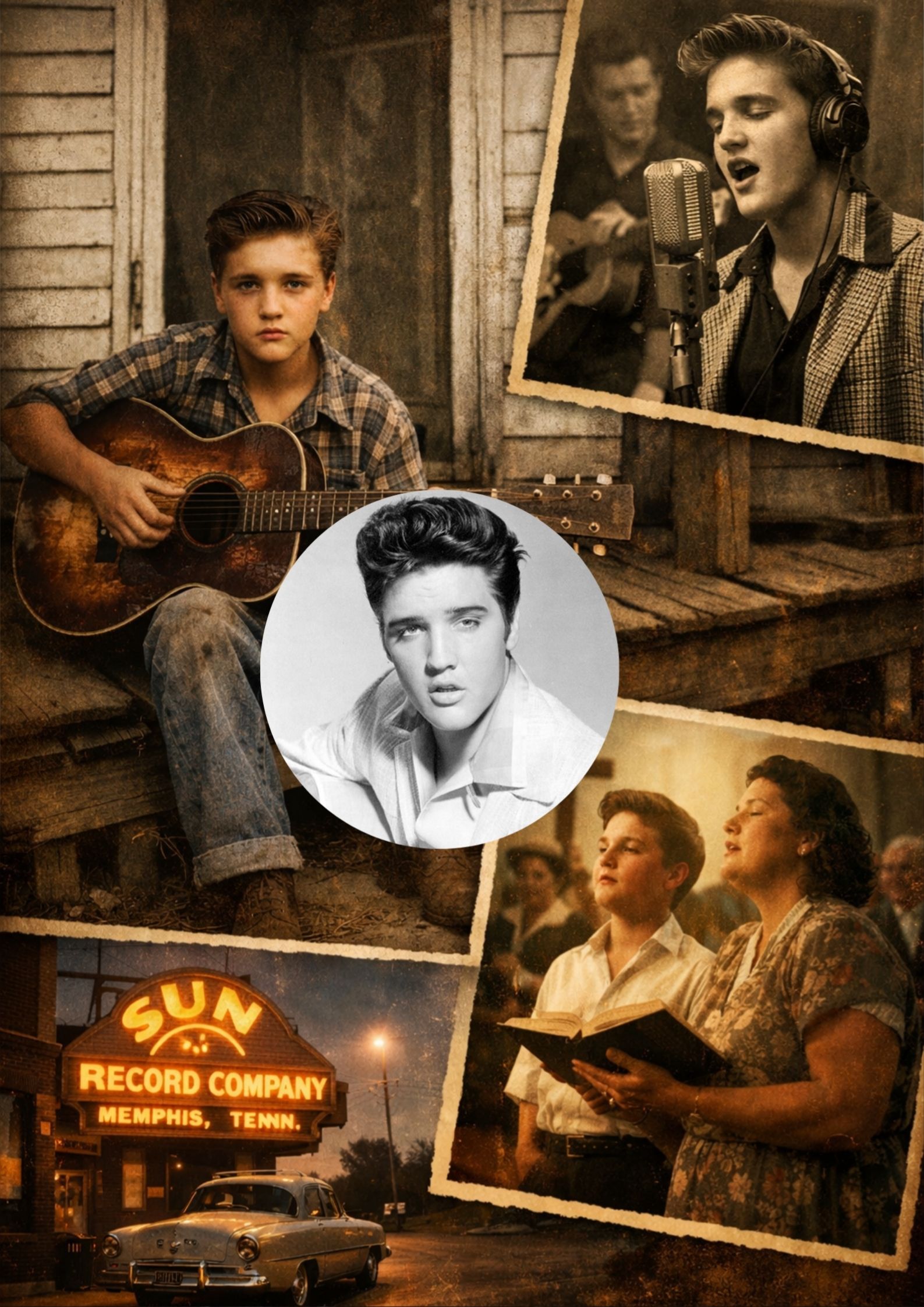
Elvis Presley: The Hard Childhood That Built a Voice America Couldn’t Ignore
Watch the video at the end of this article.
Before Elvis Presley became a symbol—before the jumpsuits, the headlines, and the myth—he was just a boy in Tupelo, Mississippi, born into a world that didn’t promise much. His story doesn’t begin with fame. It begins with loss, poverty, and a kind of hunger that wasn’t just about food. It was the hunger to matter. To protect the people he loved. To rise above a life that kept trying to shrink him.
Elvis entered the world on January 8, 1935, in a small two-room home built in East Tupelo. He was supposed to be one of two: his identical twin brother, Jessie Garon, was stillborn, leaving Elvis to grow up as an only child with a quiet shadow beside his name.
His parents, Vernon and Gladys, lived close to the edge. Money was scarce, stability even scarcer. In 1938, the family’s fragile footing broke further when Vernon was convicted for altering a four-dollar check and served time in prison, forcing Gladys and young Elvis to lean on relatives and scrape by.
That kind of childhood does something to a person. It teaches you early that life can change in a single afternoon. It also builds a fierce devotion to home—especially when home is the only place that feels safe.
The Church That Gave Him a Language for Feeling
In Tupelo, the Presley family attended the Assembly of God church, where music wasn’t background noise—it was emotional medicine. Gospel wasn’t polished; it was lived. It rose out of hardship, turned pain into sound, and offered people a way to hold each other up when words ran out. Graceland’s own history of Elvis’ early years notes how deeply the church’s music and preaching registered with him.
For older listeners who grew up with faith, family, and music woven together, this part of Elvis’ story often hits the hardest. Because you can hear gospel’s fingerprints in everything he later did—the ache in the phrasing, the way he could make a single line sound like a confession, the way his voice could lift without showing off.
“Old Shep,” a Chair, and a First Taste of Being Heard
At ten years old, Elvis stood on a chair at the Mississippi-Alabama Fair and Dairy Show and sang “Old Shep” in a youth talent contest, winning fifth prize. It wasn’t a coronation. It was something quieter: a child learning that his voice could reach strangers.
Not long after, the story of his first guitar became part of American folklore for a reason. On his eleventh birthday, Elvis received a guitar purchased at Tupelo Hardware—an instrument he would use for years, including into the early Sun Records period.
He didn’t grow up with formal lessons or expensive advantages. He learned the way working-class kids often do: by ear, by repetition, by stubbornness, by carrying the instrument like it was a lifeline.
Memphis: Where the Sound of a New America Was Waiting
In 1948, the Presleys moved to Memphis, and everything widened—streets, people, possibility. Elvis enrolled at Humes High School, still quiet, still watchful, still trying to figure out where he fit.
Memphis also placed him near an electric crossroads of American music. Blues, R&B, country, gospel—these weren’t separate worlds there. They were neighbors. And as Elvis absorbed what he heard around the city, a new kind of blend began forming inside him: a sound that would later feel inevitable, even though it had never existed quite like that before.

One Demo, One Night, and a Door That Never Closed Again
By 1953, Elvis graduated from Humes High School, and not long after, he stepped into Sun Records—still not a star, still not “Elvis,” just a young man brave enough to put his voice on tape and see what happened.
Then came July 5, 1954: an unrehearsed moment at Sun Studio where producer Sam Phillips recorded Elvis, along with Scotty Moore and Bill Black, performing “That’s All Right.” Many historians point to it as a spark at the beginning of the rock-and-roll revolution.
But the deeper truth is this: the revolution didn’t come from nowhere. It came from a childhood shaped by struggle, a church that taught him how to feel out loud, and a city that handed him multiple musical languages and dared him to speak them as one.
And if you’ve ever wondered why Elvis still matters—why his voice still reaches across decades—start here: not with the legend, but with the boy who learned early that silence can be heavy… and music can be a way out.
Watch the video at the end of this article—and tell me: which part of Elvis’ early story feels most real to you: the hardship, the church music, or the moment he first realized his voice could change a room?
