Introduction
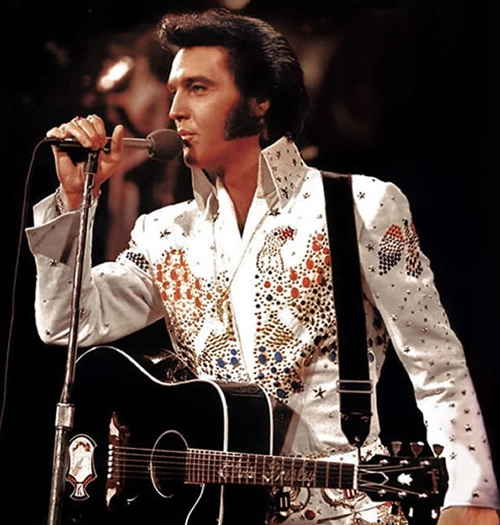
Elvis Presley: The Boy Who Walked Out of Poverty and Into Immortality
Long before the world crowned him the “King of Rock and Roll,” Elvis Presley was simply a shy Southern boy with a battered guitar, a hungry dream, and a voice that didn’t fit the rules of his time. His rise was not a smooth ascent—it was a collision of talent, ambition, and destiny, born in hardship and shaped by a culture that was changing faster than anyone could control. To understand why Elvis shocked the music world, you have to start where the legend truly began: in a tiny house, with a grieving family and a future that looked anything but glamorous.
Elvis Aaron Presley was born on January 8, 1935, in Tupelo, Mississippi. The family welcomed him with relief—and heartbreak. His twin brother, Jesse Garon Presley, was stillborn, leaving Elvis as the only child in a household that would carry loss like a shadow. His parents, Vernon and Gladys, lived in modest conditions, and the early years were marked by scraping by, leaning on neighbors, and sometimes depending on government aid. Gladys, fiercely devoted, became the emotional center of Elvis’ world. Their bond—strong, protective, almost inseparable—would shape his character for life.
Hardship did not arrive politely in the Presley home; it kicked the door down. When Elvis was only three, the family lost their house. Vernon was convicted of forging a check and sent to the Mississippi State Penitentiary. With her husband gone, Gladys and Elvis moved in with relatives. It was a humiliating chapter for a proud family, but it also taught Elvis something that never left him: security can vanish overnight. That fear—and that drive to rise beyond it—quietly hardened into ambition.
Even as a child, Elvis was drawn to performance. In Tupelo, he spent many Saturday nights at the courthouse where a live amateur radio program, “Saturday Jamboree,” broadcast to the community. There, Elvis often sang “Old Shep,” a tender song that allowed his sweetness to show. Teachers described him as “average” academically, but when he sang, adults noticed something different. In 1945, at just ten years old, Elvis performed publicly at the Mississippi-Alabama Fair and Dairy Show—an early spark that hinted at the fire to come.
For his eleventh birthday, his mother bought him a guitar. He had wanted a rifle or a bicycle, but money was tight—and Gladys believed music would protect her son more than any weapon ever could. Elvis learned basic chords from relatives and a church pastor, and slowly the instrument became part of him. Still, he was shy. He later admitted he would watch others and learn by observing, rarely daring to sing in public at first. Yet the pull of music kept growing, turning curiosity into obsession.
In November 1948, when Elvis was thirteen, the family moved to Memphis, Tennessee—a move that would change everything. Memphis wasn’t just a new city; it was a new world. The radio, the churches, the record shops, and the nightlife expanded Elvis’ musical imagination. He absorbed gospel with reverence, studied blues with fascination, and listened closely to the rhythm and soul pulsing through Beale Street. He also began shaping his image. While other students dressed plainly, Elvis wore bright clothes, styled his hair, and stood out like someone who already knew he was meant for a stage bigger than the school hallways.

That confidence came at a price. He was teased for his guitar and mocked for singing what classmates dismissed as “hillbilly” music. His grades slipped as his passion grew. Yet he wasn’t aimless—he was building a private mission. He listened to country artists and admired southern gospel singers, but he was equally pulled toward the “race records” of rhythm and blues that many white audiences in the segregated South did not understand—or approve of. The genius of Elvis wasn’t just his voice. It was his hunger to blend worlds that weren’t supposed to touch.
In April 1953, Elvis performed at his high school’s annual show and stunned the crowd. In a single night, the boy who had been overlooked became unforgettable. He later recalled how people didn’t even know he could sing, and how that performance changed his status overnight. Yet even then, a career felt distant. Elvis had no formal training and couldn’t read music. He learned by ear, by instinct, by relentless repetition. After graduating from Humes High School on June 3, 1953, he took a job as a machinist’s assistant—hardly a path toward superstardom. But he was already moving toward his next step.
That summer, Elvis walked into Sun Records and paid for studio time to record two songs: “My Happiness” and “That’s When Your Heartaches Begin.” Officially, he said it was a gift for his mother. Unofficially, it was something else: an audition disguised as a birthday present. The studio administrator, Marion Keisker, noticed the shy young man clutching his worn guitar. When Sam Phillips, Sun’s founder, asked about him, she wrote down a simple note that would later feel prophetic: “Good ballad singer. Hold.”
Elvis didn’t become a star overnight. He failed auditions. One group told him he couldn’t sing. A band leader rejected him and advised him to keep driving trucks. But Elvis kept circling the studio, lingering near opportunity like someone who refused to accept “no” as a final answer. Then fate shifted.
In July 1954, Sam Phillips brought Elvis into the studio with guitarist Scotty Moore and bassist Bill Black, hoping to find something special. Hours passed with little progress. The session felt flat—until Elvis, almost as if to entertain himself, broke into Arthur Crudup’s blues song “That’s All Right.” Suddenly the room came alive. Elvis started moving, singing with playful urgency, and the musicians matched his energy. Phillips heard it instantly: a new sound—raw, exciting, and impossible to categorize. He pressed record. The moment that created rockabilly had arrived, not through perfection, but through spontaneity.
When Memphis DJ Dewey Phillips played “That’s All Right” on the radio, the response was electric. Callers demanded to know who the singer was. Some assumed Elvis was Black—because the sound carried the soul of rhythm and blues, but the voice came from a young white man. That confusion wasn’t just cultural—it was revolutionary. Elvis had become a bridge between musical traditions that America had kept apart. And the public, especially teenagers, felt it like a jolt.
Soon came live shows—and the infamous reaction. Elvis’ stage presence was not polite. His movements were instinctive, driven by adrenaline and rhythm. Onstage, his legs shook, his hips swayed, and crowds—especially young women—screamed as if witnessing something forbidden. What looked like rebellion was, for Elvis, simply expression. But in conservative America, it felt dangerous. Some wanted him censored. Some wanted him punished. And yet the more people tried to contain him, the bigger he became.
By 1955, Elvis was no longer just a local phenomenon. His performances across the South turned him into a regional star. Promoters noticed. Labels asked questions. Colonel Tom Parker entered the picture, sensing both money and myth. The deals grew larger. The stakes rose. Elvis was accelerating toward national stardom—and there was no way to slow him down.
Elvis Presley didn’t become a legend because he was the first great singer. He became a legend because he changed the temperature of culture. He took gospel’s spiritual force, blues’ emotional grit, and country’s storytelling soul, and fused them into a sound that teenagers could claim as their own. He didn’t just sing songs—he made people feel like a new world was possible.
And it all began with a poor boy, a guitar his mother could barely afford, and a stubborn belief that he wasn’t born to remain invisible.