Introduction
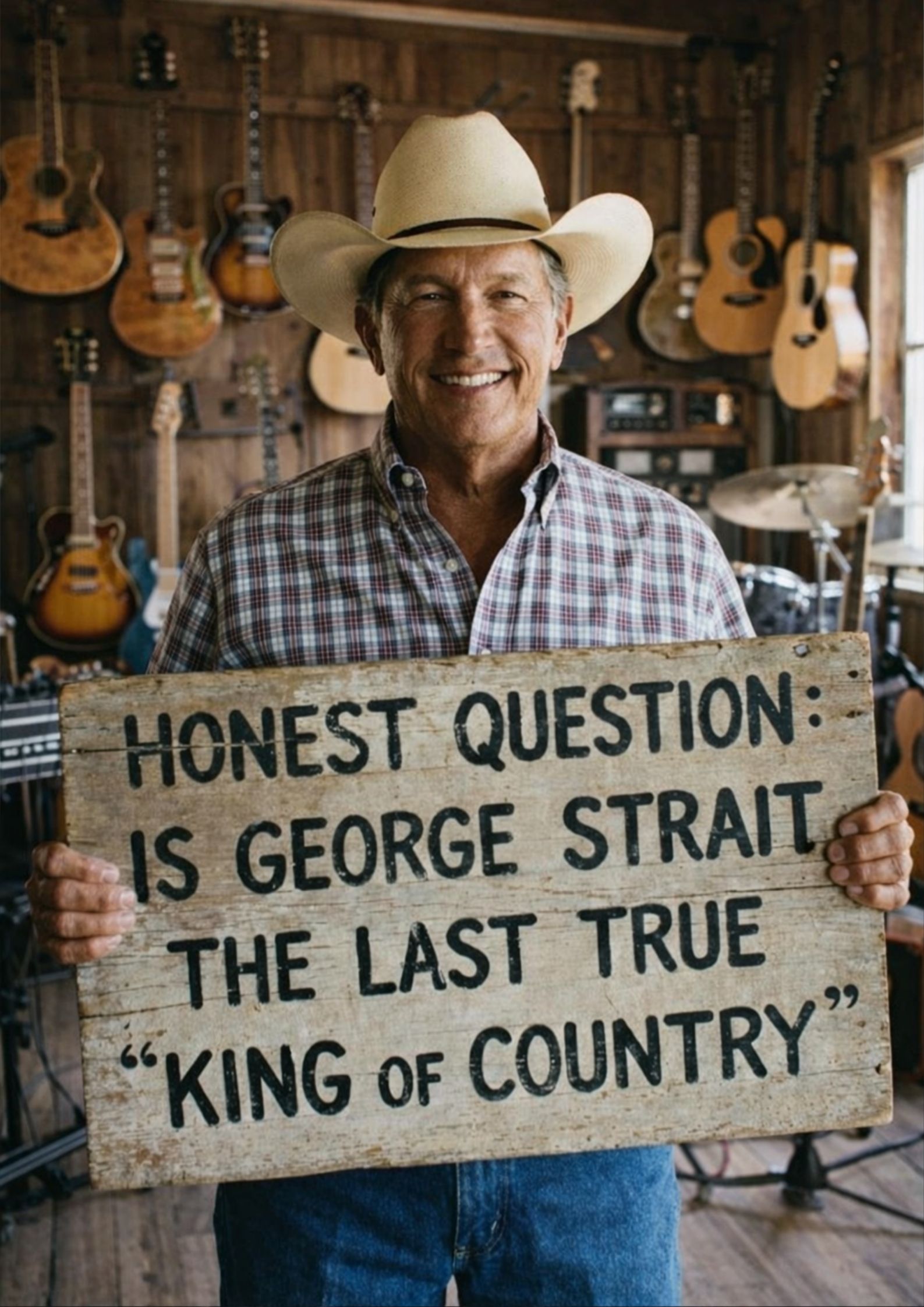
Is George Strait the Last True “King of Country”? Or Is the Crown Still in Contention?
Some titles in music behave like old highway signs: weathered, familiar, and still powerful enough to slow you down when you pass. “King of Country” is one of them. Say it in a room full of country fans—especially those who’ve lived through the genre’s radio decades, its arena boom, and its streaming era—and you’ll hear a name almost before the question finishes: George Strait.
On the surface, the case looks airtight. Four-plus decades of steady work. A catalog stacked with No. 1 hits. A voice that never chased fashion, never begged for attention, never tried to shock its way onto the front page. Strait didn’t build his reputation by reinventing himself every few years—he built it by being reliable. And in a world that changes fast, reliability can feel like a rare kind of greatness.
But the title “King of Country” has never been only about statistics. A crown suggests something deeper than record sales: stewardship of tradition, influence over taste, and that hard-to-measure quality we might call cultural trust—the sense that an artist belongs to you, to your memories, to the long line of songs that carried people through work, love, loss, and time. That’s where the debate gets richer, and where even Strait’s supporters start to add a quiet “however.”

Because country music isn’t a single river—it’s a whole watershed. Traditionalists, outlaws, honky-tonk purists, storytellers, stadium-sized entertainers: each movement pulled the genre in a different direction, sometimes at the same time. So the real question isn’t “Who had the most hits?” It’s “Who carried the genre forward without cutting the roots?”
George Strait’s argument is steadiness as leadership. He rarely altered his sound to keep up with the moment. His records held tight to classic structure: clear stories, clean melodies, emotional restraint that trusts the listener to feel what the singer refuses to oversell. Steel guitar, shuffles, heartbreak delivered without melodrama—songs that don’t shout, but somehow echo longer. That continuity created a bond with audiences that’s difficult to manufacture. For many people, Strait wasn’t just an artist; he was a constant. When the industry swerved, he stayed in his lane—and made that lane feel like home.
Yet influence in country has worn many uniforms.
Consider Willie Nelson, who didn’t simply sing country music—he helped change what country music was allowed to be. The outlaw movement was more than a sound; it was a statement about creative independence. Willie’s impact stretched into cultural identity, a reminder that country could be both traditional and boundary-pushing without losing its soul.

Or Merle Haggard, whose songs carried working-class truth with a rawness that didn’t ask permission. Haggard’s writing didn’t just entertain; it documented. You can trace his fingerprints in generations of artists who learned that a country song could hold contradiction—pride and regret, toughness and tenderness—without resolving into a tidy moral.
Then there’s Garth Brooks, who changed the scale of the genre. In the 1990s he turned country into an arena force, a global spectacle, without entirely severing its emotional core. Brooks didn’t just sell tickets; he expanded the industry’s imagination of what “country” could command in the wider world.
So what makes a king: purity, influence, or longevity?
If the crown stands for guarding tradition, Strait’s claim feels almost unmatched. He’s the guardian of form—the artist who proved you don’t have to dilute the recipe to stay relevant. If the crown stands for transformation, it’s hard to ignore Nelson, Haggard, or Brooks—men who reshaped the genre’s direction, not simply its output. If the crown stands for longevity with dignity, Strait rises again: few careers show that kind of endurance without desperation.
And then there’s the modern complication: does a single “King” even fit the streaming era? Today’s country audience is splintered into subgenres and scenes. Influence is decentralized. No one artist sits at the cultural center the way legends once did. Maybe the title now functions less like a literal hierarchy and more like a symbolic tribute—our way of keeping lineage alive in a fast-moving world.
Still, the fact that fans keep asking the question tells us something important. Country listeners—especially those with years behind them—care about continuity. They want a thread they can hold. George Strait occupies a rare middle ground: he didn’t disrupt the genre, and he didn’t sell it out. He refined it. He became the benchmark—the steady voice people measure others against.
So is he the last true King? Or one of several who wore the crown in different eras, for different reasons? The honest answer is that it depends on what you need the crown to mean. But one thing is hard to dispute: when the debate starts, Strait remains central—not because he demanded the throne, but because his career still anchors country’s sense of itself.
And maybe that’s what royalty in this music has always been: not dominance, but durability—the ability to outlast trends and still sound like truth.