Introduction
MARCH 24, 1958: THE DAY ELVIS PRESLEY TRADED THE SPOTLIGHT FOR A SOLDIER’S UNIFORM—and America Watched the King Become Private Presley
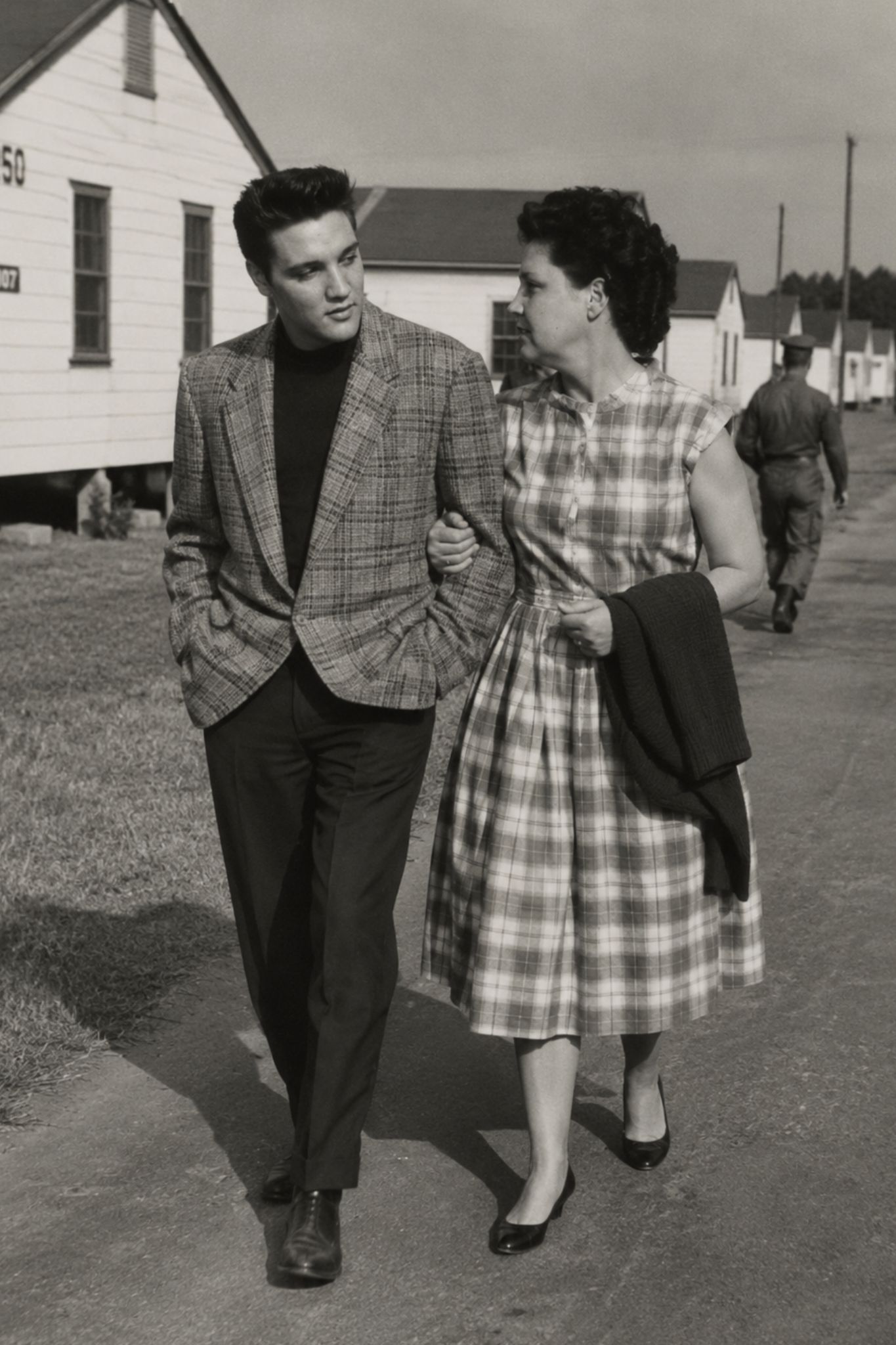
On the morning of March 24, 1958, one of the most famous young men in America stepped into a chapter of life that no concert promoter, Hollywood studio, or screaming audience could control. Elvis Aron Presley, already a household name and the undisputed symbol of a musical revolution, arrived for induction into the United States Army before moving through the military processing system that would carry him to Fort Chaffee, Arkansas. The photographs from that day remain among the most extraordinary images of his career because they capture a contradiction almost too dramatic to invent: the young man who had electrified the nation with “Heartbreak Hotel” and “Hound Dog” was suddenly standing in line, receiving orders, undergoing examinations, and preparing to live under the same military discipline as thousands of other American servicemen.
By early 1958, Elvis Presley had already achieved more fame than most entertainers could hope to experience in a lifetime. Only a few years had passed since his first recordings at Sun Records in Memphis, yet his rise had been astonishingly fast. His voice had crossed boundaries between country, gospel, rhythm and blues, and popular music, while his television appearances had turned him into a national conversation. Teenagers adored him, parents debated him, critics argued about him, and newspapers followed nearly everything he did. Hollywood had already recognized his enormous appeal, and his recordings had turned him into one of the defining figures of the new rock ’n’ roll era.
Then the military called.
Elvis had received his draft notice in December 1957, and the announcement immediately created enormous public interest. The timing seemed almost unbelievable. At the very moment his career was accelerating, he was being asked to step away from recording studios, film sets, television cameras, and concert stages. In the entertainment business, two years could feel like an eternity. Musical trends changed quickly. New performers emerged constantly. Public fascination could disappear almost as quickly as it arrived. For a young star whose career depended upon momentum, military service represented more than a personal obligation. It was a genuine professional risk.
Yet Elvis did not avoid the draft.
That fact mattered enormously to the American public. There were opportunities for the military to use him as a celebrity entertainer, and different branches understood the publicity value of having Presley associated with them. But Elvis ultimately entered the Army as a regular soldier. That decision surprised some observers and earned respect from many who had previously dismissed him as little more than a controversial young entertainer. Suddenly, the image of the rebellious rock ’n’ roll star was being replaced by photographs of a young man in military processing lines.
The events surrounding his induction were heavily documented. Cameras followed Elvis through medical examinations, paperwork, uniform fittings, and the now-famous military haircut. The haircut itself became a national media event because Elvis’s carefully styled hair had become one of the most recognizable features in American entertainment. When reporters asked about losing it, Presley responded with characteristic composure. The symbolism, however, was unmistakable. The civilian image that had helped define a generation was literally being cut away.
The photographs from Fort Chaffee reveal something especially compelling about this moment. Elvis is surrounded not by fans but by military personnel. He is no longer positioned at the center of an entertainment spectacle. He is being processed, instructed, measured, and assigned like every other recruit. For a brief period, fame did not exempt him from routine. The man who could stop traffic simply by appearing on a city street was suddenly expected to follow orders.
For older Americans who remember the era, these photographs carry an additional emotional weight. The late 1950s were a period when military service remained a familiar part of American family life. Fathers, brothers, sons, and neighbors understood the meaning of induction notices, uniforms, training camps, and long separations from home. Seeing Elvis Presley enter that same system gave many Americans a new perspective on him. He was still the famous singer whose performances had caused controversy, but he was also a 23-year-old citizen being asked to serve.
The transition would soon take Elvis far beyond Arkansas. After training, he eventually served in West Germany, where his military experience would become one of the most significant periods of his personal life. Yet on March 24, none of that history had been written. The future remained uncertain. Elvis could not know exactly how audiences would respond when he returned, whether rock ’n’ roll would still welcome him, or whether the entertainment world would have moved on without him.
That uncertainty is what makes the photographs so powerful today.
We look at them with the advantage of hindsight. We know Elvis would return to civilian life in 1960 and resume a hugely successful career. We know more films, more records, the dramatic 1968 television comeback, Las Vegas, international fame, and some of the most memorable performances in popular music history were still ahead. But the young soldier in those photographs did not know any of that.
He was simply beginning a new assignment.
Perhaps that is why March 24, 1958 deserves to be remembered as more than another date in Elvis Presley’s biography. It was the day the machinery of fame temporarily stopped. The applause faded. The movie contracts waited. The record charts continued without him. In their place came military schedules, uniforms, regulations, and responsibility.
For one extraordinary moment, America watched the King of Rock ’n’ Roll become Private Presley.
And nearly seven decades later, those photographs still remind us that beneath the legend was a young man standing at a crossroads, leaving behind the loudest stage in America and stepping into a future no one—not even Elvis Presley himself—could fully predict.