Introduction
The Day Elvis Presley Lost His Mother—and the Quiet Wound That Followed Him for the Rest of His Life
In the early hours of August 14, 1958, Elvis Presley experienced a loss that fame, money, applause, and success could never repair. His mother, Gladys Presley, died at the age of 46 in a Memphis hospital, leaving her 23-year-old son devastated at a moment when the rest of America saw him as almost unstoppable. By then, Elvis had already become one of the most recognizable young men in the country. His records dominated the charts, his television appearances had created controversy and excitement, and Hollywood had begun turning him into a movie star. Yet when Gladys died, the confident performer disappeared. Those who witnessed his grief saw something far more intimate: a frightened and heartbroken young man mourning the person who had known him before the fame, before the crowds, and before the world began calling him the King of Rock ’n’ Roll.
The bond between Elvis and Gladys Presley had always been unusually close. Elvis was born into a poor Mississippi family, and his childhood was shaped by financial insecurity, modest surroundings, and a powerful sense of family loyalty. Gladys had known him not as a celebrity but as her only surviving son, the shy boy who sang in church, listened closely to gospel music, and dreamed of helping his parents escape poverty. When success finally arrived, Elvis did exactly that. He bought his parents a better home, eventually moving the family to Graceland, and often spoke of his desire to give Gladys the comfort she had never enjoyed during his childhood. To Elvis, success was not simply about personal ambition. It was deeply connected to the promise that his family would never again have to struggle as they once had.
That is why her death struck at something much deeper than ordinary bereavement. Gladys represented home, safety, and emotional continuity in a life that had suddenly become chaotic. During the years when strangers surrounded Elvis, reporters followed his every move, and business decisions were made at extraordinary speed, she remained one of the few people connected to the boy he had been before fame. She did not need the stage costumes, hit records, or public image. She loved the person beneath them. When she was gone, Elvis did not merely lose his mother; he lost one of the strongest links to his original sense of identity.
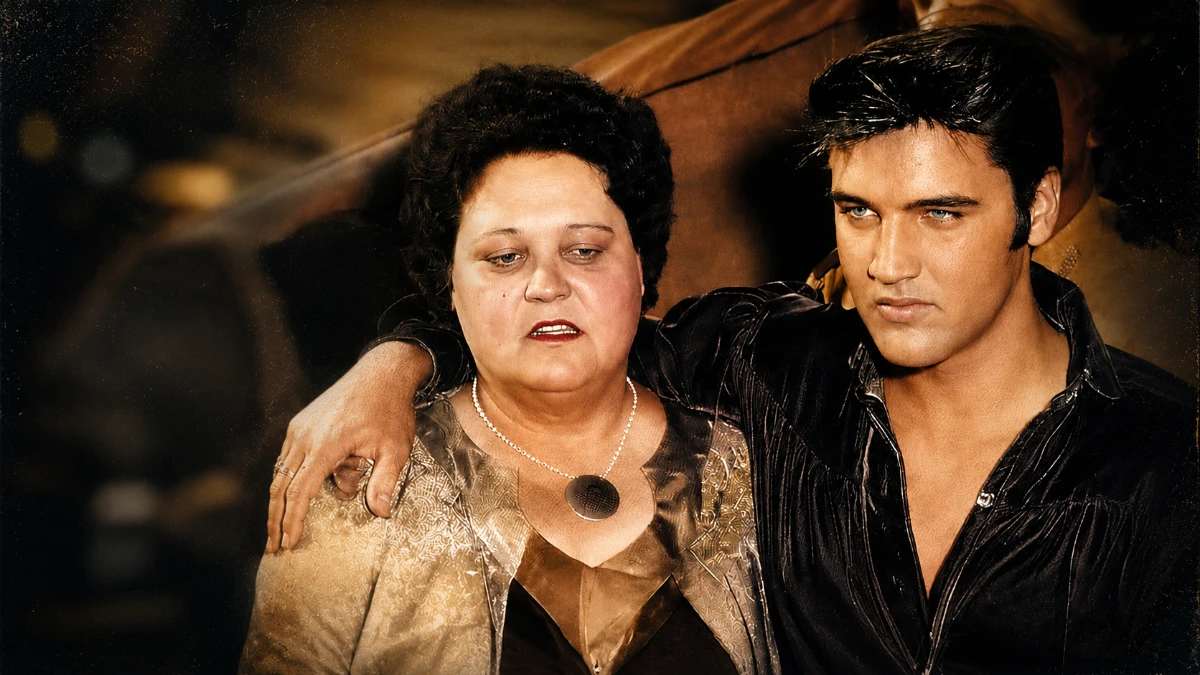
The timing made the loss even more difficult. Elvis was serving in the United States Army when Gladys became seriously ill. He was granted emergency leave and returned to Memphis to see her, but only days later she died. The public photographs and reports from the funeral revealed a side of Elvis that fans had rarely seen. The rebellious young star who had unsettled conservative America appeared overwhelmed by grief. Accounts from those close to the family described him crying openly and calling for his mother. It was a moment in which celebrity offered no protection at all. The most famous young entertainer in America could command enormous audiences, but he could not stop the one event he feared most.
It would be too simple to argue that losing Gladys caused every later difficulty in Elvis Presley’s life. Human lives rarely follow such neat explanations. Elvis would face enormous professional pressure, demanding touring schedules, complicated personal relationships, health problems, and the unusual psychological burden of extreme fame. Each of these factors played a role in the man he became. Yet many people who knew him believed that something fundamental changed after August 1958. The emotional center of his life had been removed, and although Elvis continued moving forward, he never entirely replaced it.
His career after Gladys’s death was, paradoxically, even larger than before. Elvis returned from military service in 1960 and immediately resumed recording and acting. He scored major hits, starred in commercially successful films, and later reinvented himself with the extraordinary 1968 Comeback Special. In the early 1970s, he became one of the most powerful live performers in American entertainment, filling Las Vegas showrooms and arenas while expanding his sound through gospel, country, soul, and dramatic pop. From the outside, his life appeared to be one long succession of triumphs. But success can coexist with grief, and the absence of Gladys remained part of Elvis’s private world.