Introduction
THE DAY AMERICA WATCHED THE KING LOSE HIS HAIR: Inside Elvis Presley’s Extraordinary 1958 Transformation From Rock ’n’ Roll Idol to U.S. Army Private
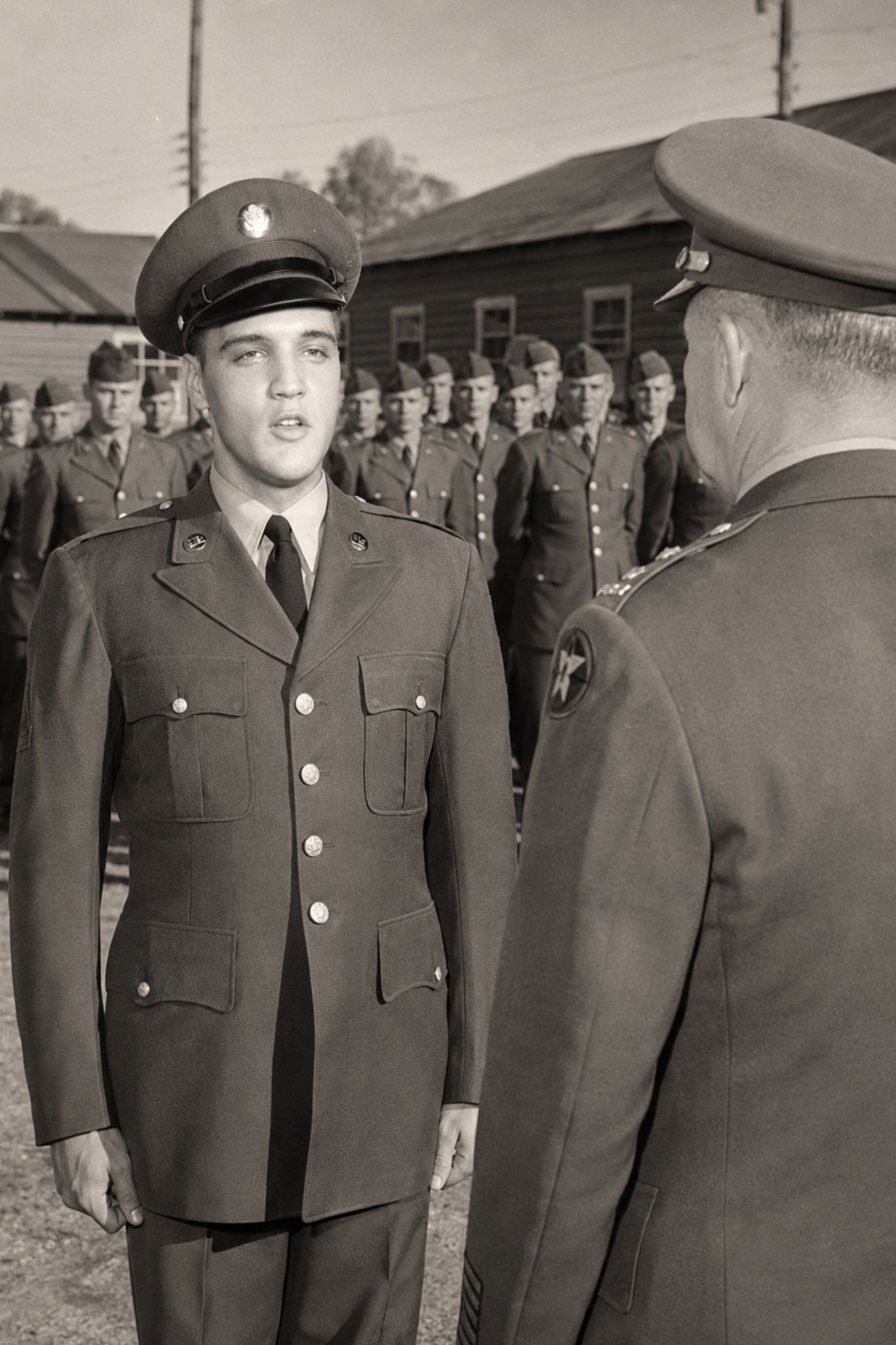
There are photographs of Elvis Presley that seem permanently attached to the mythology of American music: Elvis gripping a microphone beneath stage lights, Elvis in a carefully tailored suit before an excited audience, Elvis surrounded by fans who could scarcely believe they were standing near him. Then there are the remarkable photographs from 1958, when the most famous young entertainer in America suddenly appeared in an entirely different setting. The pompadour was disappearing, the concert clothes had been replaced by military fatigues, and the man newspapers had already crowned the King of Rock ’n’ Roll was sleeping on an Army cot like thousands of other young servicemen. More than six decades later, those photographs remain startling because they capture the moment when celebrity collided with duty—and celebrity, at least temporarily, had to step aside.
By the beginning of 1958, Elvis was not merely successful; he was a national phenomenon. His breakthrough had arrived with astonishing speed. Only a few years earlier, he had been recording at Sun Records in Memphis, combining country, rhythm and blues, gospel, and the restless energy of Southern musical traditions into something that sounded startlingly new to mainstream America. By 1956, “Heartbreak Hotel” had helped turn him into a household name, while subsequent recordings and television appearances made him one of the most discussed entertainers of his generation. Teenagers bought his records in enormous numbers, parents debated his influence, television networks monitored his every appearance, and Hollywood quickly recognized that his charisma could fill movie theaters as effectively as concert halls.

Then came a letter that even the biggest star in America could not simply ignore.
Elvis Presley was drafted into the United States Army in December 1957, and on March 24, 1958, he reported for induction in Memphis. The event immediately became national news. Photographers followed him as he moved through the process, recording scenes that now look almost surreal: Elvis undergoing medical examinations, receiving military clothing, standing among other recruits, and eventually surrendering the hairstyle that had become nearly as famous as his voice. Television cameras documented the haircut because America seemed fascinated by the symbolism of it. The carefully sculpted image of the rock ’n’ roll rebel was being transformed before the public’s eyes into Private Elvis Presley.
The haircut photographs remain among the most memorable images from this chapter of his life. Elvis smiled for the cameras, but behind the spectacle was a significant personal transition. Military service meant giving up something far more valuable than hair. For nearly two years, the momentum of one of the fastest-moving entertainment careers in history would be interrupted. In an industry where public attention could disappear almost overnight, stepping away from concert stages and movie sets carried genuine professional risk.
Elvis nevertheless entered the Army as a regular serviceman rather than pursuing a highly publicized entertainment role designed specifically around his celebrity. That decision helped reshape how many older Americans viewed him. Before his induction, some critics had treated Elvis as little more than a symbol of unruly youth culture. Military service presented a very different picture. Newspapers that had once focused almost exclusively on the excitement surrounding his performances could now photograph him wearing the same uniform as countless other American sons.
The transformation became even more vivid in quieter photographs.

One image shows Elvis resting on an Army cot, and its simplicity is precisely what makes it powerful. There is no mansion behind him. There is no Cadillac waiting outside. There are no screaming fans pressed against the edge of a stage. The cot is plain, the surroundings practical, and Elvis appears caught in one of those ordinary moments military life imposes upon everyone regardless of fame. For a brief instant, one of the most recognizable men in the world looks remarkably like any other young soldier trying to rest between responsibilities.
That contrast is what gives these vintage photographs their lasting emotional power.
The military reportedly had enormous interest in how Elvis might serve. Different branches understood the publicity value attached to having the country’s most famous young entertainer associated with them. Yet when the uniforms were finally issued and the cameras recorded his transformation, something larger than publicity was happening. Elvis Presley was entering a period that would divide his career into two distinct eras: the explosive young revolutionary of the mid-1950s and the more mature performer who would return to civilian life in 1960.
For Elvis himself, the transition was deeply personal. His life had accelerated almost beyond recognition between 1954 and 1958. Within only a few years, he had moved from modest beginnings in Tupelo and Memphis to international fame, hit records, Hollywood films, and a level of public attention almost impossible to escape. The Army suddenly imposed structure on a life increasingly defined by extraordinary circumstances. Rank mattered. Orders mattered. Schedules were determined by someone else. The King had become a private.
For one extraordinary chapter beginning in 1958, Elvis Presley was no longer simply the young man everyone wanted to watch. He was a soldier—and the photographs remain unforgettable because they captured a transformation even Hollywood could never have scripted.