Introduction
Elvis Presley Is Still Called “The King”—But After 70 Years, Does the Crown Really Belong to Him?
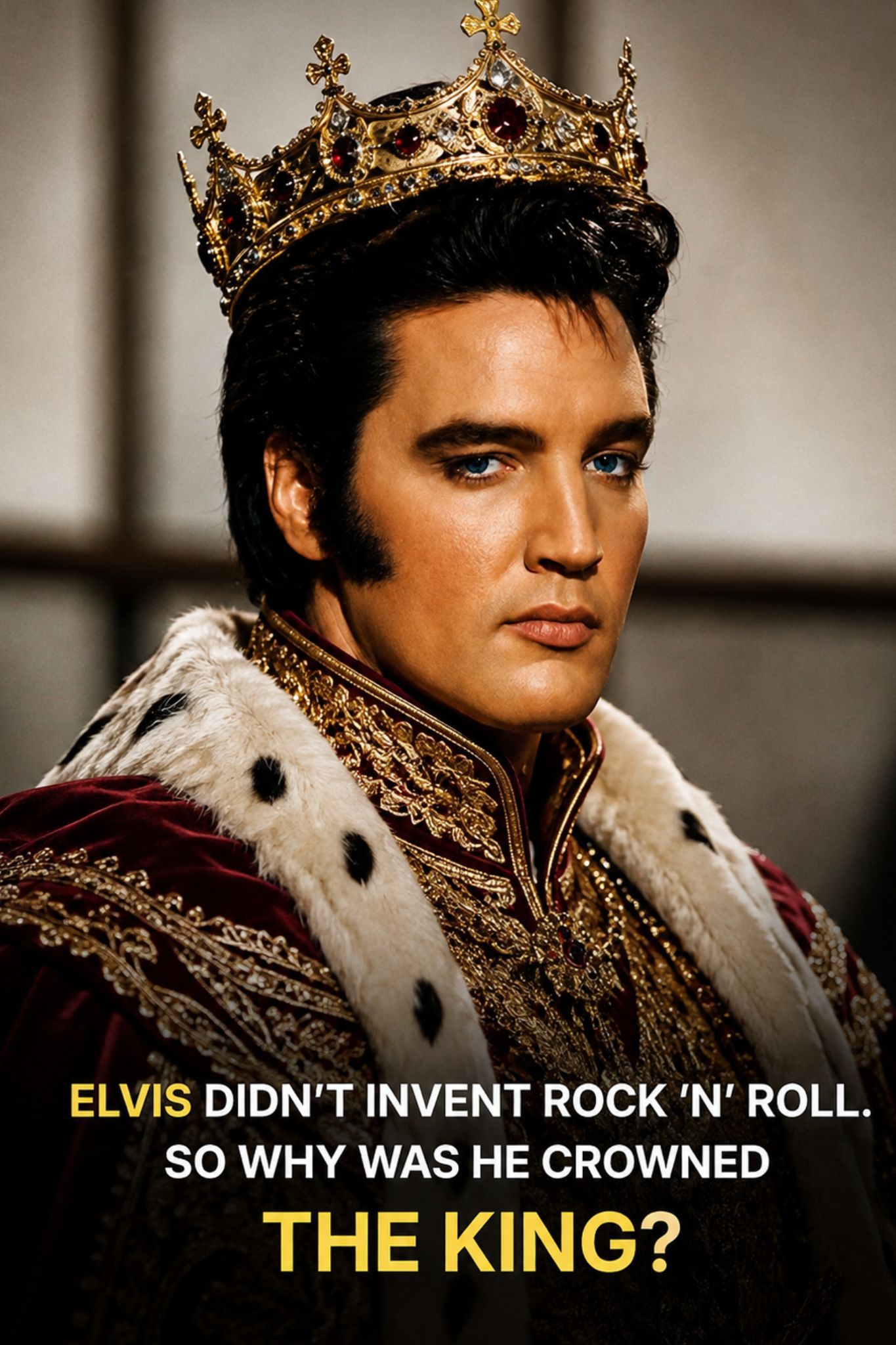
More than seven decades after Elvis Presley first walked into Sun Records, the title attached to his name remains almost impossible to separate from the man himself. He is still introduced as “the King of Rock ’n’ Roll,” a phrase repeated so often that many listeners have stopped asking what it actually means. Yet the question deserves a serious answer. Elvis did not invent rock ’n’ roll, he was not the most important songwriter in its history, and many of the musical traditions that shaped his sound had already been developed by Black blues, rhythm-and-blues, gospel, and country performers long before he became famous. If the crown is supposed to belong to the person who created rock ’n’ roll from the beginning, then Elvis cannot honestly claim it. But if the title recognizes the performer who transformed an emerging musical language into a worldwide cultural force, then the argument for Elvis Presley becomes far more persuasive.
The history of rock ’n’ roll did not begin in 1954, and it certainly did not begin with a single singer from Tupelo, Mississippi. Its foundations were built over generations through blues, gospel, rhythm and blues, country music, and the work of musicians whose names deserve to stand beside Elvis in any serious discussion. Sister Rosetta Tharpe had already demonstrated how electric guitar, gospel energy, and commanding stage presence could combine into something remarkably close to rock music. Chuck Berry created some of the genre’s defining guitar language and wrote songs that captured teenage America with astonishing precision. Little Richard brought an explosive vocal intensity that permanently changed popular music, while Fats Domino and Bo Diddley contributed rhythms, melodies, and performance styles that became essential to the developing sound. These artists were not merely influences on a movement that Elvis later invented. They were among its architects.

Acknowledging this history does not diminish Elvis; it simply places him where he belongs. Elvis Presley absorbed musical traditions that were already thriving around him, particularly the Black gospel, blues, and rhythm-and-blues music he heard growing up in Mississippi and Tennessee. He also carried a deep familiarity with Southern country music and gospel harmony. What made him extraordinary was his ability to bring these influences together with unusual instinct. When Elvis recorded at Sun Records, his performances often sounded as though different American musical traditions were colliding in real time. Country phrasing could meet rhythm-and-blues energy, gospel emotion could appear inside a pop performance, and an old song could suddenly feel startlingly modern. He did not invent the ingredients, but his combination of them reached an audience that few performers before him had been permitted to reach.
This is also where the story becomes uncomfortable and historically important. Race and the American music industry cannot be removed from any honest evaluation of Elvis’s success. During the 1950s, Black musicians often faced barriers that white performers did not. Radio programming, television appearances, touring opportunities, record distribution, and mainstream promotion were shaped by segregation and unequal access. Elvis benefited from an industry willing to market a young white performer to audiences who might not have been encouraged to embrace the Black artists whose work helped create the musical vocabulary he used. That reality should be acknowledged clearly. At the same time, reducing Elvis to someone who simply “stole” music from others also fails to describe the full story. He repeatedly expressed admiration for Black performers, recognized that the music existed before him, and was himself deeply shaped by the Southern musical environment in which cultural influences constantly crossed boundaries despite the divisions of the era.

The stronger case for calling Elvis “the King” therefore rests less on invention than on transformation. Once he appeared on national television, popular music could not return to what it had been. His voice was immediately recognizable, but equally important was the way he occupied a stage. Elvis performed as though music were not simply something to be sung but something that moved through the entire body. His timing, phrasing, charisma, humor, and emotional unpredictability gave audiences the feeling that anything might happen during a performance. To younger listeners in the 1950s, he represented excitement and possibility. To many parents and cultural authorities, he represented a disturbing change they did not entirely understand. Either way, he became impossible to ignore.
His recordings also reveal a singer who was more versatile than the mythology sometimes suggests. Elvis Presley could deliver aggressive early rock ’n’ roll, tender country ballads, spiritual gospel recordings, dramatic pop songs, blues-influenced performances, and emotionally powerful material from the American South. Songs such as “That’s All Right,” “Heartbreak Hotel,” “Hound Dog,” “Jailhouse Rock,” “Are You Lonesome Tonight?” and “Suspicious Minds” do not all belong to the same musical category, yet Elvis made each of them sound unmistakably his own. His importance was not built primarily on writing songs. It came from interpretation. He possessed the rare ability to enter material written by someone else and reshape it through phrasing, dynamics, tone, and emotional instinct until audiences associated the song with him permanently.