Introduction
THE PRICE OF THE CROWN: Why Gladys Presley Feared the Fame That Made Elvis a King—and Longed for the Son She Knew Before the World Took Him Away
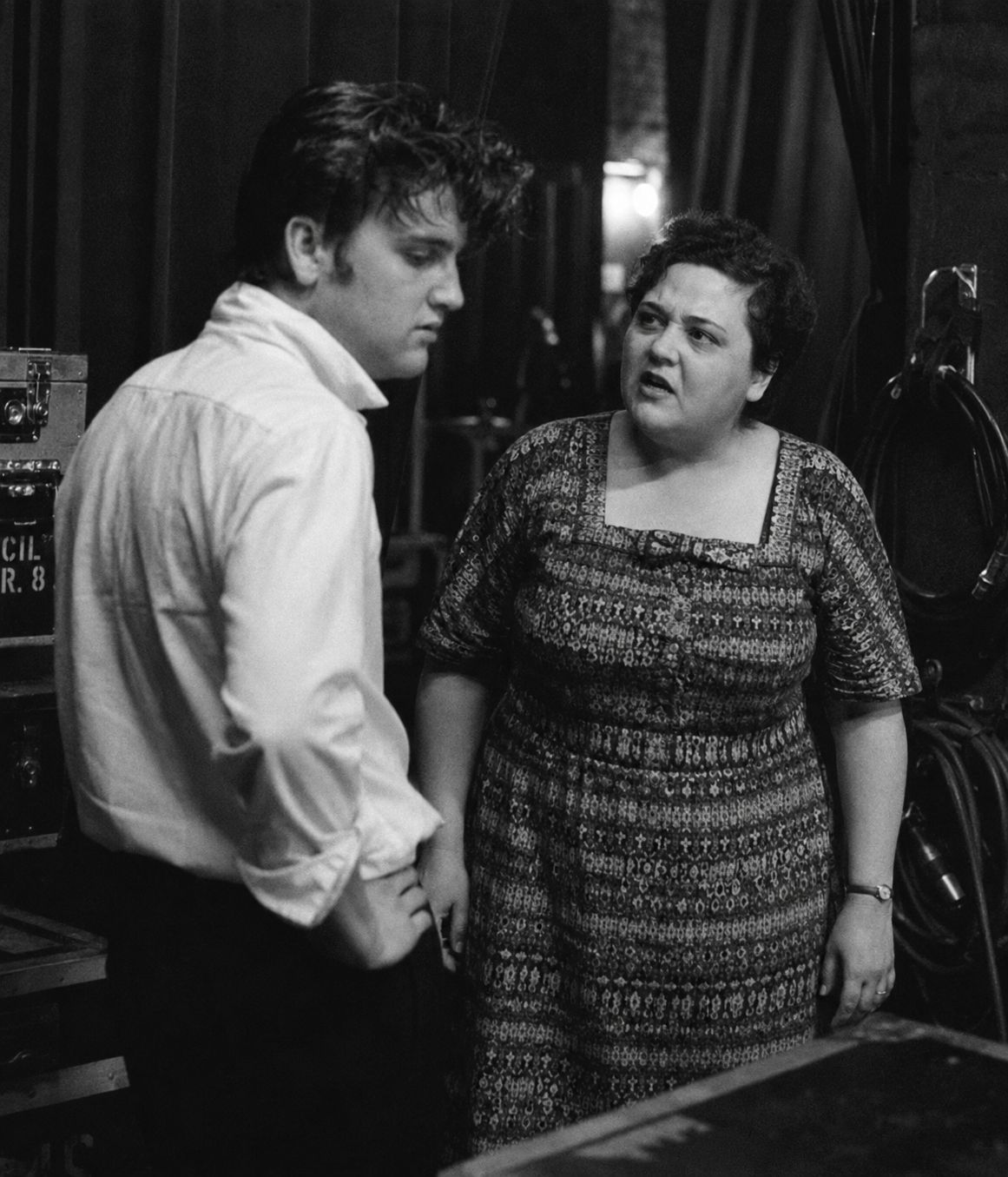
Long before Elvis Presley became the King of Rock ’n’ Roll, before the screaming crowds, gold records, Hollywood contracts, Cadillacs, television appearances, and the gates of Graceland, he was simply Gladys Presley’s boy. To understand the woman who stood at the emotional center of Elvis’ early life, one must look beyond the familiar photographs of a proud mother beside her famous son. Gladys Presley did not hate Elvis for becoming successful, nor is there convincing evidence that she rejected the man he became. What appears far closer to the truth is more complicated and far more heartbreaking: she feared what extraordinary fame was doing to the son she had raised through poverty, uncertainty, and loss. As Elvis rose higher, the ordinary closeness that had defined their relationship became increasingly difficult to preserve, and the life Gladys had once understood began disappearing beneath the machinery of celebrity.
Born Gladys Love Smith in Mississippi in 1912, she came from a working-class Southern background where hardship was not an abstraction but part of everyday existence. When she gave birth on January 8, 1935, she delivered twin boys. The first, Jesse Garon Presley, was stillborn; the second, Elvis Aaron Presley, survived. That loss became an important part of the Presley family story. Gladys poured tremendous affection and protectiveness into her surviving son, and Elvis developed an equally intense attachment to his mother. Their relationship was strengthened not by privilege but by insecurity. Money was scarce, the family moved repeatedly, and Elvis grew up understanding that stability could never be taken for granted.
When the family moved to Memphis, Tennessee, in 1948, their circumstances remained modest. They lived for a period in public housing, and Elvis attended Humes High School while developing the musical interests that would eventually transform all their lives. Those years can seem almost impossibly simple when viewed from the perspective of what followed. There were no entourages waiting outside the house, no journalists tracking his movements, no national arguments about his performances. Elvis was an unusually shy young man with distinctive clothes, an interest in music, and ambitions that had not yet become reality.
Then came Sun Records.
In July 1954, Elvis recorded “That’s All Right” with guitarist Scotty Moore and bassist Bill Black. The record began receiving attention in Memphis, and within a remarkably short period the young truck driver who had once worried about helping his parents financially became one of the most talked-about performers in the South. By 1956, after his move to RCA Victor and the enormous success of recordings such as “Heartbreak Hotel,” “Hound Dog,” and “Don’t Be Cruel,” Elvis was no longer merely popular. He had become a national phenomenon.
That distinction is essential when considering provocative claims that “Elvis Presley’s mother hated what he became.” The phrase is dramatic, but it oversimplifies a relationship defined by profound devotion. What Gladys appears to have disliked was not Elvis himself but the world that fame constructed around him. She worried about exhaustion. She worried about the people surrounding him. She worried about the pressures being placed upon a son whose success had accelerated with almost no time to adjust.
There is a cruel irony here. For years, Gladys had wanted Elvis to escape poverty. When he finally did, the escape happened so completely that she found herself in another kind of insecurity. The family no longer worried about grocery bills, but Gladys now worried about whether her son was sleeping enough, whether strangers could be trusted, and whether the extraordinary pace of his career would eventually demand too much from him.
People who witnessed the aftermath described a level of grief that revealed how central Gladys had been to his identity. At her funeral, Elvis was openly devastated. The man whose performances had seemed fearless before millions of people was suddenly a 23-year-old son confronting the loss he had always feared most.
For students of Elvis’ life, Gladys Presley’s death represents one of the most important dividing lines in his personal history. There was Elvis before August 1958, still anchored by the mother who had known him before fame, and Elvis afterward, carrying an absence no applause could fill. He would go on to achieve extraordinary things: his return from the Army, major films, the celebrated 1968 Comeback Special, Las Vegas triumphs, the Aloha from Hawaii broadcast, and countless recordings that remain familiar generations later. But Gladys would see none of them.

That may be the most heartbreaking aspect of their story. She witnessed the beginning of Elvis’ ascent but not the mature artist he would eventually become. She saw the crowds grow larger and the pressures become heavier, yet she never lived long enough to see whether her fears would prove justified.
For older admirers who remember Elvis during his lifetime, Gladys offers a way of seeing the King without the mythology. Before the rhinestones, private airplanes, enormous arenas, and international fame, there was a mother worrying about whether her son had eaten, whether he was resting, and whether the world was demanding too much from him. Her concerns were profoundly ordinary precisely because Elvis’ circumstances had become so extraordinary.
In the end, Gladys Presley did not hate what her son became. She appears to have feared the cost of becoming it. She had spent Elvis’ childhood protecting him from poverty and uncertainty, only to discover that wealth and fame created dangers she could neither understand nor control. The world saw a young man becoming a king. Gladys still saw the boy who had once come home to her at the end of every day.
And perhaps that is the lasting tragedy behind Elvis Presley and his mother. Millions celebrated the moment America discovered Elvis, but for Gladys, every step that carried him toward immortality also seemed to carry him a little farther from the quiet life in which he had simply been hers.