Introduction
TELEVISION SAID NO—THEN PAID ELVIS $50,000: The Reversal That Changed American Entertainment Forever
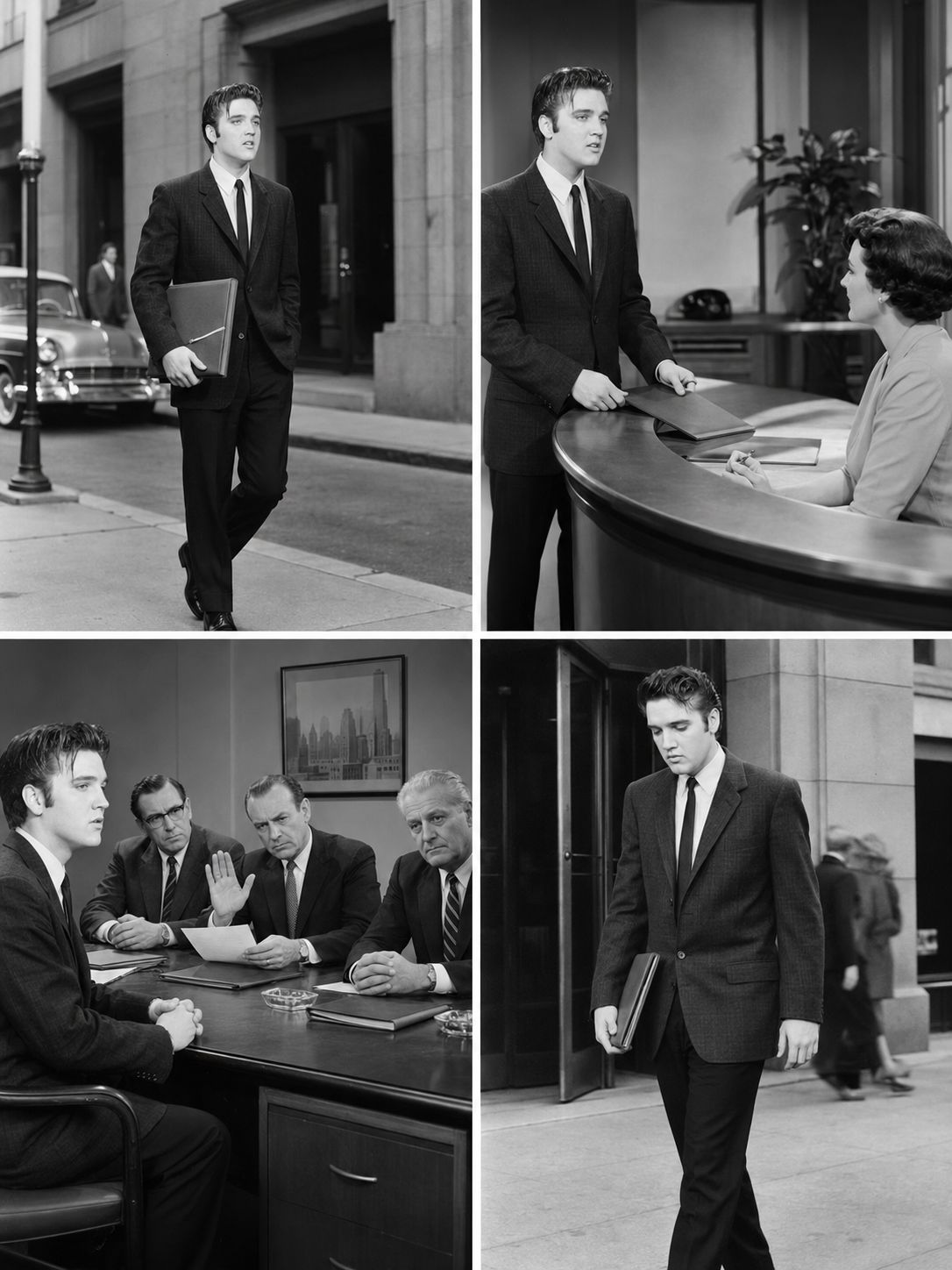
Elvis Presley was considered too controversial for television’s most powerful stage—until his popularity became impossible to ignore. What followed was an unprecedented $50,000 agreement, three historic appearances, and a night when more than 60 million viewers watched America change before their eyes.
In 1956, television did not merely entertain the American family. It helped determine which performers were respectable enough to enter the nation’s living rooms. A successful appearance could transform a regional singer into a national celebrity, while rejection from an influential program could close doors before a career had fully begun. At the center of that powerful new world stood Ed Sullivan, the famously reserved newspaper columnist and television host whose Sunday-night variety program had become one of the most important showcases in American entertainment.
Then came Elvis Presley, a young singer from Memphis whose voice, appearance, and physical energy seemed unlike anything mainstream television had encountered before. His music drew from country, gospel, rhythm and blues, and the restless enthusiasm of a new generation. Young listeners responded immediately, but many older observers were uncertain about what he represented. Some viewed him as exciting and original, while others considered his performances too unconventional for family television.
Sullivan was initially among those who hesitated. Before Elvis had made his defining appearance on the program, Sullivan had declined an opportunity to hire him for a far smaller sum. The official history of The Ed Sullivan Show recalls that Elvis was originally available for approximately $5,000, but Sullivan did not accept the offer. At that stage, the host reportedly regarded the rising singer as unsuitable for the carefully balanced atmosphere of his Sunday-night broadcast.
That rejection might have ended the story for a less determined performer. For Elvis, it became only the beginning.
By the summer of 1956, Elvis had already appeared on national programs including the Dorsey Brothers’ Stage Show, The Milton Berle Show, and The Steve Allen Show. His records were climbing the charts, his debut album had been released, and “Heartbreak Hotel” had helped make his voice impossible to avoid. More importantly for television executives, audiences were following him in extraordinary numbers. When his appearance on Steve Allen’s program attracted major attention and defeated Sullivan’s show in the ratings, the argument over whether Elvis belonged on television suddenly became a business decision as well as a cultural debate.
Ed Sullivan changed his mind.
The reversal was remarkable because it revealed how quickly the balance of power had shifted. Only weeks earlier, Elvis had been treated as a risk. Now he had become the performer television could not afford to lose. Sullivan and Elvis’s manager, Colonel Tom Parker, negotiated an agreement worth $50,000 for three appearances, an unprecedented television fee for a performer at that time. The young singer who had once been rejected for a fraction of that amount was suddenly receiving one of the most valuable contracts in the history of early television entertainment.
The money made headlines, but the deeper significance could not be measured in dollars. Sullivan’s decision represented an acknowledgment that American culture was changing. Television executives could resist Elvis’s style, criticize his movements, and question his influence, but they could no longer pretend that the public was uninterested. His audience had become too large, too devoted, and too visible.
On September 9, 1956, Elvis made his first appearance on The Ed Sullivan Show. The circumstances were unusual. Sullivan himself was recovering from injuries suffered in an automobile accident, so actor Charles Laughton served as the evening’s host. Elvis was also not inside the New York studio. He appeared through a live broadcast from Hollywood, where he was working on his first motion picture, Love Me Tender.
None of those complications weakened the impact of the moment.
When Elvis appeared on the screen, approximately 60 million people were watching. Estimates commonly place the audience at more than 60 million viewers, representing an extraordinary 82.6 percent share of the television audience. In an era when the United States had a far smaller population and fewer television sets than it would in later decades, the number was almost unimaginable. Families gathered around their screens, teenagers waited with anticipation, and skeptical parents watched closely to understand why this young man had become the most discussed entertainer in the country.
What they witnessed was not simply a successful television booking. It was a meeting between two Americas.
One America valued order, tradition, and the reassuring formality represented by Ed Sullivan’s program. The other was younger, louder, and eager for a sound that reflected its own restlessness. Elvis stood between those worlds. He did not destroy the older tradition, but he demonstrated that the future could no longer be kept outside the studio doors.
For longtime admirers, it is easy to look backward and assume that Elvis’s success was inevitable. His name has become so firmly established in cultural history that his early rejection now seems almost unbelievable. Yet in 1956, nothing was guaranteed. He was only twenty-one years old, navigating fierce criticism while learning how quickly fame could transform both opportunity and expectation.
That is what makes the $50,000 reversal so compelling. It was not simply a story about a television host admitting that he had underestimated a performer. It was a story about institutions recognizing that popular enthusiasm could no longer be controlled entirely from the top. Elvis’s audience had spoken through record sales, concert attendance, and television ratings. Sullivan’s decision showed that even the most powerful gatekeeper sometimes had to follow the public rather than lead it.
Elvis returned for his second appearance on October 28, 1956, and completed the three-show agreement on January 6, 1957. By then, his position in American popular culture was no longer in serious doubt. The performer once viewed as too controversial had become essential television. Each appearance strengthened his connection with the national audience and helped turn a rapidly rising music star into a household name.
The episode also reveals something important about Elvis himself. Rejection did not persuade him to become ordinary. He continued performing with the intensity that had first attracted listeners in Memphis and across the South. He adjusted to the demands of television without surrendering the qualities that made audiences notice him. That balance between discipline and individuality would remain central to his appeal.
Older viewers who witnessed the broadcast often remember more than the songs. They remember the atmosphere surrounding the event. They recall parents debating whether Elvis was a passing sensation, young people crowding closer to the television, and newspapers attempting to explain a phenomenon that seemed to be growing faster than anyone could control. The performance became part of family history because it arrived at a moment when postwar America was negotiating new ideas about music, youth, celebrity, and freedom of expression.
Elvis Presley did not merely appear on Ed Sullivan’s stage. He forced television to reconsider who deserved to stand there.
The host who had once refused him ultimately introduced Elvis to an audience of historic proportions. The singer who had been dismissed as a dangerous gamble became the centerpiece of one of television’s most important nights. The fee that once would have seemed impossible became a symbol of how dramatically his value had risen.
Decades later, the story remains powerful because rejection is familiar to everyone. Most people have experienced a moment when someone failed to recognize their potential. Few will ever answer that rejection before an audience of more than 60 million, but the emotional lesson is universal. A closed door does not always mark the end of a journey. Sometimes it gives the world enough time to realize what it nearly allowed to escape.
Elvis was rejected, television reconsidered, and American entertainment was never quite the same again. What began as doubt ended with a record-setting contract, three landma