Introduction
THE GRACELAND BURIAL BAN THAT NEVER EXISTED: HOW A VIRAL STORY TURNED RILEY KEOUGH AND PRISCILLA PRESLEY’S REAL SETTLEMENT INTO ONE FINAL FAMILY BETRAYAL
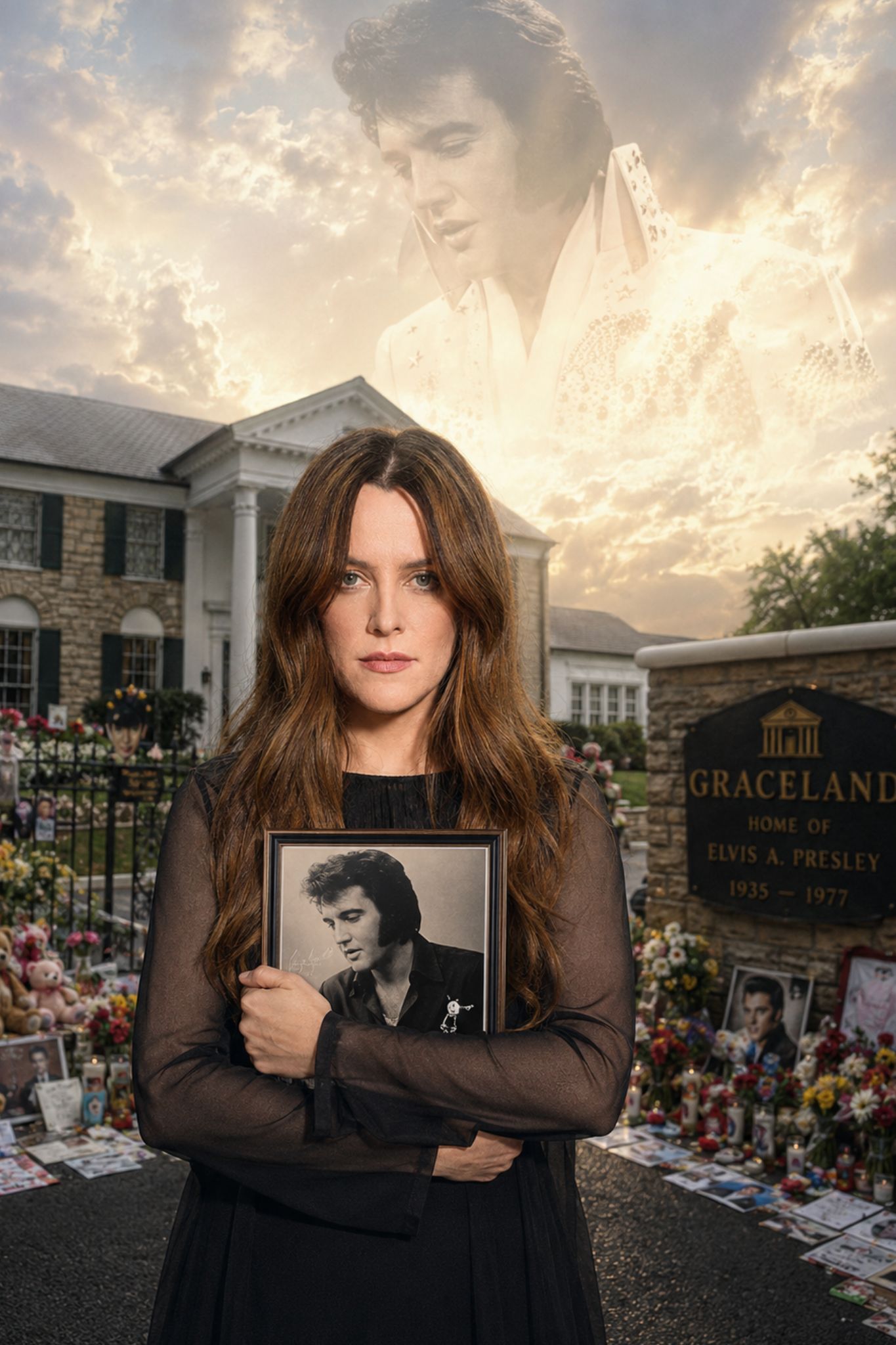
Few places in American music carry the emotional weight of Graceland’s Meditation Garden. It is not simply a burial ground behind a famous mansion; it is where the private history of the Presley family meets the public memory of millions. Elvis Presley rests there with members of his family, while Lisa Marie Presley and her son Benjamin Keough were later laid to rest on the same grounds. For longtime admirers, the garden represents family, grief, continuity, and the permanent cost of a life lived beneath worldwide attention. That is why an explosive claim suggesting that Riley Keough legally barred Priscilla Presley from being buried at Graceland was almost guaranteed to spread.
The story arrives with the polished urgency of a documentary thriller. It describes a supposedly secret legal filing dated February 14, 2024, buried inside a lengthy estate amendment and designed to ensure that Priscilla would never rest near Elvis or Lisa Marie. In this version, Riley is not merely administering her mother’s estate; she is carrying out a final judgment on behalf of Lisa Marie, punishing Priscilla for decades of alleged manipulation, commercial calculation, and hidden betrayal. The language is carefully chosen to make a complicated family matter feel like the closing scene of an American tragedy.
Yet the documented settlement tells almost the exact opposite story.
Court documents reported in 2023 stated that, to the extent of Riley’s authority, Priscilla may be buried in Graceland’s Meditation Garden. Her grave is to be placed at the available location closest to Elvis without disturbing any existing resting place. The agreement also allows for a memorial service to be held on the estate. Rather than permanently excluding her grandmother, Riley formally agreed to accommodate Priscilla’s wish to remain connected to the place that shaped so much of her public and private life.
That distinction changes the entire meaning of the controversy. Some early reports suggested that Priscilla’s desire to be buried directly beside Elvis had been rejected, largely because granting that exact request could have required moving an existing grave. The final arrangement did not promise her the precise plot she initially sought, but it did provide a burial place nearby. Over time, the difference between “not directly beside Elvis” and “completely banned from Graceland” disappeared from sensational retellings. What began as a disagreement over location became a dramatic narrative of permanent exile.
The actual legal conflict began after Lisa Marie Presley’s death in January 2023. Priscilla challenged the validity of a 2016 amendment to her daughter’s trust, which removed Priscilla and a former business manager as trustees and placed Riley and Benjamin in those roles. Since Benjamin had died in 2020, the amendment left Riley in the central position. The dispute raised understandable questions about signatures, notification, trusteeship, and the future administration of a family estate carrying enormous financial and cultural responsibilities.
The matter was unquestionably serious, but the public record does not support the darker claim that it uncovered a secret campaign of revenge. Under the court-approved agreement, Riley became the sole trustee of Lisa Marie’s trust and owner of Graceland, while Priscilla resigned from a trustee role and became a non-fiduciary special adviser. Reporting on the unredacted settlement also described a lump-sum payment, annual advisory compensation, legal fees, and provisions concerning Priscilla’s personal belongings and future memorial. These were the terms of a complicated estate settlement—not evidence of a granddaughter attempting to erase her grandmother from the Presley story.
:max_bytes(150000):strip_icc():focal(749x0:751x2)/riley-keough-elvis-golden-globes-tout-010724-e1109dabd87b47e9a88c4b87860bab15.jpg)
The strongest contradiction comes from Riley herself. Speaking after the settlement, she said she did not understand the public drama surrounding Priscilla’s burial and saw no reason her grandmother should not be laid to rest at Graceland if that remained her wish. Riley also described Priscilla as a major force in creating and protecting the public legacy of both Elvis and Graceland. Those comments do not resemble the words of someone secretly determined to prohibit her grandmother from entering the family burial ground.
Riley’s account of the family conflict was measured rather than vindictive. She acknowledged that Lisa Marie’s sudden death created upheaval and that the family needed time to understand the complicated intersection of personal grief and major business responsibilities. She explained that clarity had eventually been reached and insisted that her relationship with her grandmother had not been defined by the hostility suggested in headlines. Priscilla similarly stated that she and Riley were on good terms and continued to support one another.
This does not mean every private wound has healed or that every Presley family disagreement has been publicly explained. Families rarely reduce their most difficult relationships to neat legal language, especially when mourning, inheritance, business, and history are entangled. Riley lost her mother after already losing her brother, while Priscilla lost her only daughter after spending decades associated with the memory and estate of her former husband. Their grief was unfolding while lawyers, reporters, admirers, and online commentators examined every visible decision.
However, complexity should not become permission to invent evidence. No credible public reporting has established the existence of a February 14, 2024 Shelby County filing that reversed the court-approved burial provision. Nor has reliable documentation supported the alleged hidden will, secret pre-death agreement with Colonel Tom Parker, or collection of letters supposedly proving that Priscilla planned to exploit Elvis’s death before it occurred. Such accusations are enormous, yet the viral narrative offers no authenticated records, court exhibits, named custodians, or independently verified sources.
The story is powerful because it takes genuine historical tensions and fills every unknown space with the darkest possible explanation. Priscilla did play an influential role in the commercial preservation of Graceland. Riley does now carry significant responsibility for the property and the family trust. Lisa Marie did experience a complicated relationship with both her parents’ legacies. But none of those truths automatically proves that Priscilla treated Elvis’s death as a business opportunity or that Lisa Marie secretly instructed Riley to deny her mother a burial place.
For older Elvis admirers, the accusation may feel particularly disturbing because Graceland is more than real estate. It has become a symbolic family home shared with the public, a place where visitors approach the graves in silence and remember not merely the entertainer but the son, father, and vulnerable human being behind the legend. The possibility that someone could be excluded from that ground as punishment carries the solemn finality of an ancient family judgment.
That emotional power is precisely why the facts matter. The available settlement does not portray Riley as the last Presley casting Priscilla into exile. It portrays her as a granddaughter who assumed control during a period of profound family loss, negotiated a legal resolution, and agreed to honor her grandmother’s eventual burial request within practical limits. The arrangement may not satisfy every admirer’s idea of where Priscilla belongs, but it is not the merciless prohibition described in the viral account.
Perhaps the real story is less explosive but more human. Riley Keough and Priscilla Presley were not fighting over a simple grave. They were trying to determine who would guide an estate in which mourning, family identity, public history, and a vast commercial enterprise had become almost impossible to separate. Their settlement did not erase the difficult questions surrounding the Presley legacy, but it did answer one of them clearly.
Priscilla was not barred from burial at Graceland. Riley agreed that she could rest there. The supposed final act of vengeance is therefore not a documented chapter in the Presley family story, but a cautionary example of how easily grief can be reshaped into spectacle—and how one omitted sentence from a legal agreement can transform reconciliation into betrayal.