Introduction
THE GRIEF GRACELAND COULD NOT CONTAIN: RILEY KEOUGH REVEALS LISA MARIE PRESLEY’S FINAL YEARS AND THE FAREWELL THAT DEFIED UNDERSTANDING
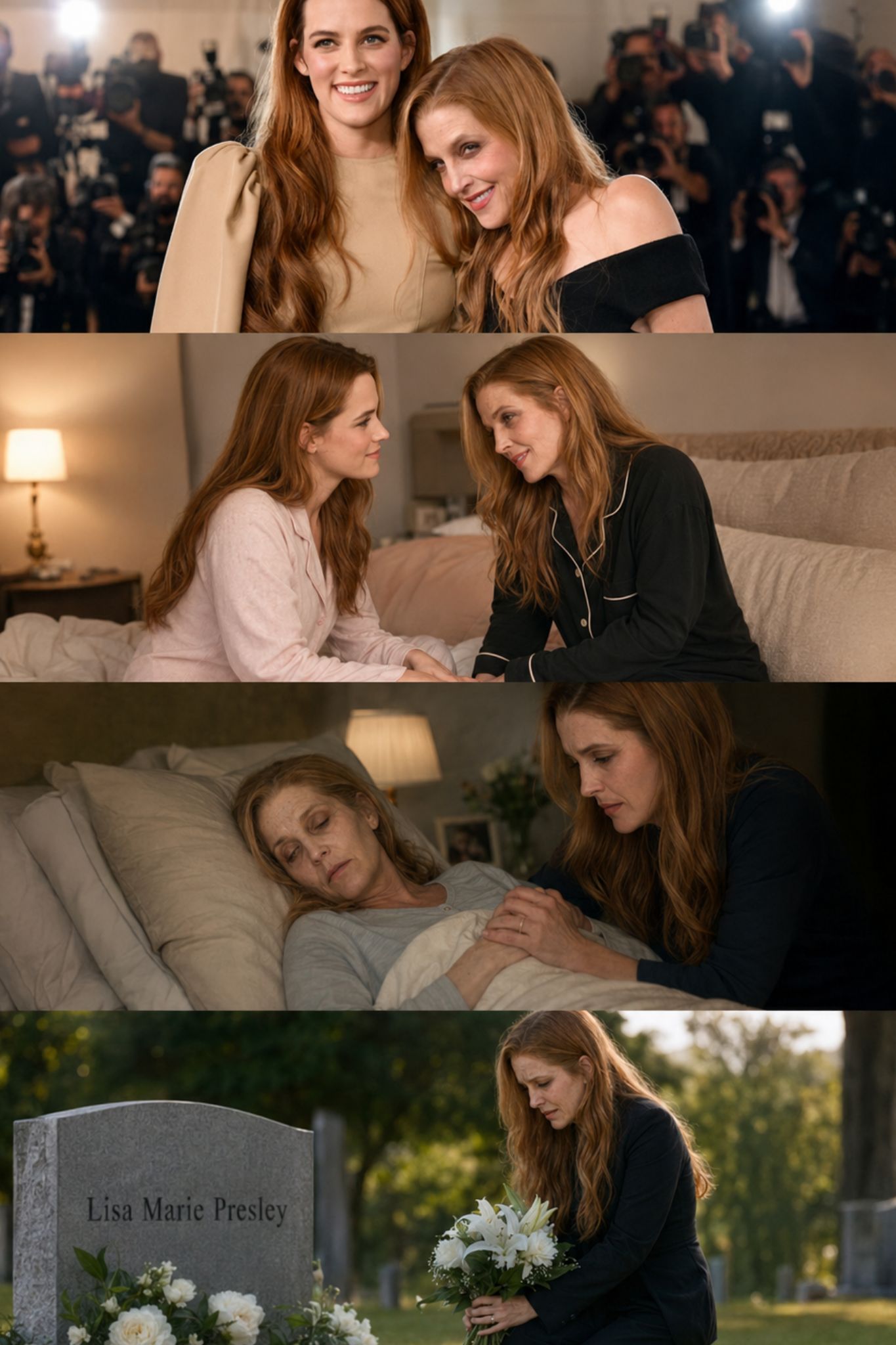
When Riley Keough sat opposite Oprah Winfrey at Graceland, the setting carried a weight no ordinary television studio could have created. They were speaking inside the home where Elvis Presley had lived, where Lisa Marie Presley had spent part of her childhood, and where several generations of the family’s memories had become inseparable from public history. Yet Riley was not there simply to discuss the legend of her grandfather. She had come to speak about her mother, the difficult final years Lisa Marie endured, and the grief that had quietly overtaken a woman the world often misunderstood.
The conversation formed part of the CBS special The Presleys—Elvis, Lisa Marie and Riley, broadcast on October 8, 2024. It accompanied the publication of From Here to the Great Unknown, the memoir Lisa Marie began through recorded recollections and Riley later completed. The book was also chosen for Oprah’s Book Club, giving Lisa Marie’s own voice an opportunity to reach readers after her unexpected death in January 2023.
For Riley, completing the memoir was not an ordinary literary project. In 2022, Lisa Marie asked her daughter to help finish a book that had remained incomplete for years. After her mother died, Riley received the recordings Lisa Marie had made and listened to them while experiencing her own grief. She heard her mother recount childhood memories of Elvis, life at Graceland, motherhood, addiction, family conflict, and the losses that shaped nearly every period of her life.
The result is more than a conventional celebrity autobiography. It is a conversation between a mother who is gone and a daughter trying to preserve her truth. Lisa Marie speaks through the recordings, while Riley provides context, tenderness, and the perspective of someone who knew the private woman behind the famous surname. The structure allows the memoir to acknowledge contradictions rather than presenting Lisa Marie as either a tragic figure or a privileged heiress.
Riley’s interview with Oprah carried the same emotional restraint. She did not attempt to transform her mother’s pain into easy drama, nor did she pretend that every decision made during grief could be understood from the outside. Instead, she described a woman whose life had been marked by loss from childhood and who eventually faced a sorrow that appeared to exceed her ability to recover.
Lisa Marie was nine years old when Elvis Presley died in 1977. The memoir describes how deeply she loved her father and how, even as a child, she feared that something might happen to him. His death did not become a closed chapter simply because the years passed. It remained part of her emotional world, influencing her relationship with Graceland, fame, family, and mortality.
That early grief was followed decades later by the death of her son, Benjamin Keough, in 2020. Riley has explained that Benjamin’s death by suicide transformed Lisa Marie’s final years. The loss did not merely make her sad; it altered her sense of purpose and appeared to weaken her desire to continue living. Riley’s account presents her mother as someone still capable of love and care, but increasingly consumed by an absence she could not accept.
The memoir’s most startling revelation concerns the period immediately following Benjamin’s death. According to Riley and Lisa Marie’s account, the family arranged for his body to remain in a carefully controlled room at home for approximately two months while they grieved and struggled to decide where he should be buried. Riley acknowledged to Oprah that the decision could sound extraordinary or even incomprehensible when described without the emotional circumstances surrounding it.
This detail attracted immediate attention because it appeared so far outside ordinary expectations. Yet Riley asked viewers to consider the act not as evidence of madness, but as an expression of a family unable to move quickly toward a final separation. Lisa Marie had lost her father suddenly as a child and had been given time near him after his death. In her grief over Benjamin, she seems to have sought a similar period of physical closeness before accepting that he had to be laid to rest.
The distinction matters. Sensational reporting can reduce an unusual decision to a shocking headline, but grief does not always follow respectable or predictable patterns. Some people move quickly into practical arrangements because doing so provides structure. Others delay decisions because each step feels like another irreversible goodbye. Lisa Marie’s response was extreme, but it came from a mother’s inability to surrender the presence of her son.
Riley’s words, “I can see how this sounds insane,” reveal her awareness of how the story would be received. She did not deny its strangeness. Instead, she placed it within the private reality of a household in mourning, where the ordinary rules of time and behavior had temporarily lost their meaning. Everyone inside the home was participating in the grieving process, and their choices were guided less by public convention than by the need to survive one unbearable day at a time.
Eventually, Benjamin was buried at Graceland, near the grandfather he never met but whose legacy had shaped his family. That decision made the estate even more complicated for Riley and Lisa Marie. Graceland was already a home, museum, shrine, business, and burial place. After Benjamin’s death, it also became the location where Lisa Marie could remain physically close to her son’s resting place.
To understand Lisa Marie’s final years, it is necessary to understand that Graceland represented both comfort and sorrow. It preserved the happiest memories of her childhood with Elvis, but it also held the graves of the people whose absence defined her life. Visitors could experience the estate as an inspiring landmark. For Lisa Marie, it was inseparable from family, death, love, and the strange burden of having private grief displayed within a place visited by the world.
The memoir also addresses Lisa Marie’s struggles with addiction. Her difficulties were not presented as an isolated moral failure, but as part of a larger history involving physical pain, emotional vulnerability, motherhood, and attempts to escape overwhelming feelings. Riley has spoken about her mother’s wish to tell the truth about these experiences in a way that might reach others facing addiction, suicide loss, or complicated grief.
By Lisa Marie’s final years, Riley believed her mother was no longer living in the same destructive cycle that had previously controlled parts of her life. Yet freedom from one struggle did not mean freedom from grief. Benjamin’s death remained present, and Lisa Marie appeared increasingly exhausted by the effort required to live without him.
This is one of the most difficult truths within Riley’s testimony. Recovery is not a single door through which someone passes permanently. A person can overcome one crisis while remaining vulnerable to another. Lisa Marie may have moved beyond a period of serious dependency, but she still carried losses that no treatment, fortune, or family name could erase.
Fame offered no protection from grief. Lisa Marie had access to resources unavailable to most families, but none could answer the central question created by Benjamin’s absence. Money could maintain Graceland, organize memorials, and preserve recordings. It could not return a son to his mother or make the future resemble the life she had expected.
Riley’s responsibility after her mother’s death was therefore enormous. She was mourning Lisa Marie while also grieving Benjamin, completing a memoir, protecting the family’s public legacy, and deciding how much of their private truth should be revealed. She had to listen repeatedly to her mother’s recorded voice, knowing that there would never be another conversation in which she could ask for clarification or reassurance.
The process might easily have become exploitative, but Riley approached it as a final act of service to her mother. She wanted readers to encounter Lisa Marie as a complete person: joyful, humorous, difficult, generous, wounded, loving, and sometimes overwhelmed. Riley believed that her mother wanted her experiences to help people feel less isolated, particularly those confronting grief and addiction.
That purpose gives the memoir a significance beyond the Presley family. Although few readers will understand what it means to grow up as Elvis Presley’s only child, many will recognize the experience of losing someone central to their lives. They may understand the guilt of surviving, the fear that memories are fading, or the longing to hear a familiar voice again.
Riley’s interview also challenges the way public figures are remembered. Lisa Marie was frequently described through her relationships to others: Elvis’s daughter, Priscilla’s child, the wife of famous men, or the mother who experienced an unimaginable loss. Those descriptions were factually connected to her life, but none captured the full person Riley knew.