Introduction
BEFORE THE MANSIONS, THE FERRARIS AND THE FAME: THE ROD STEWART STORY MOST FANS NEVER REALLY KNEW
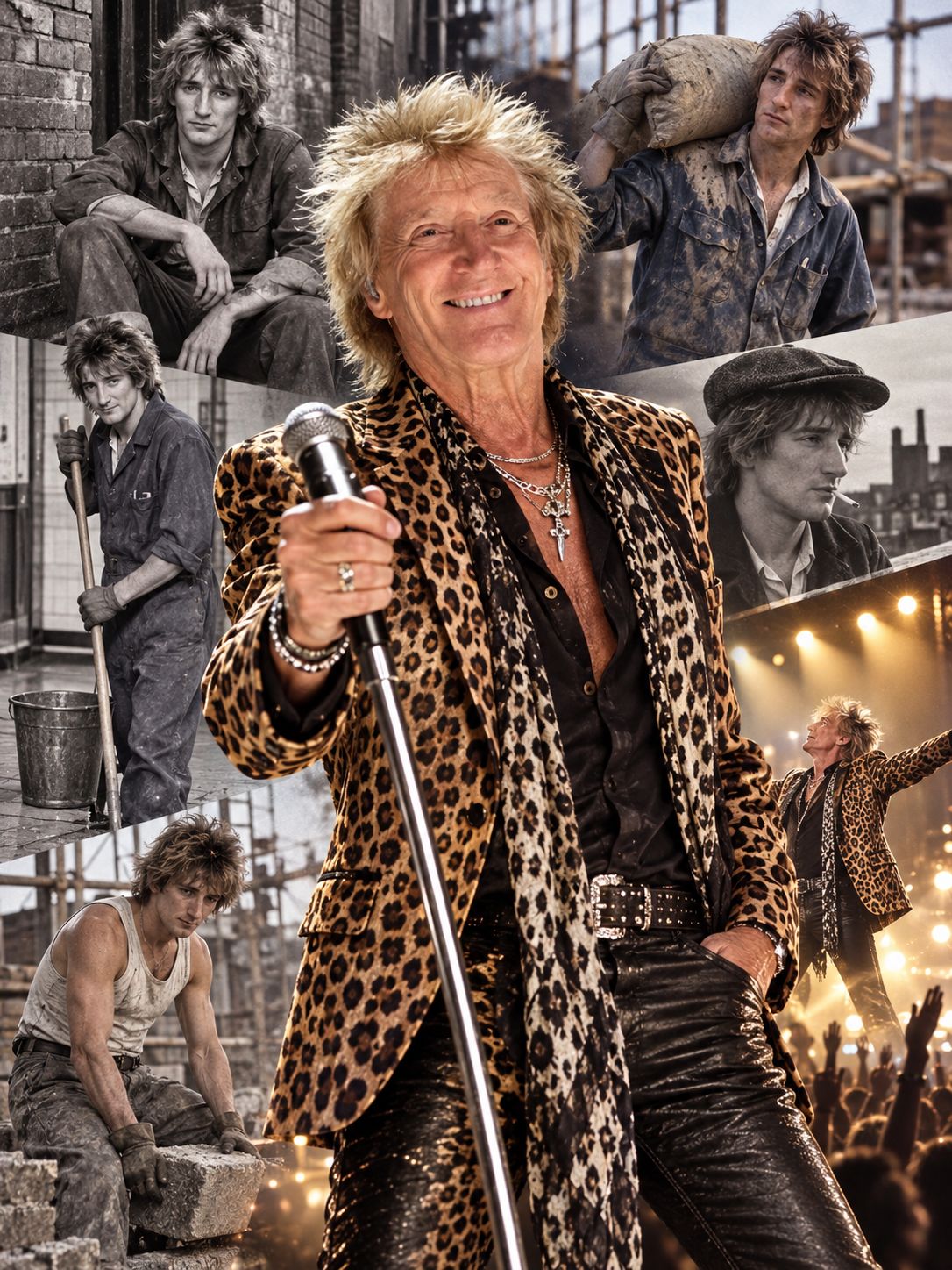
Look at Rod Stewart today and it is almost impossible to imagine him with dirt on his shoes, a few pounds in his pocket, and no guarantee that anyone would ever pay to hear him sing.
For generations, Stewart has represented one of rock-and-roll’s most extravagant images: the unmistakable blond hair, tailored jackets, luxury automobiles, spectacular homes, glamorous stages and that beautifully weathered voice capable of filling an arena before he has even finished the first line.
But strip away the mythology, and another Rod Stewart appears.
Long before the private estates and international tours, there was a teenager from North London moving from one ordinary job to another, trying football, printing, deliveries and manual labor while quietly wondering whether music might somehow provide a different future.
And buried inside those years may be the real explanation for why Rod Stewart never learned how to stop working.
THE BOY BEFORE THE ROCK STAR
Roderick David Stewart was born on January 10, 1945, in Highgate, North London, the fifth and youngest child of Robert and Elsie Stewart. His father had worked as a master builder in Scotland before the family established itself in London. Stewart would later describe his childhood warmly, and historical accounts do not portray the family as destitute. They were a working family living without the extraordinary wealth their youngest son would eventually acquire.
That distinction matters.
Rod Stewart did not rise from starvation.
But neither did he grow up expecting fame to arrive at the front door.
There was no record-company fortune waiting for him. No famous surname to open a backstage entrance. No carefully engineered path into entertainment.
There was simply a restless young man with two obsessions:
football and music.
His father bought him a guitar while Rod was still a teenager, and in 1960 the young Stewart even had a trial with Brentford Football Club. The club never called him back.
One dream closed.
Another was already making noise.

THE JOBS NOBODY PUTS ON THE ALBUM COVER
Before the microphone became his livelihood, Stewart tried the sort of jobs that have almost vanished beneath the glitter of his later image.
He worked as a silk-screen printer. He helped in the family shop. He delivered newspapers. He worked as a fence erector and sign writer.
And then there is the most famous story of all.
Rod Stewart, the gravedigger.
It sounds almost too perfect.
The future superstar, alone among the graves of Highgate Cemetery, digging into the London earth before eventually rising toward rock immortality.
There is only one problem.
It is not quite true.
Stewart himself later demolished the legend in his autobiography. His cemetery work amounted to a couple of Saturdays measuring plots and marking them with string. He openly acknowledged that the small job somehow evolved into the far more dramatic story that he had once been a professional gravedigger.
In a strange way, the truth is more interesting.
He did not spend years digging graves.
He spent his youth trying things.
And leaving them.
Printing. Deliveries. Cemetery work. Football.
Nothing seemed capable of holding him.
Except music.
THEN THAT VOICE FOUND ITS WAY OUT
Listen again to Stewart’s recordings with the Jeff Beck Group and later the Faces.
The polish of his later superstar years is not there yet.
What you hear instead is hunger.
His voice tears through the music rather than simply floating above it. It sounds cracked, impatient and gloriously imperfect — almost as though the young man singing knows there may not be another opportunity.
That voice eventually became impossible to ignore.
By the early 1970s, “Maggie May” had transformed Stewart from an admired British musician into an international star. The man who had once bounced between small jobs suddenly possessed one of the most recognizable voices on the planet.
The transformation was extraordinary.
But perhaps the teenager never entirely disappeared.