Introduction
The Farewell That Refused to End: How 104,793 Voices Turned George Strait’s Last Ride Into Country Music History
Some farewell concerts are remembered because an artist finally walks away. George Strait’s final touring performance became unforgettable for the opposite reason: it proved that a musical legacy could continue growing even after the road appeared to end. On June 7, 2014, 104,793 people filled AT&T Stadium in Arlington, Texas, for the concluding performance of The Cowboy Rides Away Tour. They arrived expecting to witness the closing of one of country music’s greatest chapters. By the time the final song faded, however, it was clear that they had not gathered merely to say goodbye. They had come to confirm that Strait’s music belonged to something larger than touring schedules, record sales, and even the man standing beneath the lights.
The number itself remains astonishing. 104,793 fans packed the stadium, creating what was then recognized as the largest indoor concert audience in North American history and breaking a record that had stood for more than three decades. AT&T Stadium had hosted major football games, championship events, and international spectacles, yet the sight of nearly 105,000 people assembling for one quietly commanding country singer carried a different kind of significance. Strait did not reach that stage through controversy, elaborate reinvention, or theatrical excess. He reached it through decades of consistency, carefully selected songs, disciplined performances, and the trust of listeners who believed every word he sang.
When Strait announced The Cowboy Rides Away Tour, he was not declaring an end to recording or promising that he would never perform again. He was stepping away from the demanding cycle of traditional touring that had shaped much of his professional life. The tour was presented as a two-year farewell to life on the road, allowing audiences across the country one more opportunity to see him in the familiar setting where his reputation had been built. The distinction was important, but emotions rarely obey technical explanations. For many admirers, the Arlington finale still felt like the last chance to see the King of Country at the center of a full touring production.
The evening carried the scale of a national celebration while preserving the emotional character of a Texas homecoming. Strait was joined by an extraordinary gathering of friends and fellow performers, including Alan Jackson, Vince Gill, Faith Hill, Martina McBride, Kenny Chesney, Sheryl Crow, Jason Aldean, and others who represented different periods of country music. Each guest added another layer to the evening, but none attempted to turn the event into a competition for attention. Their presence communicated something more respectful: the country music community had assembled to honor the man whose calm example had influenced careers, protected traditions, and demonstrated that dignity could remain powerful in an increasingly noisy industry.
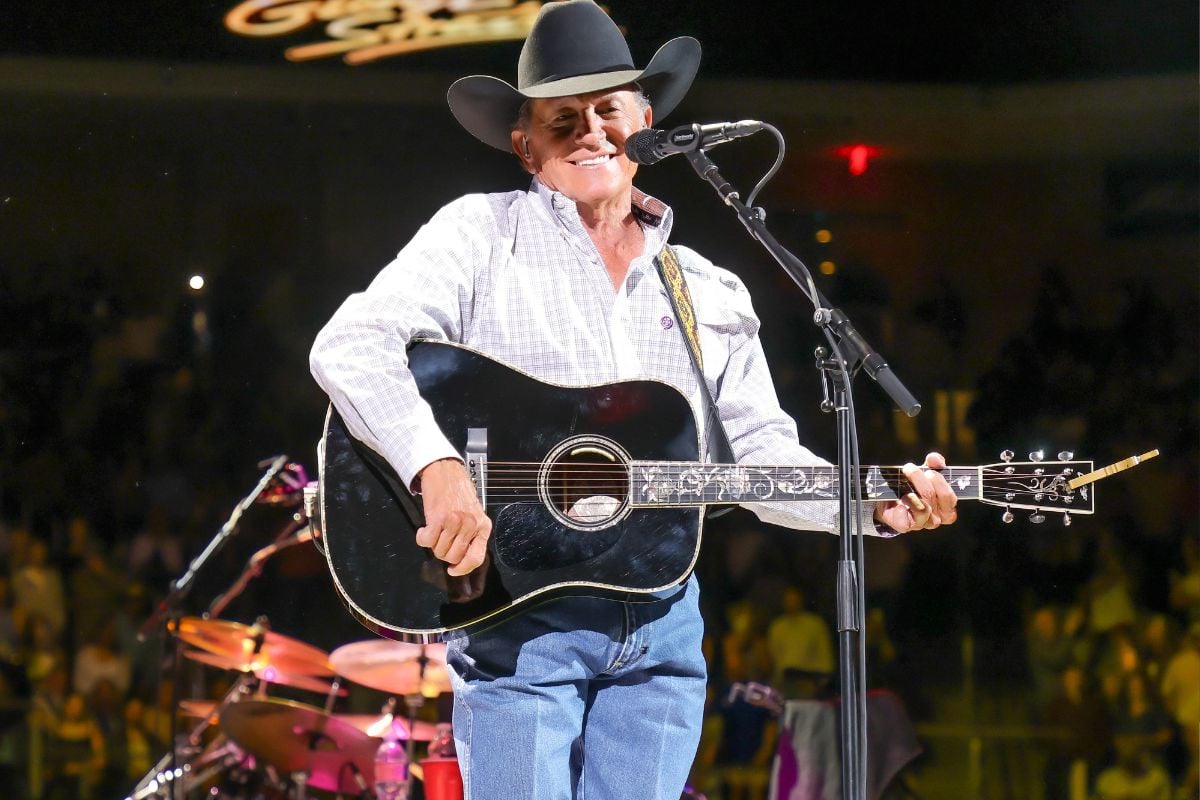
At the center of it all was George Strait, dressed and performing much as he always had. There was no need for a dramatic transformation because the familiar image was precisely what the audience had come to see. The cowboy hat, pressed shirt, guitar, and measured walk toward the microphone had become part of country music’s visual language. Strait’s stagecraft had always depended on restraint. He understood that when a singer has songs as lasting as “Amarillo by Morning,” “The Chair,” “Check Yes or No,” “Troubadour,” and “Love Without End, Amen,” the wisest choice is often to stand still and allow the stories to carry the room.
That restraint gave the concert its emotional power. Every familiar introduction seemed to open a door into someone’s past. One song could return a listener to a first dance, another to a long highway journey, and another to a family member who was no longer present. The audience was not simply revisiting Strait’s catalog; it was revisiting its own collective history. Men and women who had discovered his music as young adults were now attending with grown children and grandchildren. The stadium therefore contained more than 104,000 individuals. It contained several generations of memories joined by one unmistakable voice.
The title song, “The Cowboy Rides Away,” had always carried the sadness of departure. On this night, however, it acquired a meaning that no studio recording could completely contain. The performance marked the end of the tour, but the audience’s response transformed the expected farewell into a declaration of permanence. The applause was not merely gratitude for a successful show. It was the sound of thousands of people refusing to treat Strait’s career as something that could be neatly closed when the lights went dark.
There was a beautiful contradiction at the heart of the evening. Strait had promised a last ride, yet the size and devotion of the crowd demonstrated that his influence was still expanding. A farewell is supposed to make the world feel smaller, but this concert revealed how enormous his musical community had become. A final tour is supposed to bring a career toward silence, yet the Arlington audience made his songs sound more alive than ever. The cowboy could leave the road, but the road could not remove him from the lives of those who had traveled beside his music.
The concert also revealed why Strait’s career had endured while styles around him changed. He never treated tradition as a museum exhibit. His music remained rooted in fiddle, steel guitar, western swing, honky-tonk clarity, and direct storytelling, but those elements were presented as living forms rather than historical decorations. He understood that country music does not need to sound old-fashioned to respect its past. It needs believable voices, memorable melodies, and stories that recognize the quiet victories and disappointments of ordinary life.
After 2014, Strait proved that leaving traditional touring did not mean disappearing. He returned for carefully selected engagements, including the Strait to Vegas concert series, which began at T-Mobile Arena in 2016, as well as later one-off appearances in major cities. These performances confirmed what many fans had sensed in Arlington: the final tour had closed one chapter, but the larger story remained unfinished. Strait had earned the freedom to perform on his own terms, without returning to the relentless touring schedule he had left behind.
That is why the Arlington finale now feels less like an ending and more like a beginning. It marked the moment when Strait’s public identity moved beyond that of a constantly touring superstar and entered the realm of permanent cultural figure. He no longer needed to appear in every city to maintain his connection with listeners. The songs were already present in homes, trucks, dance halls, churches, and family collections across America. His absence from the touring circuit only made each future appearance feel more valuable.
George Strait did ride away that night, at least from the life of continuous touring he had known for decades. But 104,793 voices followed him into the darkness, carrying the melodies forward long after the stadium had emptied. The crowd arrived believing it would witness the conclusion of an era. Instead, it witnessed the moment a touring career became a timeless inheritance.
The farewell did not diminish the King of Country. It revealed the true scale of his kingdom. One cowboy left the stage, but generations of listeners continued singing, remembering, and passing the songs onward. “The Cowboy Rides Away” was supposed to close the story. In Arlington, it became the promise that George Strait’s music had only begun its longest journey.