Introduction
WHEN ELVIS LAID DOWN THE CROWN: The Memphis Prayer That Revealed the Man Behind the King
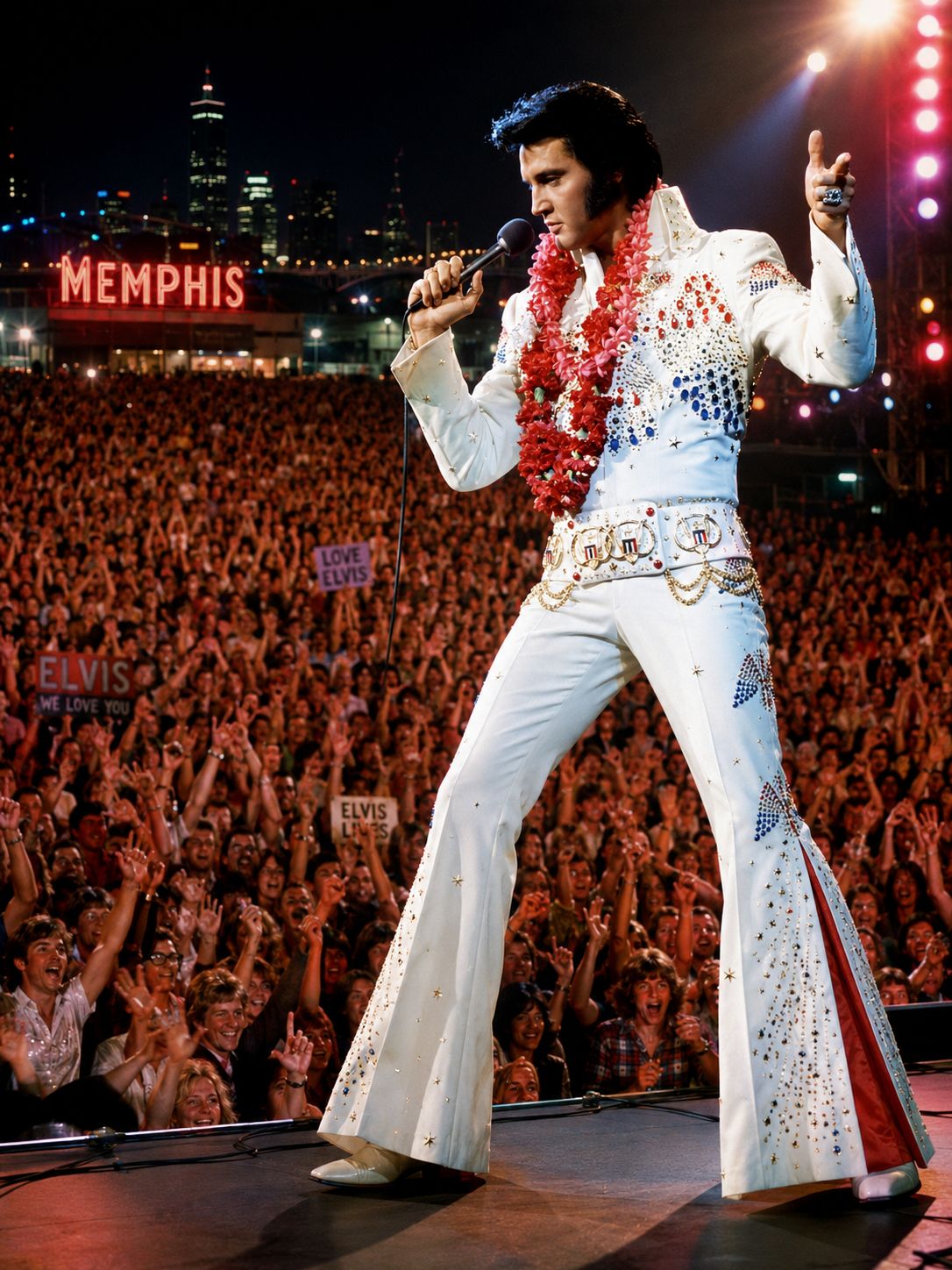
There are performances remembered for their dazzling entrances, dramatic costumes, and the deafening reaction of a crowd. Then there are rarer moments when spectacle seems to fall away and a famous performer suddenly appears strikingly human. During Elvis Presley’s historic 1974 return to the concert stage in Memphis, “Why Me Lord” created precisely that kind of atmosphere. The man celebrated throughout the world as the King of Rock ’n’ Roll stood inside the Mid-South Coliseum surrounded by gifted musicians and gospel singers, yet the emotional center of the performance felt less like a royal appearance and more like a humble appeal for grace.
The recording came from Elvis’s March 20, 1974 concert at the Mid-South Coliseum in Memphis, the city where his remarkable musical journey had begun. He had not performed a Memphis concert since 1961, making the homecoming especially meaningful to the singer and his longtime admirers. Elvis reportedly explained that he wanted to record a live performance in his hometown because Memphis was where everything had started for him. The resulting concert became Elvis Recorded Live on Stage in Memphis, an album that preserved the excitement, humor, musical power, and spiritual intensity of that important evening.
“Why Me Lord” was written by Kris Kristofferson and had already become a widely recognized country-gospel song before Elvis incorporated it into his live performances. At the Memphis concert, Elvis did not present the number as a conventional solo showcase. The deep-voiced J. D. Sumner carried the verses, while Elvis joined him and the supporting singers during the choruses, creating a communal gospel performance rather than a solitary declaration. That distinction makes the moment more compelling, because Elvis willingly stepped away from the center of attention and allowed another voice to lead a song he deeply admired.
For an entertainer whose name had become synonymous with extraordinary fame, such restraint carried considerable meaning. Elvis was accustomed to being the figure every spotlight followed, the man whose slightest movement could produce an enormous reaction. Yet during this gospel section, he appeared less interested in maintaining his public mythology than in becoming part of the musical testimony surrounding him. He listened, responded, and entered the chorus as one voice among many, creating the impression that the celebrated star was briefly setting aside his crown to participate in something larger than himself.

The emotional force of “Why Me Lord” comes from its central question: why should an imperfect person receive mercy, companionship, or another chance? It is a song shaped by humility rather than certainty, and by gratitude mixed with an awareness of human failure. When Elvis joined the chorus in Memphis, listeners could easily hear the words through the history they already knew—the astonishing rise from poverty, the international adoration, the relentless expectations, and the isolation that can accompany a life observed by millions. We cannot know precisely what Elvis was thinking, but the performance invites the listener to hear the song as a meditation on burdens that applause could never remove.
That interpretation becomes even more powerful because gospel music was not a decorative addition to Elvis’s career. It was one of the deepest and most enduring influences in his musical life. Even after rock and roll made him an international phenomenon, spiritual songs remained a place where he could concentrate on harmony, emotional surrender, and the voices of singers he had admired long before fame arrived. The Memphis concert placed “Why Me Lord” beside “How Great Thou Art” and “Help Me,” giving the performance a substantial gospel passage within an otherwise wide-ranging popular show.
The musicians surrounding Elvis were essential to the atmosphere. James Burton and John Wilkinson played guitar, Glen D. Hardin was at the piano, Ronnie Tutt handled the drums, and the vocal ensemble included The Sweet Inspirations, J. D. Sumner and the Stamps, Kathy Westmoreland, and Charlie Hodge. Joe Guercio’s orchestra added scale, but the heart of “Why Me Lord” remained the relationship between the lead voice, the answering chorus, and the silence into which each phrase seemed to fall. The arrangement gave Elvis room to respond rather than dominate, revealing his respect for the Southern gospel tradition and for the singers who embodied it.
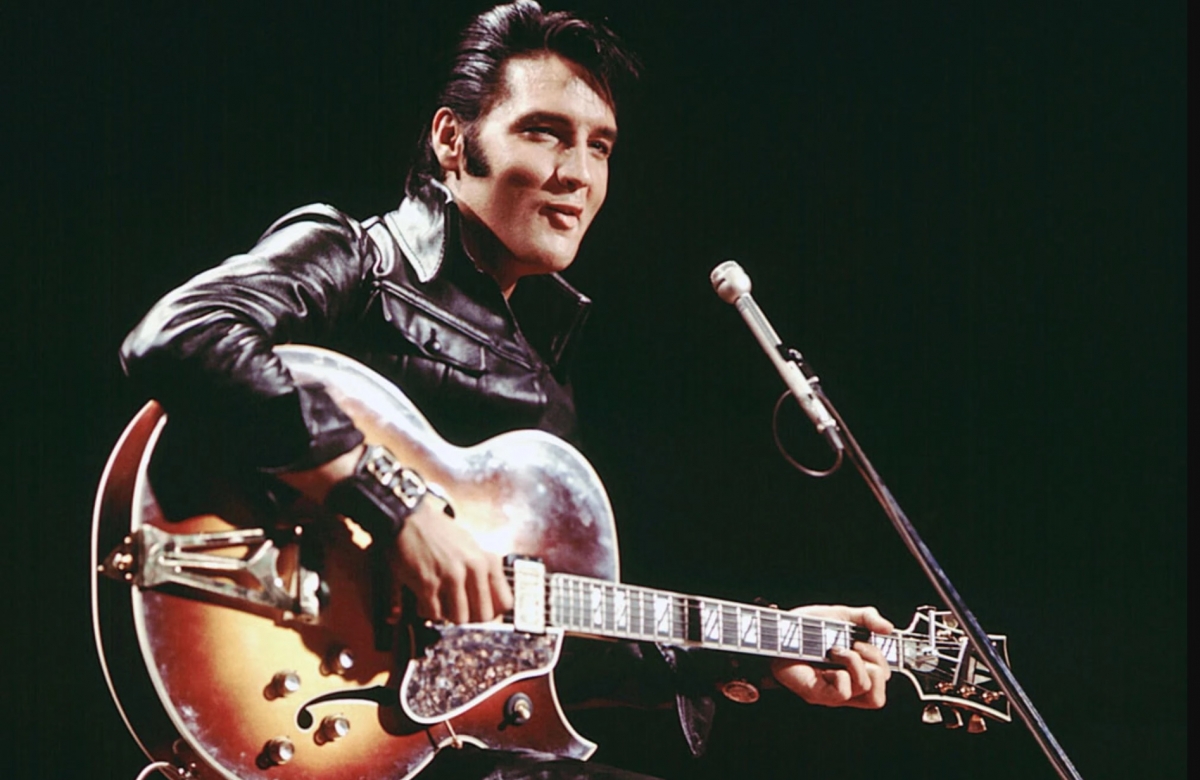
For older listeners, the song may resonate because its question becomes more profound as the years pass. Youth often imagines that achievement will provide answers, but maturity teaches that success cannot protect anyone from regret, grief, uncertainty, or the awareness of time. A person may receive recognition beyond anything once imagined and still wonder whether the most important parts of life have been understood correctly. “Why Me Lord” gives language to that quiet reckoning without pretending that every doubt can be neatly resolved.
Elvis’s public identity was built partly upon grandeur. The jeweled stage clothes, dramatic introductions, devoted crowds, and legendary title all helped create an image larger than ordinary life. Yet the most enduring Elvis performances frequently reveal the tension between that image and the sensitive musician beneath it. On “Why Me Lord,” the strength of his presence comes not from asserting power but from accepting humility, joining the chorus and allowing the song’s unanswered question to remain unanswered.
There is something especially poignant about hearing this performance in Memphis, where the young Elvis had first entered Sun Studio and helped ignite a cultural transformation. The city represented origins, family memories, musical discovery, and the beginning of a journey that would carry him far beyond anything he could have anticipated. Returning there as a global icon might easily have produced a concert devoted entirely to triumph. Instead, the recorded program made room for songs about dependence, faith, human limitation, and the need for guidance.
The album itself became another important chapter in Elvis’s gospel legacy. Its performance of “How Great Thou Art” earned him his third Grammy Award, and all three of the Grammys he received during his lifetime were connected to inspirational or gospel recordings. That history reminds us that although the world called him the King of Rock ’n’ Roll, some of his most formally honored work came from the spiritual music he had loved since his earliest years.
What makes “Why Me Lord” so haunting is not that Elvis openly explained his private struggles before the audience. He did not deliver a long confession, nor did he announce that the song represented every hidden concern in his life. The power lies in what the performance leaves unspoken. A familiar public figure enters a song about mercy, and the listener naturally senses the distance between the man everyone believed they knew and the private individual living behind the famous name.
In that sense, the performance becomes more than a piece of concert history. It represents the moment when celebrity, memory, and spiritual longing briefly occupied the same stage. The crowd had come to see the commanding entertainer who could turn a room electric with a movement or a familiar opening phrase. During “Why Me Lord,” however, they encountered a different kind of strength—the courage to step back, listen, and join a prayer whose deepest question possessed no easy answer.
Elvis did not stop being the King that night, but for several unforgettable minutes, the title seemed unimportant. The glitter remained, the audience remained, and the famous voice was still unmistakable, yet the emotional meaning had changed. He was no longer simply the untouchable figure at the center of a legend. He sounded like a man standing among other voices, grateful for what he had received and searching for peace beyond the reach of fame.
That is why the Memphis recording still moves listeners decades later. “Why Me Lord” does not erase the contradictions of Elvis Presley’s life, and it does not offer a simple explanation for the burdens he carried. It gives us something more honest: a brief glimpse of vulnerability inside an enormous public image. Beneath the lights, the applause, and the crown, there remained a human voice asking one of life’s oldest questions—and hoping that somewhere beyond the noise, an answer might still be heard.