Introduction
THE VEGAS STORY THAT COLLAPSED UNDER THE FACTS—AND THE REAL INJUSTICE IT COULD NOT HIDE
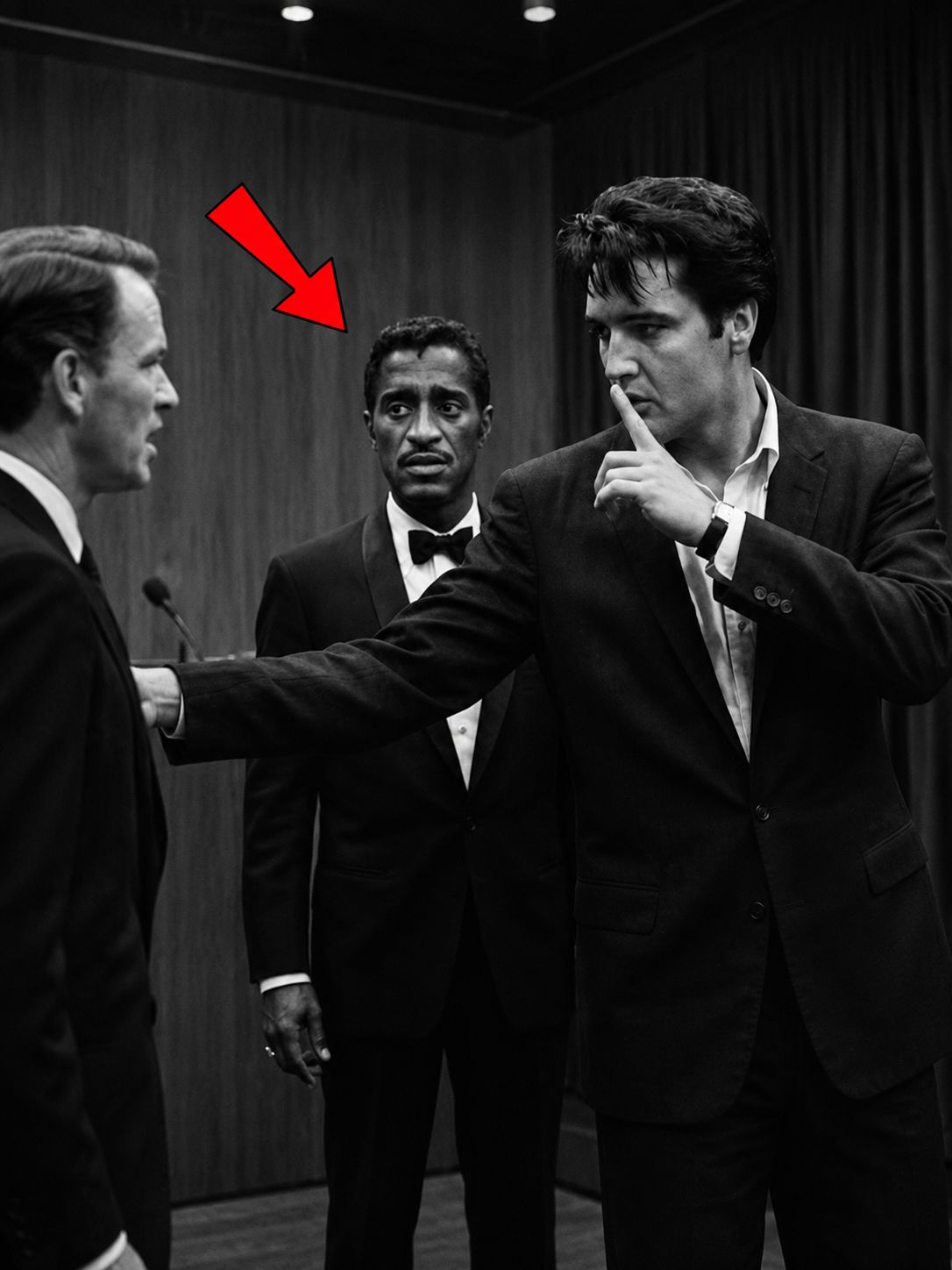
It is the kind of story built to travel quickly. A crowded Las Vegas lounge falls silent after a wealthy casino owner directs a vicious racial insult at Sammy Davis Jr. Frank Sinatra prepares to intervene, Dean Martin puts down his glass, and then Elvis Presley rises from the corner, places himself between Sammy and the offender, and delivers a quiet defense so powerful that no one in the room can answer him. In less than a minute, the young singer supposedly exposes the cruelty hidden beneath the glamour of the Strip and reveals a moral courage the public had rarely seen.
There is only one serious problem: the specific confrontation cannot be verified.
No dependable contemporary newspaper report, casino record, biography, or established Elvis archive appears to document the alleged incident. The date and career details also conflict with the known historical timeline. Elvis’s engagement at the New Frontier took place in the spring of 1956, not March 1960, and his celebrated return to regular live performance in Las Vegas did not begin until July 1969 at the International Hotel. The dramatic story now circulating online appears largely in recently published social-media posts and videos that repeat nearly identical wording without supplying original evidence.
Yet dismissing the account as unverified should not lead us to dismiss the history that made it seem believable. The invented scene gains its emotional force from an injustice that was unquestionably real. Behind the glowing marquees, elegant supper clubs, famous comedians, and orchestras, Las Vegas remained deeply segregated during much of Sammy Davis Jr.’s rise. Black performers could bring enormous profits to hotel showrooms while still being denied the basic treatment routinely granted to white guests.

Black entertainers were often required to enter through kitchens or service areas, and many could not stay in the resorts where they performed. They appeared before well-dressed audiences, received enthusiastic applause, and then crossed town to find lodging in the Black community. UNLV’s historical research describes this contradiction plainly and notes that Black residents and performers were central to the struggle that led Las Vegas public accommodations toward integration in March 1960.
Few artists embodied that contradiction more painfully than Sammy Davis Jr. He was a singer, dancer, actor, impressionist, and stage personality capable of commanding nearly any room he entered. His talent made him indispensable to the entertainment industry, but talent did not protect him from humiliation. He could stand beneath the brightest lights in the city and still be reminded that the social system surrounding those lights did not regard him as equal.
That is why the viral story’s most disturbing image is not the imaginary casino owner. It is Sammy standing momentarily speechless after the insult. The scene recognizes something historically true about racism: repeated exposure does not make cruelty harmless. Accomplishment does not create immunity. A performer may learn how to remain composed before an audience, but professionalism should never be mistaken for an absence of pain.
The real Sammy Davis Jr. was not merely a passive victim waiting for a famous white entertainer to defend him. He was an important advocate whose work reached beyond the showroom. UNLV historians identify him as one of the entertainers most closely connected to the campaign for fairness in Las Vegas, explaining that he assisted local civil-rights efforts and supported community activism without always seeking publicity for himself. His presence challenged the city because the casinos wanted the income and prestige he generated while resisting the equality his success demanded.
Frank Sinatra also played a documented part in resisting the treatment Sammy received. Historical accounts indicate that Sinatra pressured the Sands to allow Sammy to stay at the hotel during the 1950s. That intervention mattered, but scholars caution against reducing the desegregation of the Strip to one celebrity’s ultimatum. The larger transformation came through pressure from Black residents, activists, workers, and entertainers, whose sustained efforts forced the city to reconsider its practices.
This distinction is essential because the most honest version of the story should not transform Sammy into a supporting character in someone else’s moral triumph. The real courage belonged first to the people who endured the system, confronted it, and continued performing with excellence while demanding that the city recognize their humanity.
Where, then, does Elvis Presley belong in this history?
Elvis emerged from a Southern musical environment in which country, gospel, blues, rhythm and blues, and popular music existed in constant conversation. Smithsonian historians have emphasized that his sound reflected both Black and white gospel traditions, blues, country music, and the broader musical culture he encountered while growing up in Mississippi and Memphis. His national success also took place within an industry that often gave white artists access to audiences and commercial opportunities denied to the Black musicians whose work helped shape American popular music.
Acknowledging that unequal system does not require denying Elvis’s talent. It requires understanding the complicated cultural world in which his talent was rewarded. Elvis possessed a distinctive voice, charisma, instinct, and an extraordinary ability to combine influences. At the same time, the music that formed him came from communities whose creators did not always receive comparable recognition, payment, or freedom.
There is evidence that Elvis and Sammy moved within the same entertainment world and shared moments of public warmth. Sammy attended Elvis’s 1969 Las Vegas opening, and a later recollection from one of Elvis’s backing singers described Elvis removing a ring and giving it to Sammy from the stage. Such stories offer a more credible glimpse of mutual regard than the dramatic confrontation attributed to March 1960.
Elvis’s career also suggests that he felt genuine respect for many Black musicians. His repertoire drew from performers and songwriters whose contributions shaped blues, gospel, rhythm and blues, and early rock and roll. But respect between individual artists did not automatically dismantle the system surrounding them. A singer could admire Black music while still benefiting from an industry divided by race. A casino could celebrate Sammy onstage while discriminating against Black patrons and employees elsewhere in the same building.
The circulating story simplifies all of this into a perfect sixty-second scene. One cruel man speaks. One beloved star stands. One powerful response defeats prejudice. It is emotionally satisfying because it gives injustice a clear beginning and an immediate ending.
History rarely offers such convenient resolutions.
Racial discrimination in Las Vegas was not created by one offensive casino owner, and it was not ended by one speech. It was embedded in hotel rules, housing patterns, employment practices, entrances, dining rooms, reservation policies, and assumptions about who was permitted to belong. Its defeat required more than a celebrity confrontation. It required organization, economic pressure, political negotiation, community leadership, and the persistence of people who refused to accept permanent exclusion.
Still, the imagined moment reveals something meaningful about the stories audiences wish were true. People want to believe that someone with influence would have stood beside Sammy. They want Elvis to recognize the insult immediately, set down his drink, and refuse to remain silent. They want the powerful people in the room to understand that neutrality would make them participants in the humiliation.
That desire is understandable. Silence in the face of cruelty has never been empty. It protects the person causing harm while leaving the target isolated. The imagined Elvis becomes compelling because he does what every witness should do: he recognizes that the dignity of another human being is more important than comfort, status, or access to powerful circles.
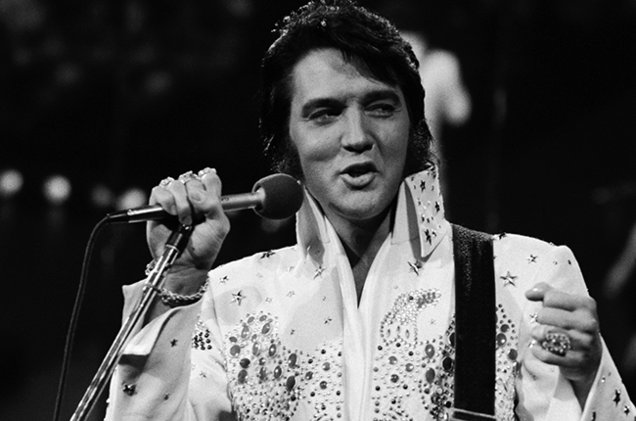

But the strongest lesson does not depend upon pretending the incident happened. It comes from examining why such a confrontation was needed in the first place. Sammy Davis Jr. should never have required rescue in order to enter a hotel, eat in a restaurant, or rest in the building where his talent earned money for others. His extraordinary ability did not make him deserving of equal treatment; he deserved equality because he was human.
For older readers who remember the era, the subject may carry an especially sobering weight. The photographs often show immaculate tuxedos, polished tables, smiling celebrities, and rooms designed to communicate effortless sophistication. The discrimination remained largely outside the carefully framed image. The public saw the show, but not always the separate entrance. They heard the applause, but not the rules enforced after the curtain closed.
That contrast is the real story worth remembering.
The viral account may not survive serious historical examination, but Sammy Davis Jr.’s courage does. So does the work of the Black Las Vegas community that challenged segregation. So does the uncomfortable reality that the entertainment capital of the world depended upon Black brilliance while resisting Black equality.
Elvis Presley does not need an invented speech to remain an important and complex figure in American music. Sammy Davis Jr. does not need to be defended by Elvis in a fictional lounge to prove his dignity. The truth is already powerful enough.
Behind the Sands Hotel’s glittering façade stood a city being forced to confront its own hypocrisy. Onstage, Sammy Davis Jr. helped define American entertainment. Beyond the spotlight, he and countless others pushed for the right to enter through the same doors as the audiences who applauded them.
The imaginary room fell silent for sixty seconds. The real struggle lasted for decades—and it was Sammy, not the legend built around Elvis, who stood at its center.