Introduction
BEFORE THE WORLD CALLED HIM KING, GLADYS CALLED HIM SON: The Promise Elvis Spent His Life Trying to Keep
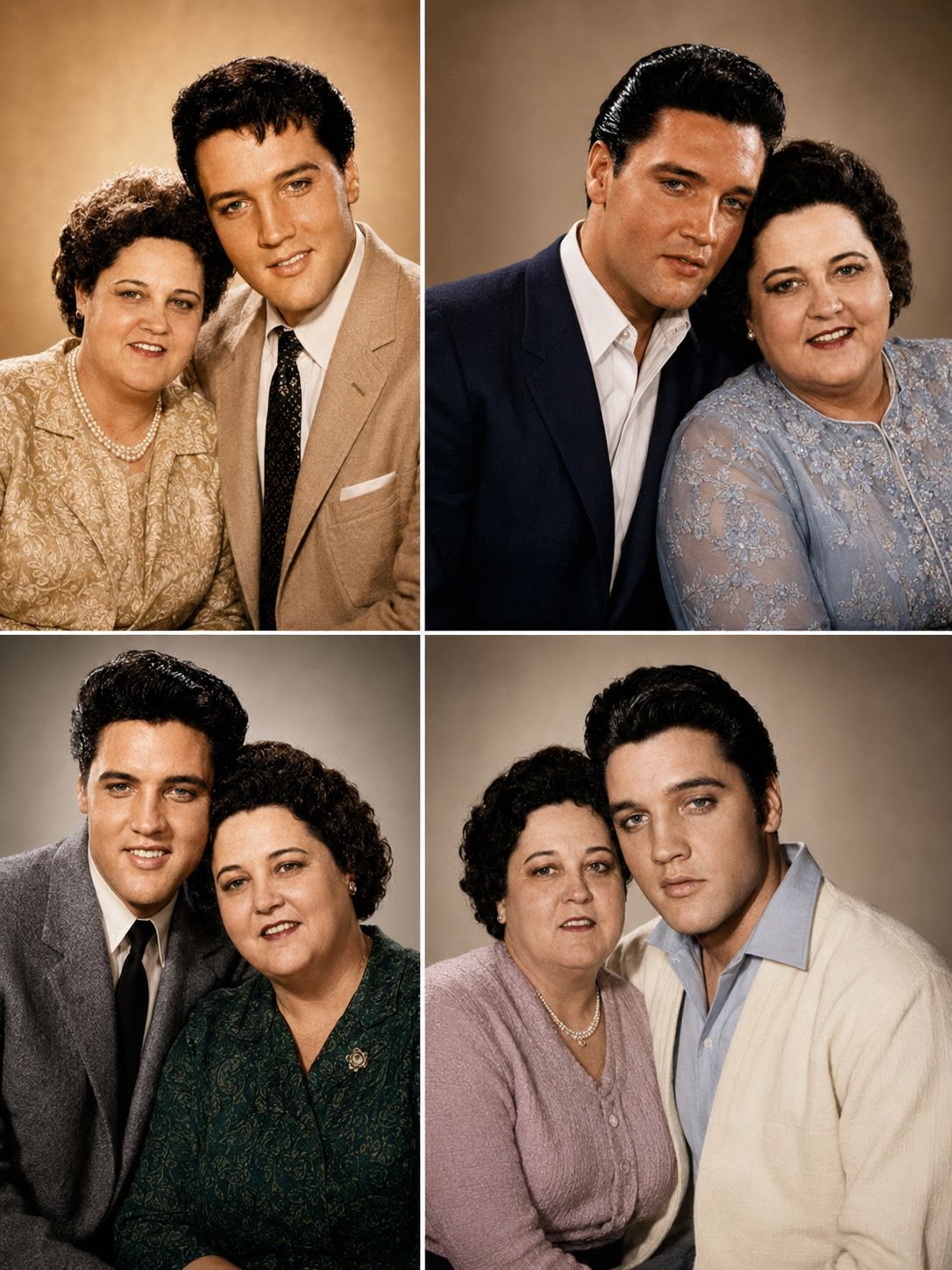
Long before the gold records, the movie premieres, and the crowds calling his name, Elvis Presley was simply a devoted son growing up in a family that possessed little money but an abundance of loyalty. Before journalists attempted to explain his extraordinary appeal and before audiences began treating him as someone larger than life, there was Gladys Presley, the mother who knew the shy, uncertain boy behind the future legend. She had witnessed his earliest dreams, understood his deepest insecurities, and encouraged him during the years when success was not a certainty but a distant possibility.
For Elvis, making his mother proud was never a small part of the journey. It was one of the forces that gave the journey meaning.
Elvis was born to Gladys and Vernon Presley in a modest two-room house in Tupelo, Mississippi, on January 8, 1935. His twin brother, Jessie, was stillborn, leaving Elvis to grow up as their only surviving child. The Presley family endured serious financial hardship, moving between homes and depending upon whatever work was available. Gladys became fiercely protective of her son, while childhood friends later remembered her as a warm but watchful mother who welcomed young people into the family home while making certain they stayed out of trouble.
Those difficult beginnings shaped the bond between them. Gladys was not watching her son from the comfortable distance of wealth or social privilege. She was beside him through uncertainty. She worked to help support the family, including taking jobs after the Presleys moved to Memphis in 1948. Elvis also worked during his teenage years, contributing while attending Humes High School and quietly developing the musical identity that would eventually change American culture.
Music entered their relationship early. When Elvis wanted a bicycle as a child, his parents could not afford it, so Gladys persuaded him to accept a guitar instead. The instrument cost $12.95, an ordinary purchase that became one of the most consequential gifts in popular-music history. The guitar gave the young Elvis a private place to experiment, imitate the sounds he heard around him, and gradually discover the voice that no one else yet recognized.

That story carries a gentle irony. Gladys could not give her son everything he wanted, but what she was able to give him proved far more important. The bicycle might have carried Elvis through the streets of Tupelo for several years. The guitar helped carry him into history.
In 1953, shortly after graduating from high school, Elvis entered the Memphis Recording Service and paid approximately four dollars to record “My Happiness” and “That’s When Your Heartaches Begin.” The official Graceland chronology describes the acetate as a birthday gift for Gladys. At that moment, Elvis was not recording for an international audience. He was making something personal for the woman whose approval mattered most.
It is tempting to view that modest recording only as the first step toward Sun Records, RCA, and worldwide fame. Yet its emotional meaning is equally important. Before music became his profession, it was already an expression of gratitude. The first private audience for the voice that would eventually reach millions was his mother.
When Elvis’s career began accelerating in 1954 and 1955, the transformation was astonishing. Regional appearances became national attention. His Sun Records contract was sold to RCA, and “Heartbreak Hotel” became a major success in 1956. Television appearances introduced him to audiences across the United States, while his combination of country, gospel, rhythm and blues, and popular music challenged familiar boundaries. By the age of twenty-one, the quiet Memphis teenager had become one of the most discussed entertainers in America.
The public saw the excitement. Gladys remembered everything that had come before it.
She knew the rented rooms, the uncertain employment, the worn belongings, and the years when a few dollars could make a meaningful difference. She had watched Elvis experiment with his appearance and musical interests while other people regarded him as strange. She understood the courage required for a sensitive young man to stand before strangers and offer them something he could not yet fully explain.
That history gave every achievement another meaning. A successful record was not merely a commercial victory. A new home was not simply a demonstration of wealth. Each accomplishment represented Elvis’s attempt to provide security for the family that had protected him when security seemed impossible.

In 1956, Elvis purchased a home on Audubon Drive in Memphis for himself and his parents. The following year, as his fame grew and the property attracted increasing attention from admirers, the family searched for a more private residence. Gladys and Vernon toured Graceland in March 1957 and immediately recognized it as the home they wanted. Elvis completed the purchase for $102,500, buying the mansion for himself, his parents, and his paternal grandmother.
To the outside world, Graceland eventually became a symbol of Elvis’s spectacular success. To the Presley family, it was something more intimate: evidence that the years of hardship had not been forgotten.
Elvis was only twenty-two when he bought it. He was filming, recording, traveling, and living under a level of public scrutiny few young people could have understood. Yet one of the most significant uses of his new wealth was giving his mother and father a permanent home. Vernon, Gladys, and Elvis’s grandmother moved into Graceland in May 1957 while Elvis was away working.
One can imagine the quiet satisfaction behind that moment. The family that had once moved in search of work now stood inside a home that seemed almost unimaginable compared with their beginnings. The boy who had watched his parents struggle could finally tell them, without needing a grand speech, that their sacrifices had been seen.
Gladys did not view Elvis merely as a celebrity. She continued to see her son.
That distinction mattered because fame was beginning to separate Elvis from ordinary life. The public image grew rapidly: the hairstyle, the clothes, the television controversy, the screaming audiences, and the title that would eventually follow him everywhere. Gladys remained connected to the part of him that existed before all of it. She represented home, memory, and the emotional world from which his ambition had emerged.
The official Graceland tribute to Gladys describes Elvis as wanting to give his mother a better life after everything she had given him. It also emphasizes that her influence continued through his love of family, music, generosity, and community. The qualities audiences often admired in Elvis—his politeness, gratitude, and desire to give—were connected to lessons learned within the family.
This helps explain why his success felt so personal. Elvis Presley was not simply escaping poverty for himself. He was carrying his family with him.
He could buy expensive automobiles, perform before enormous crowds, and appear on national television, but the emotional reward may have been found in smaller moments: seeing Gladys inside the home he had provided, watching her reaction to another achievement, or hearing pride in her voice after years when the future had offered no promises.
The phrase “We did it” was not recorded as a documented declaration between them, but it captures the spirit of their journey. Elvis’s accomplishments belonged to him, yet they also carried the labor, faith, and sacrifice of the mother who had stood beside him before the applause began.
Tragically, Gladys had little time to enjoy the security her son worked so hard to provide. She died in August 1958, while Elvis was serving in the United States Army. Graceland’s official remembrance states simply that her death broke her son’s heart. She had lived at the mansion for little more than a year, but her presence remained inseparable from Elvis’s understanding of home.
After her death, the world still had Elvis Presley. The recordings continued, the films arrived, and the concerts eventually grew larger than ever. But the woman who had known him before history claimed him was gone.
That loss gives the early photographs of Elvis and Gladys their enduring power. We do not merely see a famous performer beside his mother. We see two people who had traveled an extraordinary distance together. Behind them were poverty, hard work, uncertainty, and the memory of a two-room house. Ahead of Elvis were triumphs Gladys would never witness.
Perhaps that is why the story continues to touch older readers so deeply. Many understand that the greatest success is not always measured by public recognition. Sometimes it is the moment when a parent sees that the child they protected has found a place in the world. Sometimes it is the opportunity to repay love that was given without any guarantee of reward.
The world remembers Elvis Presley as the King of Rock ’n’ Roll. Gladys remembered the boy with the inexpensive guitar, the uncertain future, and the determination to make life better for the people he loved.
Before the mansions and the medals, before the legendary concerts and the permanent place in music history, Elvis had already discovered the achievement that mattered most: he had given his mother a reason to look at him with pride—and in his heart, every victory remained something they had reached together.