Introduction
THE DAY ELVIS’S MARRIAGE ENDED—AND THE SONG THAT MADE HIS PRIVATE HEARTBREAK IMPOSSIBLE TO HIDE
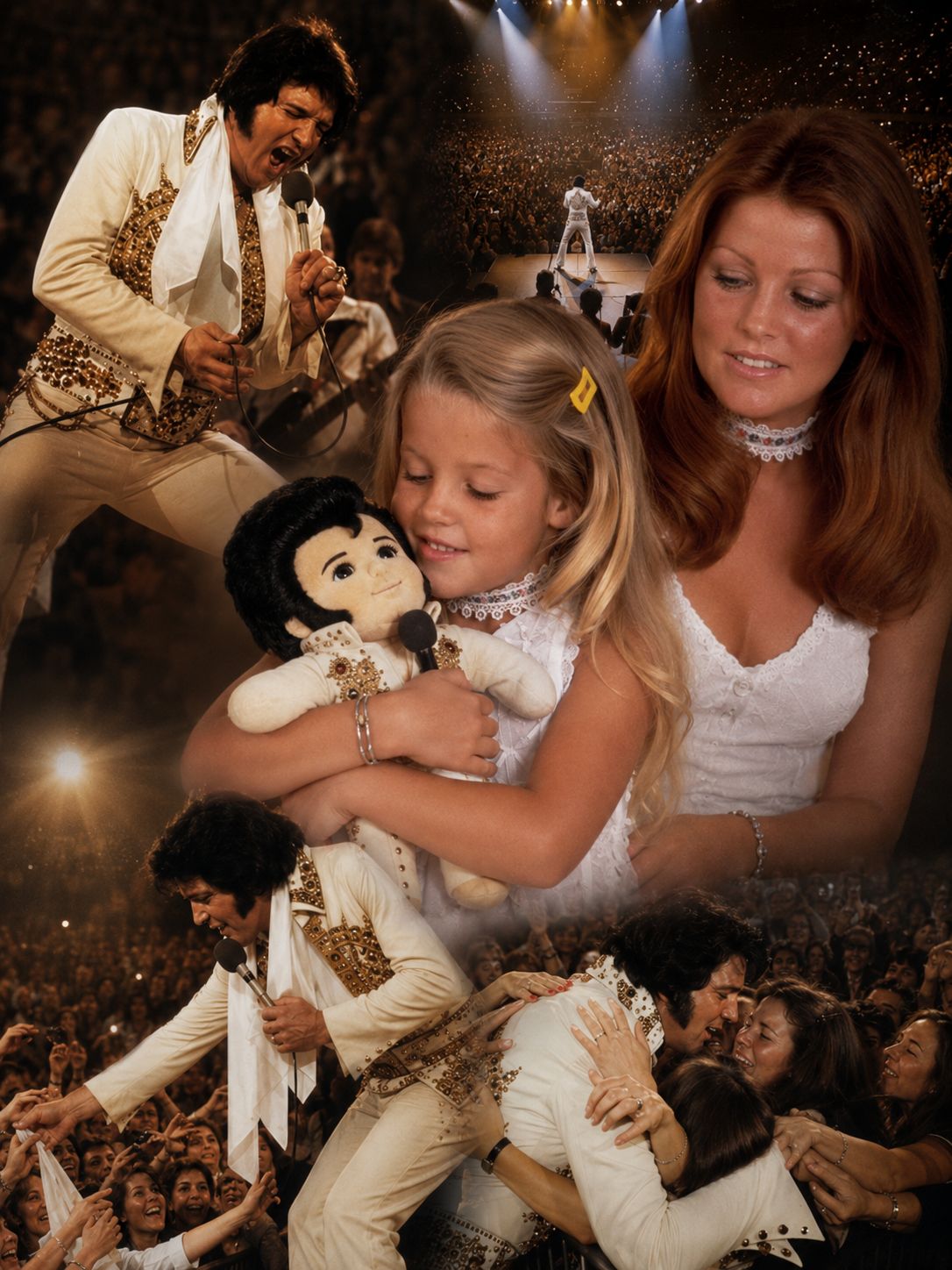
There are performances remembered because the singer reached an extraordinary note, commanded a magnificent stage, or received an ovation that seemed capable of shaking the building. Then there are performances that survive for a more unsettling reason: the audience senses that the artist is no longer merely interpreting a song. The words appear to have entered his private life, and every note seems to carry a burden that cannot be hidden behind professional polish. Few recordings illustrate that transformation more powerfully than Elvis Presley singing “You Gave Me a Mountain.”
For generations, Elvis has been remembered as the King of Rock and Roll, the young man whose arrival changed the sound, appearance, and emotional temperature of popular entertainment. His early records possessed an urgency that made teenagers feel they were hearing the future, while his later ballads revealed a voice capable of remarkable tenderness, faith, loneliness, and regret. Audiences saw the famous suits, the brilliant stage lights, the devoted crowds, and the extraordinary confidence of a performer who appeared completely at home before thousands of people. What they could not always see was the sensitive and increasingly burdened man living behind the legend.
A dramatic story shared online claims that Elvis signed his divorce papers one morning, walked onto a Las Vegas stage that evening, and sang “You Gave Me a Mountain” as though his broken marriage had suddenly become music. It is an unforgettable image, but the established chronology does not support that exact sequence. Elvis and Priscilla Presley’s divorce was granted on October 9, 1973, while his preceding Las Vegas engagement had run from August 6 through September 3, 1973. The famous same-day performance should therefore be understood as a powerful internet legend rather than a confirmed historical event.
Yet correcting the calendar does not remove the emotional truth at the center of the story. In some ways, the reality is even more moving because “You Gave Me a Mountain” had already become part of Elvis’s stage repertoire while his personal world was changing around him. Written by the great country storyteller Marty Robbins, the song describes a man who has survived repeated hardship only to confront one final challenge that feels too great to overcome. Elvis’s official music archive credits Robbins as the songwriter and preserves several concert recordings, demonstrating how important the number became within Presley’s live catalog.

When Elvis sang it, the song never sounded like a decorative addition to a concert program. Its structure demanded emotional commitment, beginning with reflection and gradually rising toward an admission of exhaustion. The central image of a mountain was simple enough for every listener to understand, yet large enough to contain many kinds of sorrow. In Elvis’s hands, it could represent the collapse of a marriage, the isolation created by fame, the demands of endless performance, or the distance between the public image and the private man.
By the early 1970s, Elvis’s marriage to Priscilla Presley had reached its conclusion. They had separated before their divorce became final, but their lives remained connected through their daughter, Lisa Marie Presley, and through a shared history that could not be erased by a court ruling. Photographs taken on the day their divorce was granted show them leaving the courthouse together, presenting an outward picture of dignity rather than public hostility. Graceland’s official chronology notes that they remained close friends and continued sharing responsibility for Lisa Marie after the divorce.
That civility did not mean the ending was emotionally easy. A marriage can conclude without bitterness and still leave behind profound sadness, unanswered questions, and memories that return unexpectedly. Elvis had lived for years within a world where nearly every decision became part of a larger public narrative, but divorce confronted him with something fame could not control. The King could command an arena, but he could not order time to reverse itself or force a family chapter to remain unchanged.
This is where “You Gave Me a Mountain” begins to sound less like an ordinary country ballad and more like an emotional self-portrait. Elvis had always possessed an unusual ability to enter the meaning of a song, especially when the material concerned loneliness, spiritual longing, separation, or the need for reassurance. He did not have to write the words for them to become personal. When a song matched something within him, his voice could make the distinction between performance and confession almost disappear.
Listeners familiar with Elvis’s earlier work can hear how dramatically his emotional vocabulary had developed. The youthful confidence of the 1950s remained part of his identity, but the mature singer of the 1970s carried a darker and more reflective authority. His voice had grown deeper, and his phrasing often suggested a man measuring each word against experiences the audience could only imagine. During “You Gave Me a Mountain,” he did not sound like someone describing a distant fictional character. He sounded like a man standing beneath the full weight of his own life.

The title itself held particular significance for Elvis because his career had become a succession of mountains. He had escaped poverty and risen to a degree of fame no previous popular singer had experienced in quite the same way. He had survived public criticism, years of repetitive film work, changing musical fashions, and the immense pressure of rebuilding his concert career. The triumphant 1968 television comeback, the Las Vegas years, and the globally presented Aloha from Hawaii concert proved that his power remained formidable, but every victory created another expectation he would be required to meet.
The world rarely allowed Elvis to appear ordinary. People expected him to remain charming, generous, humorous, confident, and vocally commanding regardless of his private condition. Every concert audience arrived hoping to meet the version of Elvis preserved in its own memories. Some wanted the rebellious young singer, others wanted the Hollywood star, and many wanted the grand figure in white whose voice could fill a showroom with gospel power and operatic drama. The human being inside that collection of expectations had almost nowhere to rest.
For Elvis, singing may have offered one of the few places where private feeling could emerge without requiring a direct explanation. He did not need to stand before an audience and describe the details of his divorce. Instead, he could choose a song about a man facing an impossible burden and allow the performance to communicate what ordinary speech could not. The audience might applaud the vocal achievement, but beneath the applause they could also recognize something painfully sincere.
That sincerity explains why later listeners have been willing to believe the dramatic story about the divorce papers and the Las Vegas stage. The tale feels plausible because Elvis’s delivery sounds so intensely personal. It is easy to imagine him carrying the final judgment of his marriage into a darkened showroom and releasing his sorrow through the song. The dates may not align, but the performance creates an emotional reality strong enough to make the legend feel true.
There is also a broader lesson in the way the story has endured. Modern audiences often treat famous lives as if every important emotion must belong to one dramatic moment, yet grief rarely works so neatly. Elvis did not need to sing the song on the exact evening of his divorce for it to reflect the end of his marriage. Heartbreak can begin long before legal papers are signed and continue long after everyone has left the courthouse. The most painful endings are often not single events but long seasons in which hope, memory, acceptance, and regret repeatedly exchange places.
Older listeners may understand this better than anyone. They know that a familiar song can acquire a new meaning after a loss, a separation, or a major change in family life. Music heard casually in youth may become almost unbearably moving decades later because experience has finally revealed what the songwriter understood. In the same way, “You Gave Me a Mountain” became inseparable from the later image of Elvis, not because it documented one precise day, but because it expressed the accumulating burdens of an extraordinary life.
The performance should therefore be remembered neither as a piece of sensational gossip nor as proof that every lyric described Elvis literally. Its importance lies in the relationship between singer and song. Marty Robbins created a powerful story of endurance, but Elvis gave that story a voice marked by fame, exhaustion, family change, and a longing for peace. He transformed the mountain from a poetic symbol into something listeners could almost see standing before him.
Behind the white suit was a man whose private world had changed. Behind the famous smile was an artist who understood that applause could not repair every loss. Behind the title of the King was someone attempting to carry expectations heavier than any crown. When Elvis Presley sang “You Gave Me a Mountain,” he did not need to announce that his heart was broken. The voice told the audience everything.