Introduction
Before the Disco Years, the Bee Gees Stood Under the Midnight Lights and Delivered One of Their Most Tender Pleas
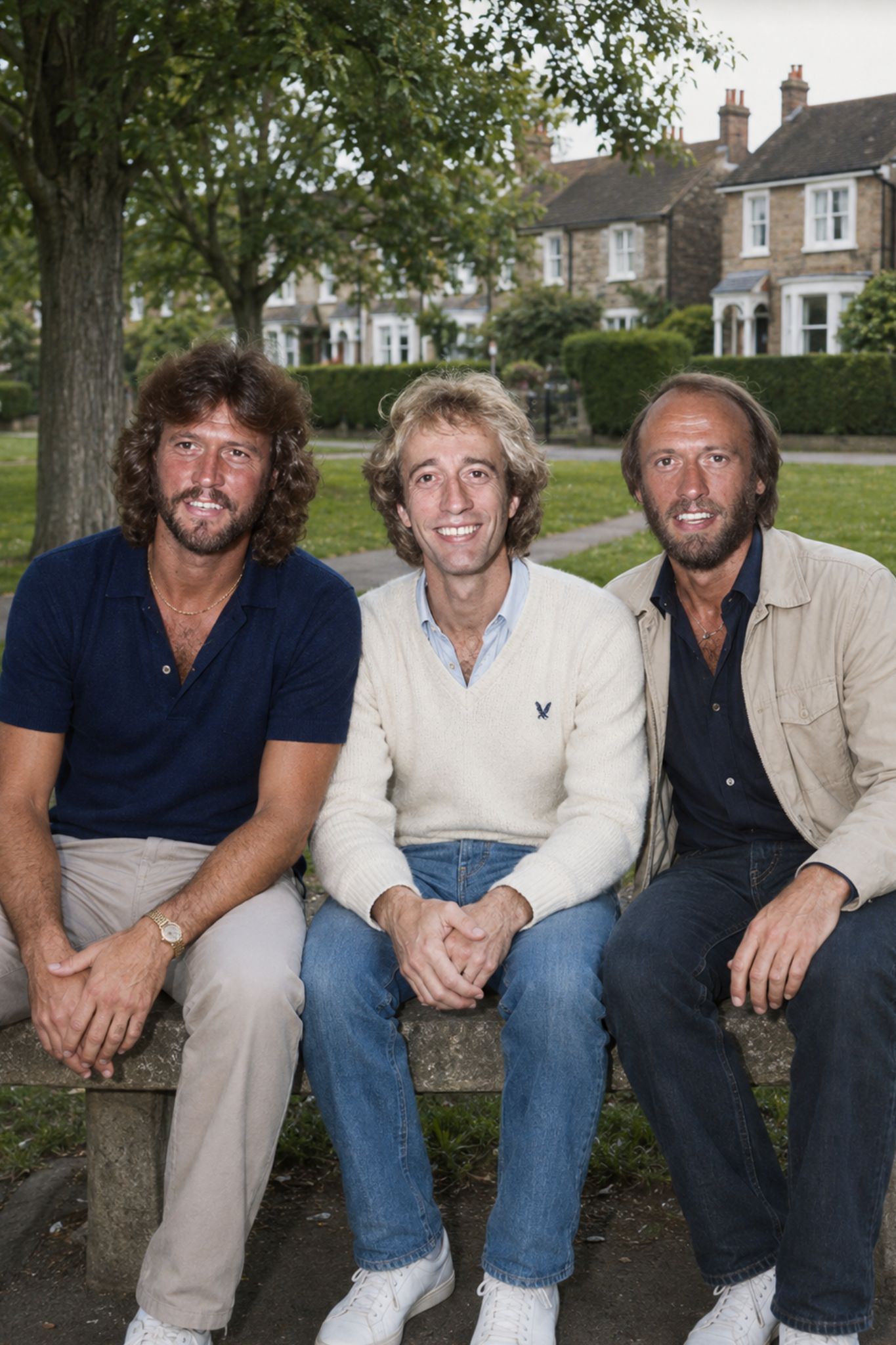
Long before the Bee Gees became inseparable from the dazzling rhythm and global phenomenon of the late 1970s, they had already established themselves as remarkable craftsmen of melody, harmony, and emotional storytelling. One particularly revealing moment came in June 1973, when the brothers performed “Run to Me” on the influential American television program The Midnight Special. The appearance captured the group during an important transitional period, when their music was moving through uncertainty but their greatest strength—the extraordinary union of three family voices—remained unmistakably intact.
Released as the lead single from the album To Whom It May Concern, “Run to Me” offered listeners something both immediate and enduring. It was not built around elaborate spectacle or a fashionable musical trend. Instead, it relied on a beautifully shaped melody, a direct emotional message, and the natural vocal chemistry of Barry, Robin, and Maurice Gibb. The song reached #9 in the UK and #16 in the US, confirming that the group still possessed a deep connection with audiences on both sides of the Atlantic.
Those chart positions tell only part of the story. The lasting importance of “Run to Me” lies in the way it presents the Bee Gees at their most sincere. The song is structured as an invitation to someone who feels disappointed, uncertain, or alone. Its message is not complicated, yet it carries considerable emotional weight. The singer offers reassurance without attempting to control the listener’s feelings. He does not promise that every difficulty will disappear. He simply promises presence, understanding, and a place of safety.
That quality gives the recording a mature tenderness. Many songs of the period were designed to make bold statements or announce dramatic emotions, but “Run to Me” works through restraint. Its appeal comes from the calm confidence of its central promise. The brothers seem to understand that comfort is often most convincing when it is expressed quietly. A person in distress may not need a grand solution; sometimes, the most meaningful gift is knowing that someone will remain nearby.
The Bee Gees’ harmonies deepen that sense of reassurance. Barry’s lead vocal brings warmth and clarity, while Robin’s distinctive voice introduces a more fragile emotional color. Maurice helps complete the blend, providing the musical balance that gave so many Bee Gees recordings their remarkable depth. When their voices come together, the song seems to expand beyond the experience of one individual. It becomes a shared expression, almost as though several voices are repeating the same promise from different emotional perspectives.
This family blend was never merely a technical achievement. It carried the sound of shared history. The brothers had grown up singing together, learning instinctively how to enter a phrase, support a melody, and move around one another without destroying the natural shape of the song. Their harmony was polished, but it rarely felt mechanical. Even at its most sophisticated, it retained the closeness of voices formed within the same household.
The June 1973 performance on The Midnight Special gave American viewers an opportunity to experience that connection visually as well as musically. Television performances during this era possessed a directness that is difficult to reproduce today. There were fewer distractions, less dependence on rapid editing, and greater attention to the performers themselves. The singers had to stand before the audience and allow the song to justify their presence.
For the Bee Gees, this was an ideal environment. Their greatest instrument was not an elaborate stage production but the relationship between their voices. A song such as “Run to Me” required concentration rather than theatrical excess. The emotional effect depended upon phrasing, timing, and the subtle exchange between the brothers. Under the lights of The Midnight Special, the performance became an intimate conversation presented to a national audience.
The appearance also arrived during a complex chapter in the group’s history. The Bee Gees had already enjoyed major international success during the 1960s, producing dramatic ballads and carefully arranged pop recordings that distinguished them from many of their contemporaries. Yet the early 1970s brought changing musical tastes and periods of commercial uncertainty. The group was no longer regarded simply as the newest sensation, and every release carried the burden of proving that their earlier achievements had not been temporary.
This context makes the success of “Run to Me” especially significant. Reaching #9 in the UK demonstrated that British listeners still responded strongly to the brothers’ melodic instincts, while its arrival at #16 in the US confirmed their continued relevance in the enormous American market. The song did not need to dominate every chart to make its point. It showed that the Bee Gees could still reach listeners through emotional honesty and disciplined songwriting.
The album title To Whom It May Concern also seems appropriate when considered alongside the song. The phrase traditionally introduces a message intended for anyone who may need to receive it. “Run to Me” operates in much the same way. It is addressed to a particular person within the song, yet its emotional meaning is open to anyone who has ever needed reassurance. The listener can step into the story without knowing every detail.
For older audiences, the performance may awaken memories of a time when music television felt like an appointment rather than an endless stream of available content. Viewers waited for a favorite performer, listened without interruption, and often remembered a single appearance for years. A song heard in the right moment could become permanently connected to a family home, an old television set, or a particular season of life.
The passage of time has only strengthened the appeal of “Run to Me.” Musical fashion has changed repeatedly since 1973, but the song’s central idea remains relevant. People still experience disappointment. They still need loyalty, patience, and the reassurance that they do not have to carry every burden alone. Because the Bee Gees built the song around those enduring emotions rather than a temporary trend, it continues to speak clearly decades later.

The performance also reminds us that the Bee Gees’ history cannot be reduced to one musical era. Their later success may have been larger and more culturally dominant, but songs such as “Run to Me” reveal the foundation beneath it. Before the celebrated dance records, there were beautifully written ballads, carefully arranged harmonies, and three brothers learning how to transform private feeling into universal music.
What makes the song particularly affecting is its refusal to sound desperate. It offers comfort with dignity. The melody rises naturally, the voices support one another, and the emotional message is delivered without unnecessary exaggeration. That balance requires considerable artistic judgment. A lesser performance might have made the song overly dramatic. The Bee Gees understood that the deepest emotions often become more powerful when the singer trusts the listener.
Seen from the distance of more than half a century, the 1973 Midnight Special performance stands as a quiet historical document. It shows the brothers before another enormous transformation in their career, still searching, still developing, and still relying on the one musical gift that no changing fashion could take from them. Their surroundings would change, their public image would evolve, and their success would eventually reach almost unimaginable heights. Yet the essential sound was already there.
“Run to Me” remains a reminder of why the Bee Gees endured. They understood melody, but they also understood emotional need. They knew how to write songs that sounded personal without becoming private and universal without becoming vague. In June 1973, under the television lights of The Midnight Special, Barry, Robin, and Maurice did not need to predict the extraordinary future ahead of them. For those few minutes, they simply stood together and offered the world a promise: when life becomes difficult, there is still comfort in a familiar voice.