Introduction
WHEN BARRY GIBB AND DOLLY PARTON SANG “WORDS,” A LOVE SONG BECAME A FAREWELL TO TIME ITSELF
Some songs are inseparable from the moment in which they first appeared. They carry the clothing, production style, and cultural atmosphere of a particular decade, remaining valuable mainly because they return listeners to a familiar place in the past. Other songs accomplish something rarer. They continue to change as their listeners grow older, revealing meanings that may not have been visible when the music was new. “Words,” written by Barry, Robin, and Maurice Gibb, belongs unmistakably to this second tradition.
First recorded during the extraordinary rise of the Bee Gees in the late 1960s, “Words” was built upon a simple but enduring idea: language possesses the power to rescue a relationship, deepen a wound, preserve a memory, or express what silence cannot carry. Its melody is graceful and immediately recognizable, yet its true strength lies in its emotional openness. The song does not explain every circumstance surrounding its plea. It simply acknowledges that words matter, especially when time is limited and affection remains difficult to express.
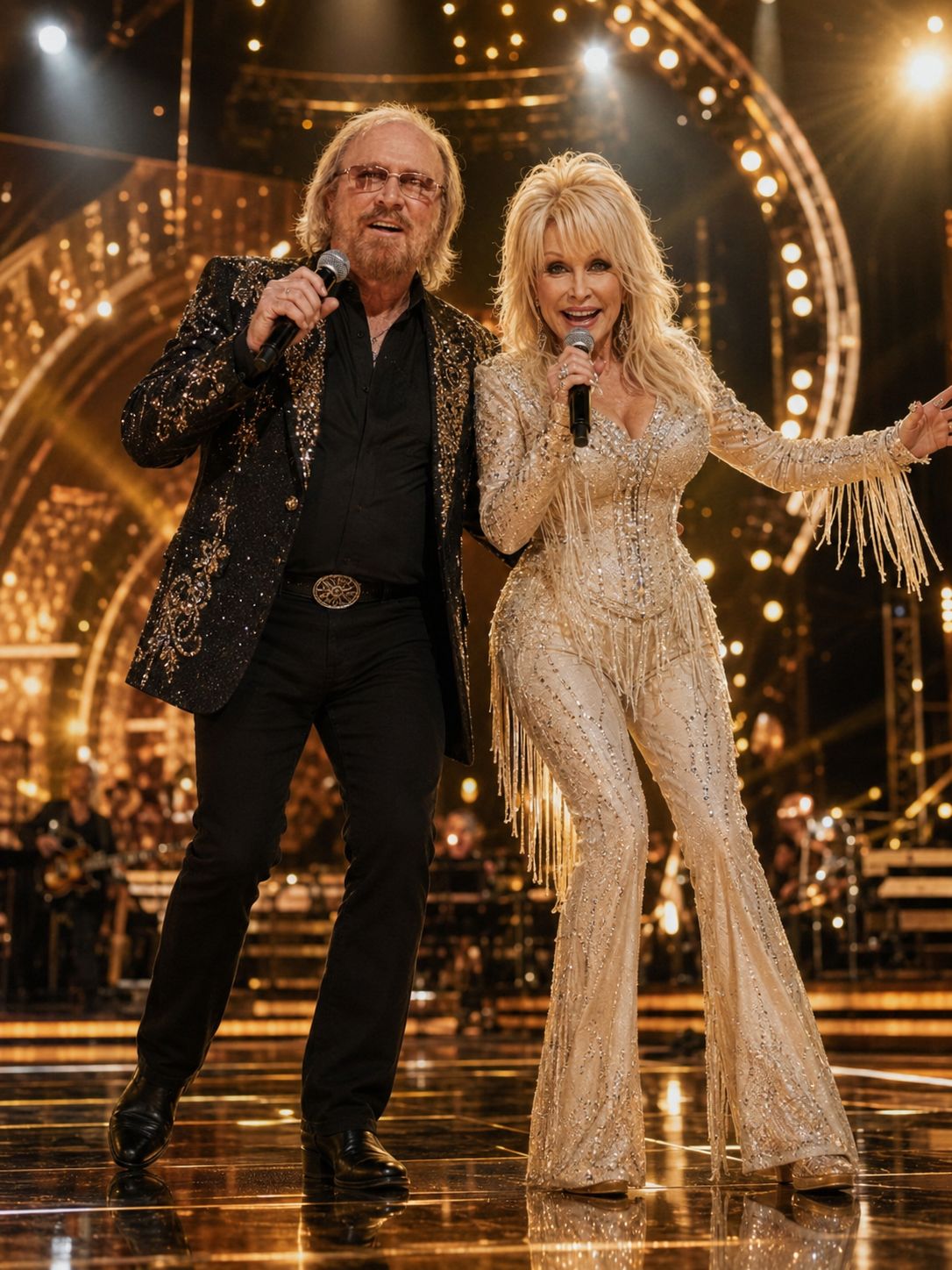
More than five decades later, Barry Gibb and Dolly Parton returned to the song together, transforming it into something deeper than a respectful remake. Their version feels like a meeting between two great musical lives, each shaped by triumph, grief, endurance, and the passage of time. They do not attempt to recreate youth or compete with the famous original. Instead, they allow maturity to enter every line.
That decision gives the recording its quiet power.
The collaboration appeared on Greenfields: The Gibb Brothers’ Songbook, Vol. 1, Barry Gibb’s collection of newly interpreted songs drawn from the extraordinary catalog he created with his brothers. The project brought Barry together with a distinguished group of artists associated with country, folk, Americana, and roots music. Among them were Alison Krauss, Keith Urban, Brandi Carlile, Sheryl Crow, Miranda Lambert, Olivia Newton-John, and Little Big Town.
Produced by Dave Cobb, the album placed familiar Gibb compositions within arrangements that felt warmer, more spacious, and closer to the natural sound of musicians performing together in a room. Rather than covering the songs with excessive production, Cobb allowed the melodies, lyrics, and individual voices to remain at the center.
That approach was particularly effective on “Words.”
The arrangement is patient and carefully restrained. Acoustic guitar, piano, pedal steel, Hammond organ, and strings provide emotional color without competing for attention. Each instrument serves the conversation between the singers. The music seems to breathe around them, giving every phrase enough space to arrive with dignity.
The performance becomes striking from the moment Barry begins.
His later voice carries a different quality from the youthful recording known to generations of Bee Gees admirers. The elegance remains, as does the instinctive command of melody, but time has added a gentler roughness and a greater sense of reflection. He no longer sounds like a young man trying urgently to save a fragile moment.
He sounds like someone who understands what happens when important words are delayed for too long.
There is wisdom in that difference.
In youth, the song may be heard primarily as a plea between two people attempting to remain connected. In Barry’s mature interpretation, it can also be heard as a meditation on memory, absence, and the things people wish they had expressed more clearly while opportunities still remained.

That meaning cannot be separated from the history of Barry, Robin, and Maurice Gibb.
For decades, the brothers created one of the most distinctive musical partnerships in popular culture. Their individual voices possessed recognizable qualities, but when joined together, they formed harmonies that seemed almost beyond explanation. Their creative relationship produced songs across changing eras, from emotional ballads and melodic pop to rhythm-driven international hits and sophisticated compositions written for other artists.
They experienced extraordinary success, but they also endured the pressures that accompany family, fame, competition, and constant public attention. Like many brothers, they argued, separated, reunited, and continued creating. Their story was not one of effortless harmony in private life, but of a bond repeatedly tested and renewed through music.
By the time Barry recorded Greenfields, he was carrying that history forward without Robin and Maurice physically beside him.
That knowledge changes the emotional atmosphere of “Words.”
The song is not explicitly about brothers, grief, or remembrance. Yet when Barry sings it in his later years, the listener cannot entirely avoid hearing the absence surrounding him. The spaces between phrases seem to contain memories of rehearsals, studios, tours, disagreements, laughter, and the unmistakable sound of three voices becoming one.
What was once a romantic plea now feels capable of holding several forms of love.
It can speak to a partner, a sibling, a friend, or someone who is no longer present to hear what should have been said. That openness gives the song its continuing life. It does not belong to one relationship or one generation. It belongs to anyone who has ever understood that language sometimes arrives too late.
Then Dolly Parton enters, and the emotional landscape broadens again.
Dolly’s voice has always carried a remarkable balance of brightness and sorrow. She can deliver a line with conversational ease while allowing deeper feeling to remain just beneath the surface. Her greatest performances often sound natural rather than studied, as though she has simply discovered the most honest way to tell the story.
On “Words,” she does not appear to be visiting the Bee Gees’ musical world from outside. She enters the song with complete familiarity, treating its emotion as something already present within her own tradition of country storytelling.
Her contribution brings warmth, directness, and gentle strength.
Where Barry’s voice suggests reflection and accumulated memory, Dolly’s offers reassurance. She does not overpower the melody or turn the duet into a display of competing personalities. Instead, she listens. Her phrasing responds to his, and the performance develops like a conversation between two people who understand that the song is larger than either one of them.
This quality is essential.
A lesser duet might have been built around dramatic high notes, elaborate vocal exchanges, or an attempt to create an obvious commercial event. Barry and Dolly take another path. They rely on restraint, trust, and the emotional authority that comes from long lives in music.
They do not need to prove that they are legends.
Their attention to the song proves it for them.
The connection between Dolly Parton and the Gibb songwriting tradition also carries meaningful history. Barry, Robin, and Maurice wrote “Islands in the Stream,” the celebrated duet recorded by Dolly and Kenny Rogers. That song became one of the defining popular recordings associated with both singers and demonstrated how naturally the Gibbs’ melodic gifts could meet the warmth and accessibility of country music.
“Islands in the Stream” was expansive, memorable, and built for broad appeal.
“Words” feels more intimate.
Rather than sweeping the listener into a grand declaration, it invites quiet attention. The emotional drama exists within the smallest details: the pause before a phrase, the slight weathering of a familiar voice, the way Dolly softens the ending of a line, and the manner in which Barry allows the melody to remain tender rather than turning it into a monument to the past.
The official studio performance further strengthens that intimacy. The focus remains upon the musicians, the shared material, and the visible respect between the two veteran artists. There is no need for elaborate spectacle. The history carried by their voices provides more than enough drama.
For older listeners, this simplicity can be especially moving.
Many people who first heard “Words” in their youth have since lived through marriages, friendships, family changes, bereavements, reconciliations, and long periods of reflection. They no longer hear the song with the innocence of its first release. Every line may now carry the memory of someone, a conversation, or an opportunity that cannot be recovered.
Barry and Dolly understand that reality without explaining it directly.
Their voices contain time.
The slight roughness within the recording is not a weakness to be concealed. It is evidence of lives fully lived. Their mature tones bring credibility to a song concerned with emotional honesty. When they sing about the importance of words, they sound like people who have witnessed both the healing and damage language can create.
That is one reason the performance feels almost like a farewell across generations.
It does not necessarily announce an ending. Instead, it recognizes that every musical era eventually passes into memory. The young artists who once introduced these songs become the senior figures protecting them. Audiences who danced, listened, and dreamed beside the original recordings become grandparents sharing the same melodies with younger members of their families.
The song survives because it is passed from one voice to another.
Barry’s Greenfields project was built upon that understanding. The Gibb catalog was not treated as a collection of artifacts sealed inside the sound of a particular decade. The compositions were placed into new musical settings where other artists could reveal different colors within them.
The country and Americana arrangements proved especially suitable because many Gibb songs were always closer to traditional storytelling than casual listeners may have realized. Beneath the famous harmonies and polished production lay strong melodies, carefully constructed narratives, and emotions that could survive almost any arrangement.
Dave Cobb’s production brings those qualities forward.
The acoustic textures do not force “Words” into an unfamiliar identity. They uncover the simplicity that had always been present. Pedal steel adds a gentle sense of distance and longing. The piano supports the melody with quiet dignity. The strings rise without overwhelming the singers, while the Hammond organ contributes warmth beneath the surface.
Everything is arranged to serve the human voice.
That choice feels appropriate because “Words” is ultimately about communication. A crowded production would have contradicted its message. The recording requires room for hesitation, memory, and response.
Barry and Dolly provide exactly that.
Their voices do not blend by becoming identical. The beauty lies in their differences. Barry carries the refined melodic character associated with the Bee Gees, while Dolly brings the clarity and narrative honesty of country music. Each singer arrives with a history large enough to dominate the performance, yet neither attempts to do so.
When their voices join, the moment feels less like a collision between famous personalities and more like an agreement.
They seem to be saying that songs do not belong only to those who first recorded them. They belong to the people who return to them with honesty, and to listeners who discover new meaning as their own lives change.
This is why the duet appeals so strongly to mature audiences. It does not demand attention through volume or novelty. It rewards patience. It assumes that the listener is willing to slow down and hear what age has added rather than complain about what time has altered.
There is grace in that approach.
Modern entertainment often encourages artists to conceal age, reproduce earlier success, and present the illusion that nothing essential has changed. Barry Gibb and Dolly Parton reject that illusion. They sing as they are now, not as they were decades earlier.
The result is more truthful than imitation could ever be.
Their version of “Words” honors the original while allowing it to become a different emotional experience. The young recording carried urgency. The later duet carries perspective. One asks whether language might preserve love in the present. The other seems to ask what remains after years have passed and many voices have fallen silent.
For Barry, the answer is clearly music.
Through Greenfields, he continued the creative work associated with his brothers while inviting new collaborators into the story. He did not attempt to replace Robin or Maurice. Such a thing would have been impossible. Instead, he allowed their compositions to travel forward, carrying the family name into new rooms and new generations.
Dolly’s presence makes that journey feel especially meaningful.
She understands musical inheritance, family history, faith, hardship, and the responsibility of preserving songs that have become part of the public’s emotional life. Her voice brings compassion to Barry’s remembrance without turning the performance into sorrow alone.
There is gratitude within it.
There is pleasure in hearing them together.
There is also an awareness that opportunities like this are precious.
When the song ends, the listener may feel that something larger than a duet has taken place. Two artists from different traditions have met inside a composition shaped by three brothers. The past has not been recreated, but it has been honored. Loss has not been erased, but it has been given melody.
That is the enduring miracle of “Words.”
Language may fail people in ordinary life. Important sentences remain unspoken, apologies arrive late, and affection is sometimes assumed rather than expressed. Music offers another chance. A song can preserve what conversation could not. It can cross decades, return after silence, and allow one generation to speak to another.
When Barry Gibb and Dolly Parton sang “Words,” they did more than revisit a classic.
They transformed it into a conversation between youth and age, memory and presence, loss and gratitude. Barry carried the voices of Robin and Maurice within the song’s history. Dolly answered with the warmth of an artist who understood the value of every remaining moment.
Together, they reminded listeners that great songs do not simply survive time.
They gather it.
Every year, every farewell, and every cherished memory becomes part of the music. What began as a beautiful plea in the 1960s now sounds like a message sent across generations: speak while there is time, listen while the voice remains, and never underestimate the power of a few honest words.
For in the hands of Barry Gibb and Dolly Parton, “Words” became more than a song.
It became remembrance.
It became gratitude.
And for one deeply moving performance, it became a farewell that refused to say goodbye.