Introduction
THE SONG NASHVILLE NEVER SAW COMING: How the Bee Gees, Kenny Rogers, and Dolly Parton Erased Music’s Dividing Lines
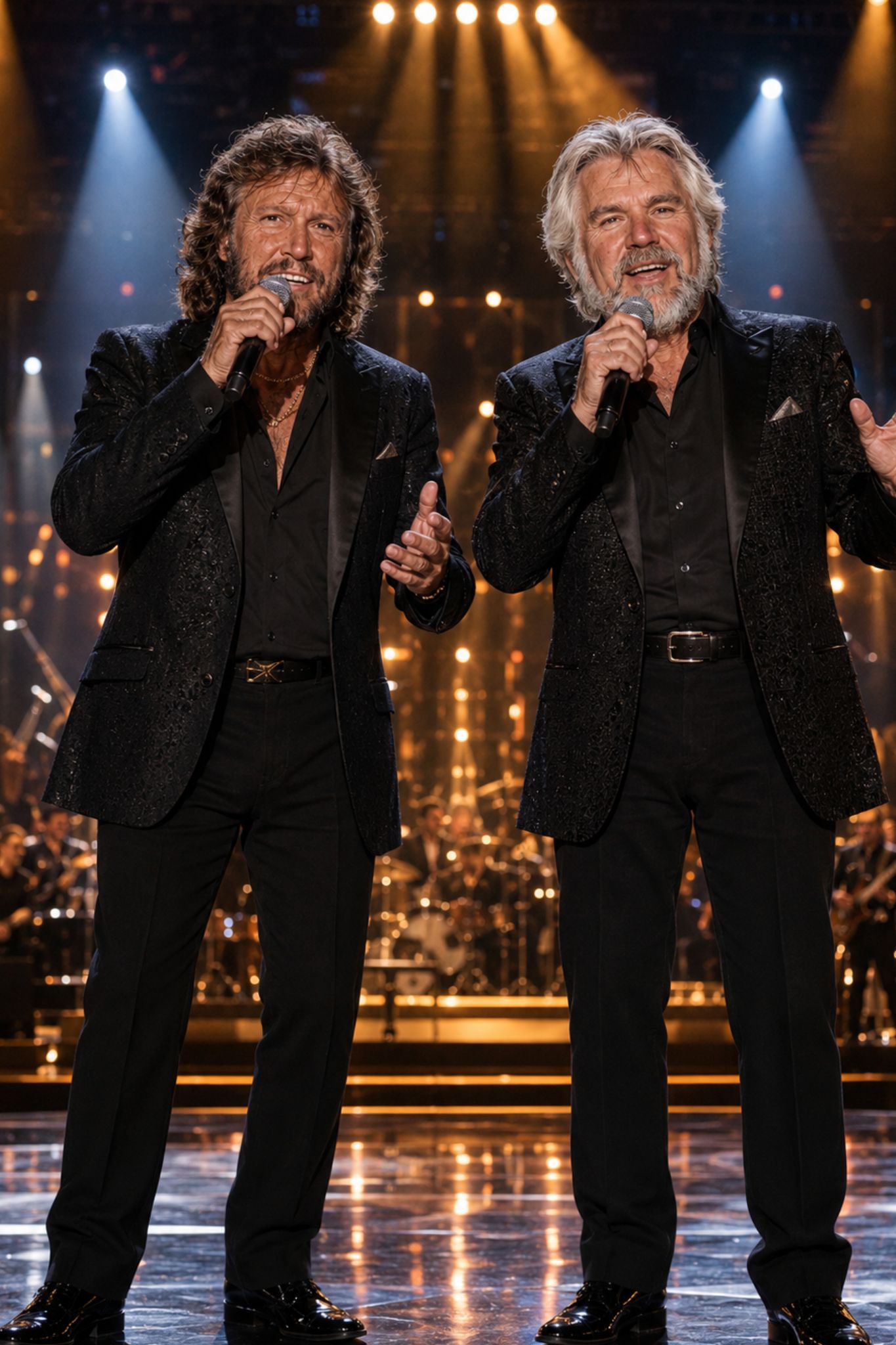
Some recordings become successful because they match the mood of their moment. Others rise above the moment entirely, changing the way audiences, musicians, and record companies understand what a song can accomplish. “Islands in the Stream” belongs to that rarer category. When Kenny Rogers and Dolly Parton joined their voices in 1983, they did more than record a memorable duet. They created a meeting place between country and pop, between Nashville tradition and international songwriting, and between two performers whose contrasting personalities somehow produced perfect emotional balance.
Behind that extraordinary meeting stood Barry, Robin, and Maurice Gibb, the brothers whose work as the Bee Gees had already transformed popular music. By the early 1980s, the Gibb brothers were famous throughout the world for their unmistakable harmonies, elegant melodies, and instinctive understanding of emotional drama. Yet their songwriting gifts extended far beyond the sound most listeners immediately associated with them. They could write with remarkable sensitivity for other voices, adjusting their melodic imagination to fit performers whose backgrounds were entirely different from their own.
That ability became essential when Barry Gibb began working with Kenny Rogers on the album Eyes That See in the Dark. On paper, the partnership may have appeared surprising. The Bee Gees were identified with international pop, while Kenny stood as one of country music’s most familiar and trusted storytellers. Their musical worlds were separated by radio formats, industry expectations, and the carefully guarded boundaries that record companies believed audiences wanted.

The early 1980s music business was deeply committed to classification. Country records were promoted to country stations, pop records were sent elsewhere, and singers were often warned against moving too far beyond the identity that had made them successful. Executives believed that clear categories made performers easier to market. An artist was expected to remain recognizable, predictable, and loyal to one established audience.
But Kenny Rogers had never sounded like a man imprisoned by a category. His voice carried the warmth of country storytelling, yet his records often reached listeners who did not consider themselves country fans. He understood how to take a lyric about regret, devotion, difficult choices, or the passing of time and make it feel like a private conversation. Rather than singing at the audience, Kenny seemed to speak directly to each person within it.
That quality made him an ideal interpreter of the Gibb brothers’ writing. Barry understood that Kenny did not need a song filled with unnecessary vocal decoration. He needed a melody spacious enough to carry feeling and a lyric broad enough to belong to many different lives. “Islands in the Stream” provided both. Its words suggested companionship, reassurance, and the strength two people can offer one another when the wider world feels uncertain.
The song’s title was inspired by Ernest Hemingway’s posthumously published novel, but its emotional language was direct and immediately accessible. It did not depend on complicated imagery or fashionable references. Instead, it described two people becoming a place of safety for one another, like separate islands connected by something stronger than distance. That simple idea gave the song a timeless quality. Listeners did not need to know its literary origin or understand the circumstances of its composition. They only needed to recognize the feeling of finding steadiness in another person.

Yet the recording was not complete when Kenny first approached it alone. The melody was strong, and his performance carried sincerity, but the song seemed to require another perspective. It needed a second voice—not merely as decoration, but as an equal participant in the conversation. The duet structure would allow the lyric to become something shared rather than something described by only one person.
Then Dolly Parton entered the studio, and the character of the song changed almost immediately.
Dolly brought a brightness that contrasted beautifully with Kenny’s calm, weathered tone. Where his voice sounded grounded and reassuring, hers seemed to lift above the melody with warmth and clarity. The difference between them did not create conflict. It created movement. Kenny established the emotional foundation, while Dolly supplied the answering light. When their voices met in the chorus, the song suddenly sounded complete.
That completeness was not simply technical. Kenny and Dolly possessed a natural personal chemistry based on humor, mutual respect, and an understanding of how to give one another room. Neither singer attempted to dominate the performance. Kenny did not treat Dolly as a supporting voice, and Dolly did not turn the duet into a display of vocal power. They listened to each other, responded to each other, and allowed the emotional meaning of the song to remain at the center.
The result sounded effortless, though its achievement was extraordinary. Three brothers known for one of the most distinctive sounds in pop music had written a song that felt perfectly at home in the voices of two country stars. Those country stars then delivered it in a way that reached far beyond Nashville. The recording became not only a country success but a major mainstream hit, proving that audiences were far less concerned with industry boundaries than executives had assumed.