Introduction
FIFTY-ONE DAYS BEFORE THE SILENCE: The Final Night Elvis Presley Walked Beneath the Lights
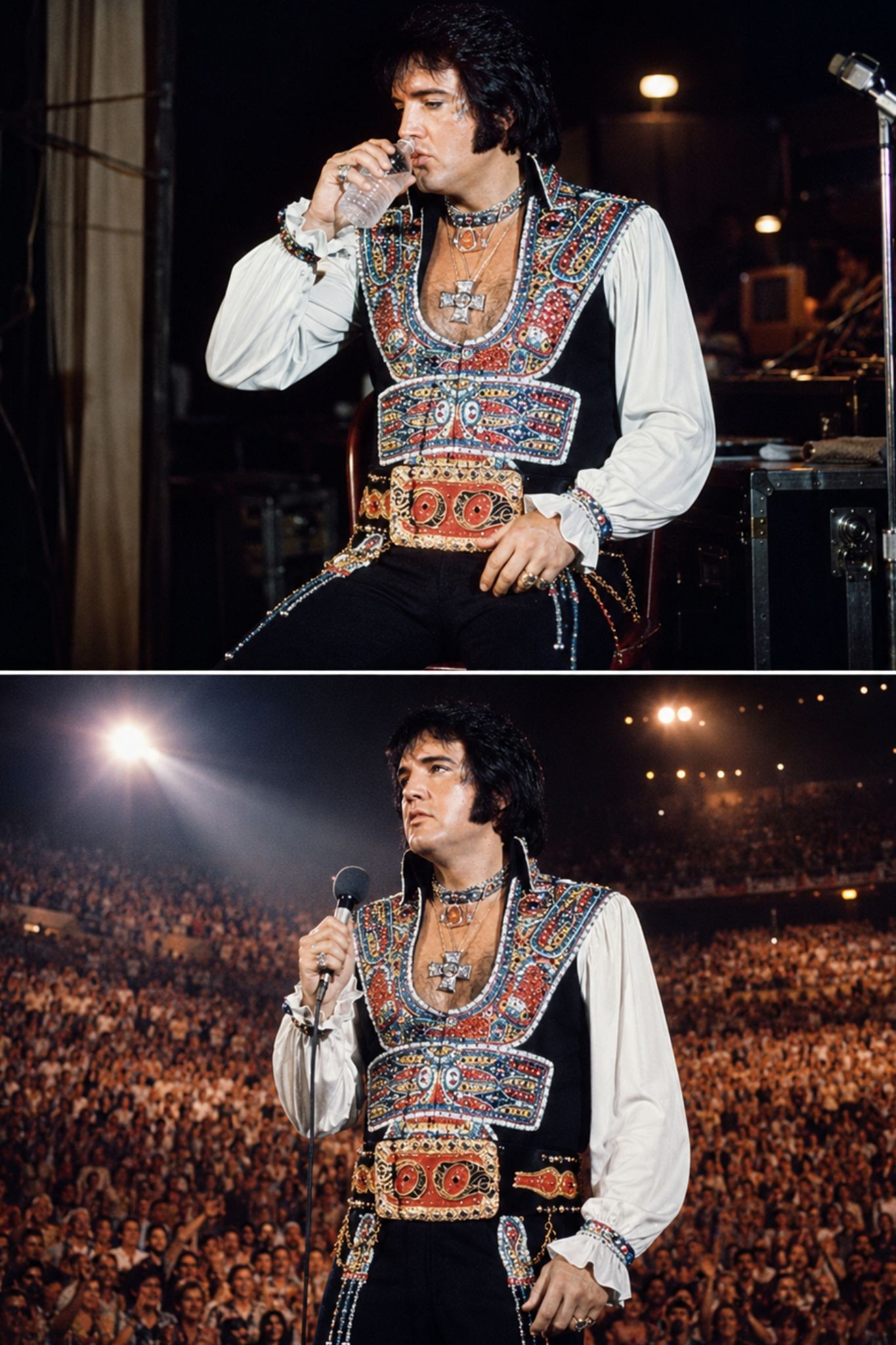
On June 26, 1977, nearly eighteen thousand people entered Market Square Arena in Indianapolis believing they were attending another concert by Elvis Presley. They expected familiar songs, dazzling stage clothes, affectionate humor, and the unmistakable excitement that followed the man known throughout the world as the King of Rock and Roll. What none of them understood was that they were about to witness the final public performance of one of the most influential entertainers in modern history.
There was no announcement describing the evening as a farewell. No tribute film introduced the concert, and no solemn voice warned the audience to remember every detail. Elvis was only forty-two years old, and another tour was already being planned. However difficult his circumstances had become, both his career and his life still appeared unfinished. Fans naturally assumed there would be another city, another show, and another opportunity to watch him step beneath the lights.
That assumption is what gives the night its lasting emotional power. History was unfolding in front of thousands of people, yet it looked almost ordinary while it was happening. The audience applauded, laughed, waited through the supporting acts, and prepared for the familiar moment when the orchestra would announce Elvis’s arrival. Only afterward would every song, gesture, and spoken word acquire the weight of a final goodbye.
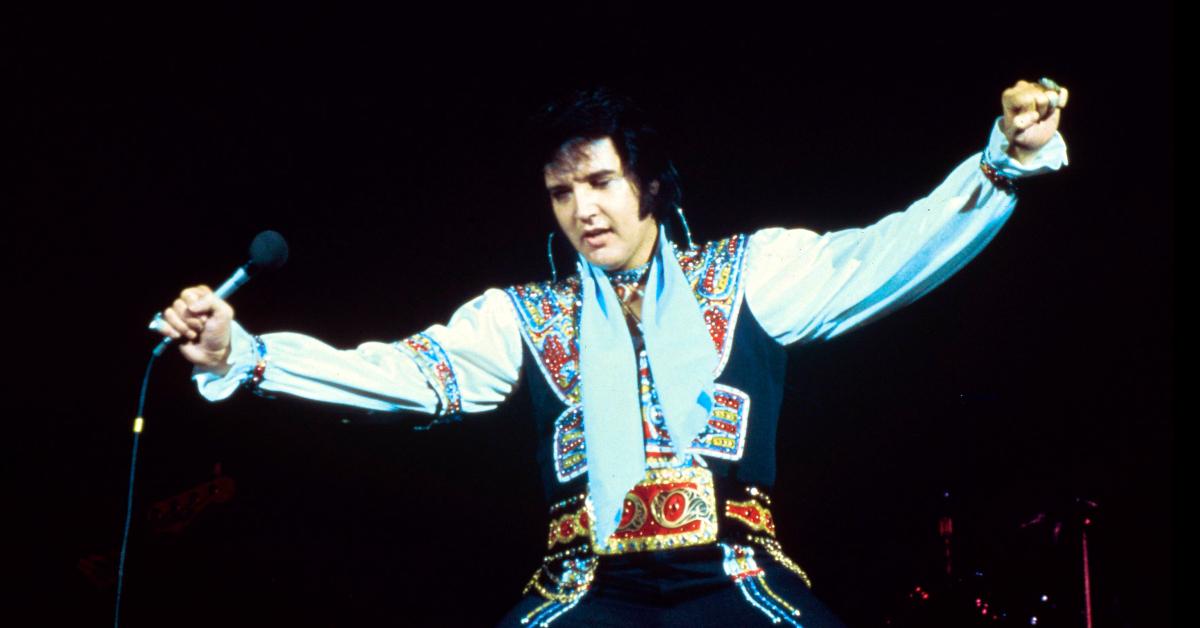
When Elvis Presley entered the arena, he wore a striking white stage suit decorated with gold. The image was immediately recognizable. By the 1970s, such costumes had become part of his concert identity, suggesting ceremony, confidence, and the larger-than-life spectacle audiences expected from him. Yet beneath the elaborate clothing stood a man whose physical condition had clearly changed.
The years of relentless touring, emotional strain, demanding schedules, and serious health difficulties had taken their toll. Elvis no longer moved with the effortless energy that had once transformed American television. The famous turns, sudden movements, and playful gestures appeared less frequently. Even so, flashes of his old instinct remained. A smile, a vocal phrase, or a brief movement could still bring the crowd to its feet.
He opened with “C.C. Rider,” a song closely associated with his concert appearances. The familiar arrangement immediately connected the Indianapolis audience to years of shared memories. Many had first heard Elvis when he was the young singer whose voice seemed to combine country, gospel, blues, and rhythm in a way the mainstream had never encountered before. Others had followed him through Hollywood, Las Vegas, and the celebrated comeback that restored him to live performance.
By 1977, however, the relationship between Elvis and his audience had grown deeper than simple admiration for a popular star. His music had accompanied people through marriages, military service, family gatherings, periods of hardship, and changing decades. Seeing him in person was not merely attending a concert. For many fans, it was reconnecting with part of their own lives.
The performance included songs from several chapters of Elvis’s career. Some were energetic reminders of earlier years, while others allowed him to explore the emotional and spiritual qualities that had always existed beneath his public image. Although his voice was not consistently as controlled as it had once been, it still possessed the ability to communicate vulnerability with remarkable directness.
That quality became especially important during songs about endurance, comfort, loneliness, and devotion. Elvis had always been more than a singer with an impressive range. He was an interpreter who could make a familiar lyric sound as though it had emerged from his own experience. Even when the technical details were imperfect, the feeling could remain undeniable.
Among the evening’s most meaningful selections was “Bridge Over Troubled Water.” The song offered reassurance to someone facing uncertainty, and Elvis approached it with the dramatic intensity that had defined many of his finest later performances. In hindsight, the choice seems almost prophetic. A man surrounded by concern and exhaustion stood before thousands of people and sang words of comfort, offering strength through music while appearing desperately in need of that same strength himself.
Contemporary reactions to the concert were divided. Some critics believed the production had become old-fashioned and that Elvis no longer matched the extraordinary standard established earlier in his career. Complaints were made about the supporting program, the lighting, and the uneven condition of the central performer. Such judgments form part of the historical record, but they cannot fully capture what the evening meant to those inside the arena.
Audiences do not always experience a concert as critics do. They notice technical weaknesses, but they also bring loyalty, memory, and affection. The Indianapolis fans were not simply measuring notes or comparing the performance with recordings from twenty years earlier. They were watching someone whose music had helped shape their understanding of youth, change, freedom, faith, and American popular culture.
Elvis still possessed the rare ability to make a large arena feel unexpectedly intimate. A glance toward the crowd, a quiet word between songs, or a moment of humor could make thousands of people feel personally acknowledged. That connection had been central to his appeal from the beginning. His performances did not feel distant or carefully protected. They carried a sense of immediacy, as though the barrier between singer and listener might disappear at any moment.
One of the evening’s most poignant scenes came when Elvis introduced his father, Vernon Presley, to the audience. Vernon stepped forward and acknowledged the crowd while standing beside the son whose rise had changed their family forever. The moment now appears like the closing of an extraordinary circle.
The Presley family had once lived with very little. Elvis’s early life in Tupelo and Memphis offered no guarantee that he would become a professional musician, much less one of the most recognized people on earth. Now father and son stood before thousands in a packed arena, connected by a journey that neither could have imagined when Elvis was young.
The concert eventually reached its traditional closing number, “Can’t Help Falling in Love.” By that stage of his career, the opening notes signaled that the evening was drawing to an end. The song had become a musical farewell between Elvis and his audience, expressing affection with a simplicity that required no grand explanation.
On June 26, however, the familiar ritual became something permanent. Elvis sang the song, accepted the applause, and prepared to leave the stage. He did not know that he would never perform before a live audience again. The people watching did not know it either.
Before departing, he offered a brief farewell: “We’ll meet you again. God bless, adios.” Those words sounded like a routine promise. Elvis expected to return, and the crowd believed him. There was no reason for most people in the arena to interpret the sentence as anything more than a warm conclusion to another concert.

Fifty-one days later, on August 16, 1977, Elvis Presley died at Graceland. Suddenly, the final words spoken in Indianapolis became part of music history. The promise of another meeting could no longer be fulfilled on a concert stage, and the ordinary closing of one summer evening became the final curtain of an extraordinary career.
There is something uniquely heartbreaking about a goodbye that no one recognizes. During a planned farewell, audiences listen differently. They hold onto every note, study every expression, and prepare themselves for the final moment. The Indianapolis crowd was given no such opportunity. They believed time remained.
That is why recordings and eyewitness memories from the concert continue to carry such emotional force. Listeners now hear what the original audience could not. Every pause seems heavier, each smile appears more fragile, and every lyric feels surrounded by knowledge of what would soon follow.
Yet the final concert should not be remembered only as a portrait of decline. It was also an act of endurance. Elvis was struggling, but he still walked onto the stage. He still faced the audience, reached for the songs, and attempted to give people the experience they had come to receive.
The performance revealed the human being beneath the legend. He was not the untouchable figure of posters and headlines, but a tired artist continuing to serve the music that had defined his life. He had risen from modest beginnings, transformed popular culture, survived changing fashions, and returned night after night because singing remained inseparable from who he was.
When Elvis left Market Square Arena, he believed his journey would continue. Perhaps that belief is the most painful detail of all. The final curtain fell without ceremony because neither the performer nor the audience knew that it was falling.
The King left the stage after promising that they would meet again. In one sense, that promise was broken. In another, it has been kept thousands of times. Whenever a recording begins, whenever an old performance is shown, or whenever a listener discovers his voice for the first time, Elvis Presley returns beneath the lights. The man left the building forever, but the music never did.