Introduction
THE AFTERNOON THE KING VANISHED: The Broadcast That Told America Elvis Presley Was Gone
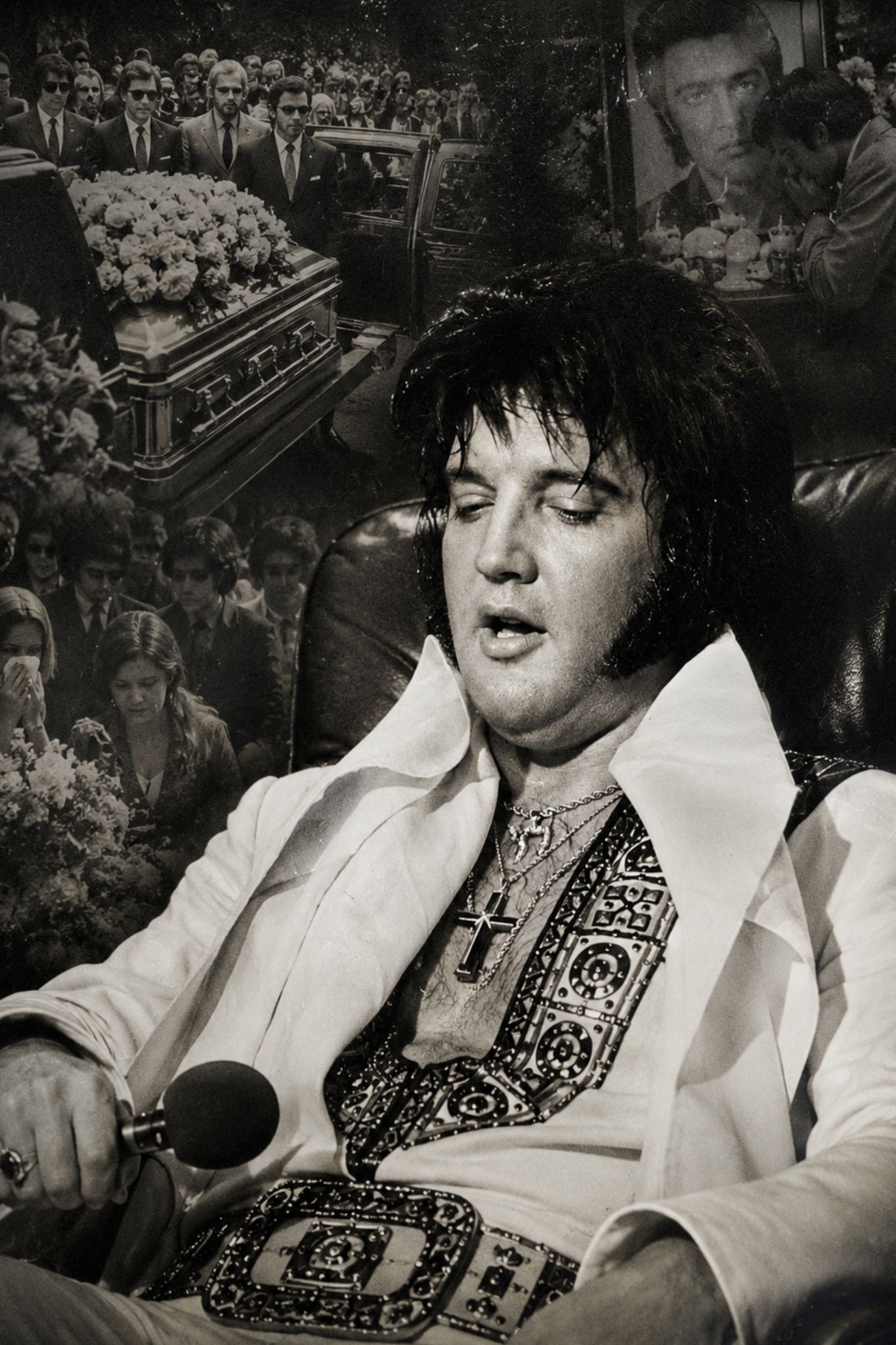
On the afternoon of August 16, 1977, ordinary radio programs and television schedules were interrupted by a report that seemed almost impossible to accept. Elvis Presley, the singer who had transformed American popular music and become one of the most recognizable figures of the twentieth century, was dead at only 42 years old. The announcement traveled rapidly from Memphis into homes, offices, automobiles, restaurants, and neighborhood shops, leaving millions of listeners struggling to understand how someone who had appeared so permanent could suddenly be gone.
Elvis had been found unresponsive at Graceland, his Memphis home, and was taken by ambulance to Baptist Memorial Hospital. Efforts to revive him were unsuccessful, and he was pronounced dead at approximately 3:30 p.m. His fiancée, Ginger Alden, had discovered him earlier that afternoon, correcting later retellings that mistakenly suggested his manager had been the person who found him.
The first reports were brief, uncertain, and emotionally overwhelming. News presenters who had spent years introducing Elvis’s records were suddenly required to speak about him in the past tense. Newspapers began preparing enormous headlines, while radio stations abandoned their regular playlists and filled the evening with his songs. Listeners heard familiar recordings differently because every lyric now carried the knowledge that the voice behind it would never again enter a studio or walk onto a concert stage.
Official accounts initially described the medical emergency as cardiac failure or cardiac arrhythmia. Graceland’s official information continues to state that Elvis died from heart failure, while later medical discussions have examined the combined effects of serious illness, an enlarged heart, declining health, and extensive prescription medication use. Because interpretations have varied over the decades, describing the cause simply as a fully settled heart attack can hide the complexity surrounding his final condition.
Yet on that August afternoon, the public was not thinking about medical terminology. People were thinking about the young singer from Tupelo, Mississippi, whose voice had once arrived on the radio with an energy that seemed to announce a new age. They remembered the dark hair, the confident smile, the dramatic clothing, and the sound that brought together country, gospel, rhythm and blues, and early rock and roll.
Elvis did not create every musical tradition that shaped his work, but he possessed a remarkable ability to bring those influences together in performances that reached an enormous audience. His early recordings sounded both familiar and entirely new. They carried the emotional directness of gospel, the storytelling tradition of country music, and the urgency of rhythm and blues, delivered by a performer whose instinctive style could not be easily copied.
By the middle of the 1950s, Elvis Presley had become a national phenomenon. His rise was so rapid that even the entertainment business seemed unprepared for it. Records sold in extraordinary numbers, television appearances drew enormous audiences, and public discussions about his influence reached far beyond music. To younger listeners, he represented excitement and possibility. To many older observers, he appeared to signal changes in American culture that were moving faster than society could comfortably understand.
Behind that historic transformation stood a young man who remained closely connected to his family and his modest beginnings. Fame gave Elvis wealth, automobiles, homes, and opportunities his parents could never have imagined during his childhood. It also placed him beneath constant observation, surrounding him with expectations that would continue for the rest of his life.
His career entered an unusual chapter in March 1958, when he was drafted into the United States Army at the height of his fame. Elvis could have pursued a more protected entertainment assignment, but he entered regular military service and was eventually stationed in West Germany with the 3rd Armored Division. Army records show that he served in armored units from 1958 until 1960 and was promoted during his service.

Images of Elvis wearing a military uniform became part of his public story. He was no longer standing before screaming concert crowds but training, driving military vehicles, and attempting to perform the duties expected of an ordinary soldier. His service strengthened the respect many Americans felt for him, particularly because he did not present himself as someone entitled to escape the obligations faced by other young men.
The Army years also brought profound personal change. Elvis lost his beloved mother, Gladys, shortly before leaving for Germany, a loss that affected him deeply. When he returned to civilian life in 1960, he was still one of the most famous entertainers in the world, but he was no longer quite the same young man who had entered the service.
His recording career resumed successfully, yet much of the 1960s became dominated by motion pictures and soundtrack albums. Some films were commercially successful and remain warmly remembered by admirers, but the repetitive production schedule gradually moved him away from the musical experimentation that had defined his earliest work. For a performer whose deepest strength was direct communication through song, the distance from serious live performance became increasingly limiting.
Then came the remarkable 1968 television comeback special. Dressed in black and surrounded by musicians, Elvis appeared focused, powerful, and eager to prove that the original musical instinct remained intact. The program reminded audiences that beneath the movie image stood an exceptional live performer capable of commanding attention without elaborate scenery.
That comeback led to major appearances in Las Vegas and a demanding touring period across the United States. Elvis once again stood before large audiences, performing old favorites beside gospel songs, country material, contemporary ballads, and dramatic anthems. His concerts became major events, and his arrival was often enough to change the atmosphere inside an arena.
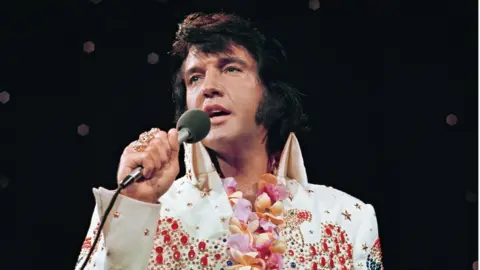
One of his greatest international achievements came in 1973 with Aloha from Hawaii, a concert broadcast by satellite to audiences across numerous countries. The production presented Elvis as a global entertainer, surrounded by an orchestra and performing with the confidence of someone who had already survived several different eras of popular culture.
However, the enormous demands placed upon him gradually became more difficult to sustain. By the middle of the 1970s, his health was visibly deteriorating. Touring continued, but the contrast between his extraordinary voice and his physical exhaustion became increasingly painful for those around him.
Even in decline, Elvis could still produce moments of astonishing musical power. Gospel songs often revealed his deepest concentration, while emotional ballads allowed him to communicate weariness, hope, loneliness, and faith. Audiences sometimes watched a struggling man, but they also heard flashes of the artist who had permanently changed the possibilities of popular performance.
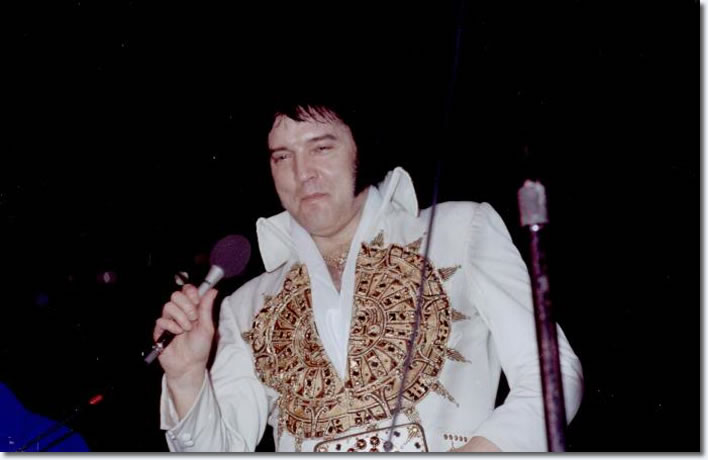
His final concert took place on June 26, 1977, at Market Square Arena in Indianapolis. Elvis ended the evening with “Can’t Help Falling in Love” and told the audience, “We’ll meet you again. God bless, adios.” No one present understood that these would become his final words from a concert stage. Another tour was scheduled to begin in August, demonstrating that neither Elvis nor those around him regarded Indianapolis as a planned farewell.
On August 16, Elvis was preparing to leave Memphis for that tour. Instead, Graceland became the center of an international tragedy. As confirmation of his death spread, people began gathering outside the estate, carrying flowers, photographs, and handwritten messages. The Associated Press records that Elvis died at Graceland at the age of 42, an event that instantly became one of the defining cultural memories of 1977.
For many Americans, the news felt personal even though they had never met him. Elvis had been present through records played at family gatherings, songs heard on car radios, films watched in neighborhood theaters, and performances discussed across generations. His voice had accompanied people from youth into adulthood, making his death feel like the disappearance of part of their own history.
The reaction also revealed how widely his music had traveled. Grief was not limited to Memphis or the United States. Fans around the world understood that an artist who had changed the sound and image of popular entertainment was suddenly gone. Newspapers that had once debated his cultural influence now described the end of an era.
President Jimmy Carter later recognized that Elvis had permanently changed the face of American popular culture. That judgment captured what ordinary listeners already understood. Elvis was more than a successful recording artist. He had altered the way performers moved, dressed, interpreted songs, and communicated with mass audiences.
His importance could not be measured only by record sales or sold-out concerts. Elvis Presley became a bridge between musical traditions, bringing sounds rooted in Southern churches, country radio, blues communities, and regional performance into the center of international popular culture. His success opened doors, created debates, and inspired generations of performers who followed him.
The tragedy of August 16 was therefore not simply the death of a celebrity. It was the sudden ending of a complicated American life. Elvis had experienced poverty, unprecedented fame, military service, family devotion, artistic triumph, commercial pressure, declining health, and the crushing responsibility of being expected to remain the King every time he entered a room.
The original news reports could announce where he had died and how old he was, but they could not immediately explain what the loss meant. That understanding emerged slowly, as fans returned to the recordings and recognized how much cultural history was contained within the voice.
Nearly five decades later, the announcement still carries emotional force. Those old broadcasts preserve the moment when the world first learned that Elvis Presley was gone. The language is formal, the footage is often grainy, and the reporters speak with the restraint expected of their era. Yet beneath every sentence is unmistakable disbelief.
The young man who once feared that audiences might forget him had become unforgettable. Graceland remains closely associated with his life, his recordings continue to reach new generations, and his influence remains audible throughout country, gospel, rock, soul, and modern popular performance. Elvis Presley Enterprises identifies him as one of the most important figures in twentieth-century popular culture, a judgment supported by the continuing global attention surrounding his work.
August 16, 1977, ended the life of Elvis Presley, but it did not end his presence. The news report announced a death; the years that followed revealed the scale of the legacy. Every time one of his recordings begins, the shock of that afternoon briefly gives way to something stronger—the return of a voice that history has never been able to silence.