Introduction
WHEN GLASTONBURY BELONGED TO ROD STEWART: At 80, One Legendary Afternoon Proved That Some Voices Never Leave Us
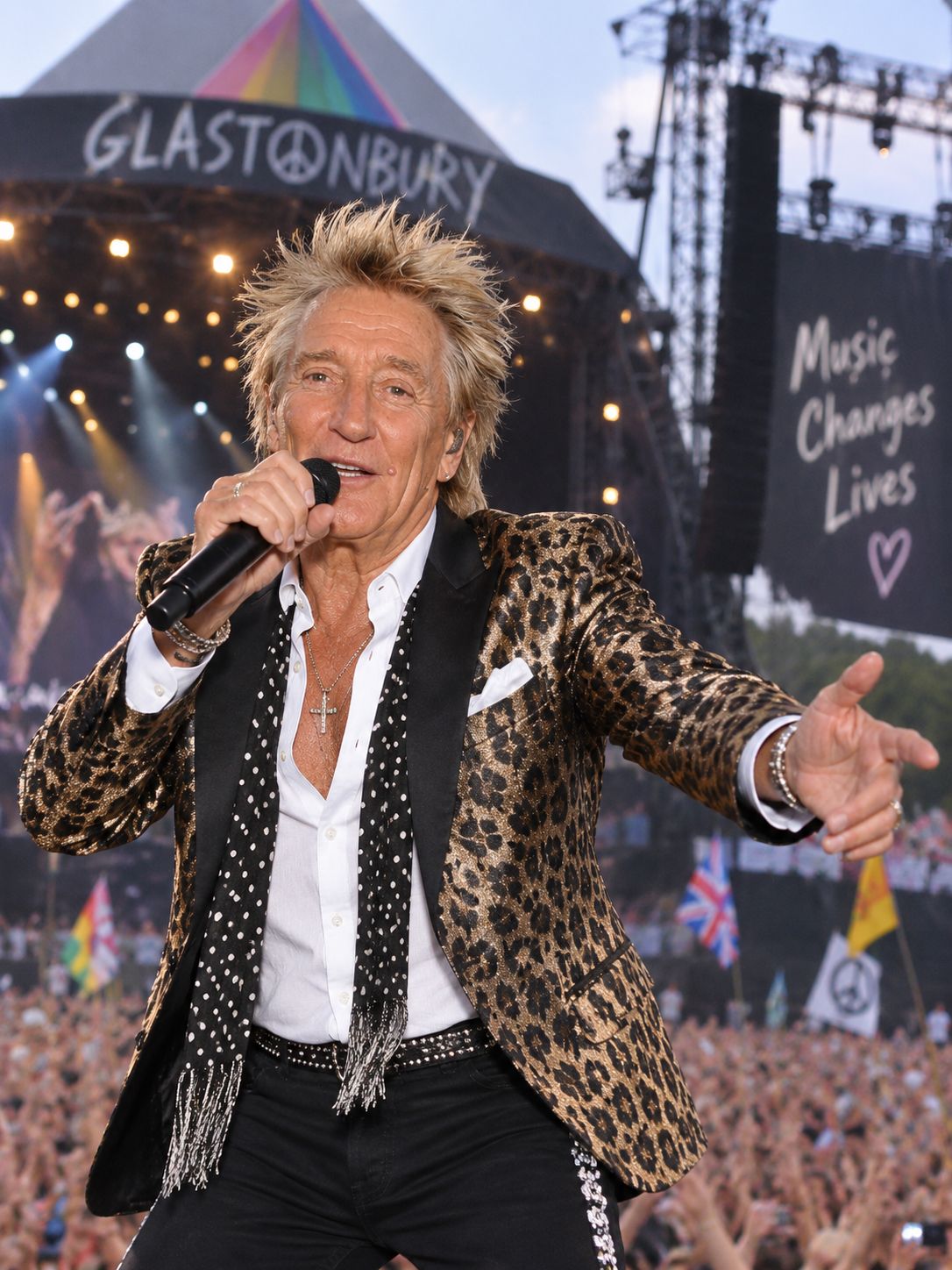
There are performances that impress because they are new, daring, and unexpected, and then there are performances that matter for an entirely different reason. Rod Stewart’s appearance at Glastonbury 2025 belonged firmly to the second category. When the unmistakable British singer walked onto the Pyramid Stage for the celebrated Sunday afternoon Legends Slot, the occasion felt larger than another entry on a festival timetable. It was a meeting between a performer whose music had accompanied several generations and an audience gathered to celebrate not simply a catalogue of famous songs, but the extraordinary endurance of a voice, a personality, and a career that had survived changing fashions for more than half a century. At the age of 80, Stewart did not need to prove that he belonged there. His history had already done that for him. What remained was something warmer and more human: the opportunity to stand before Glastonbury once again and remind thousands of people why those songs had stayed with them for so long.
The significance of the afternoon became even clearer when one considered how much time had passed since Stewart’s previous major appearance at Worthy Farm. He had headlined the Pyramid Stage in 2002, and more than two decades later he returned not as an artist attempting to recreate his youth, but as a veteran comfortable with the remarkable distance he had travelled. The official Glastonbury schedule placed him on the Pyramid Stage on Sunday afternoon, before Nile Rodgers & Chic, Noah Kahan, and Sunday headliner Olivia Rodrigo. Yet festival importance cannot always be measured by who performs last. The Legends Slot has developed its own emotional weight, becoming a place where audiences celebrate artists whose songs have become woven into British cultural memory. Stewart arrived carrying exactly that kind of history.
For older listeners in particular, Rod Stewart represents far more than a familiar face from another era. His voice has always possessed a quality that resists polish: weathered, grainy, conversational, and instantly recognizable. It can suggest vulnerability without becoming fragile and confidence without sounding distant. That unusual mixture helped make songs such as “Maggie May,” “I Don’t Want to Talk About It,” and “Sailing” endure long after the musical landscape around them changed. At Glastonbury, those songs were not simply reminders of past chart success. They became shared memories. Somewhere in that enormous field were people who had first heard Stewart on vinyl, people who remembered buying his records when they were new, people who had discovered him through parents or grandparents, and younger listeners encountering those melodies as living pieces of musical history rather than museum exhibits.
That intergenerational connection is one reason the afternoon carried such emotional force. Popular music often places enormous emphasis on youth, novelty, and reinvention, but Glastonbury’s Legends Slot offers another perspective. It asks audiences to consider endurance. What does it mean for a song to remain recognizable after fifty years? What does it mean for a singer to walk onto one of the world’s most famous festival stages at 80 and hear thousands of people respond to music created decades earlier? Stewart’s performance offered a persuasive answer. Longevity in music is not simply about surviving. It is about creating something that remains useful to people — songs they return to when they celebrate, remember, grieve, travel, fall silent, or simply wish to hear a familiar voice again.
The afternoon was also enriched by musicians who carried their own histories onto the stage. Ronnie Wood, Stewart’s former Faces bandmate and longtime Rolling Stones guitarist, joined him for “Stay With Me,” creating a reunion that connected the enormous Glastonbury crowd with a much earlier chapter of British rock. Mick Hucknall appeared for “If You Don’t Know Me by Now,” while Lulu also joined Stewart during the set. These appearances did more than add famous names to the bill. They transformed part of the performance into a celebration of friendships, shared careers, and a musical generation that helped define British popular culture. Reuters reported that the approximately 90-minute set ultimately closed with the crowd joining Stewart for “Sailing,” perhaps the most fitting conclusion possible for an afternoon built around collective memory.
Another particularly meaningful moment came when Glastonbury founder Michael Eavis appeared onstage. Stewart embraced the man whose farm had grown into one of the most famous gathering places in modern music, and the audience responded warmly. It was a quiet reminder that Glastonbury itself has aged alongside many of the musicians it celebrates. Festivals are sometimes described through attendance figures, lineups, stages, and headlines, but their true identity is built through accumulated memories. Eavis and Stewart standing together represented two different but intersecting histories: one man who helped create the place and another whose music had travelled through much of the same cultural era.
There was also something refreshing about seeing Rod Stewart at 80 without demanding that he somehow become the young man audiences remembered from old photographs. Age was not something that needed to be hidden from the occasion; it was part of what gave the performance meaning. The years had added context to every familiar chorus. His presence demonstrated that a legendary career is not defined by remaining unchanged but by allowing the songs to gather new associations as performer and audience grow older together. A lyric heard at 20 rarely carries exactly the same meaning at 50, 60, or 70. Great popular songs survive because they seem able to travel with us, changing slightly as our own lives change.
For that reason, the Glastonbury performance was never merely about nostalgia. Nostalgia may bring an audience to a familiar song, but it cannot by itself create the communal energy of thousands of people singing together. That requires music that still communicates something. Stewart’s most enduring recordings possess precisely that quality. They are melodic, direct, emotionally accessible, and often built around the kind of choruses that invite participation rather than admiration from a distance. On the enormous Pyramid Stage, those characteristics became especially powerful because the boundary between performer and audience repeatedly seemed to narrow. The crowd was not simply watching history; for ninety minutes, it was participating in it.