Introduction
THE SONG ELVIS NEVER GOT TO SING WITH DOLLY — The Duet Country Music Can Only Imagine
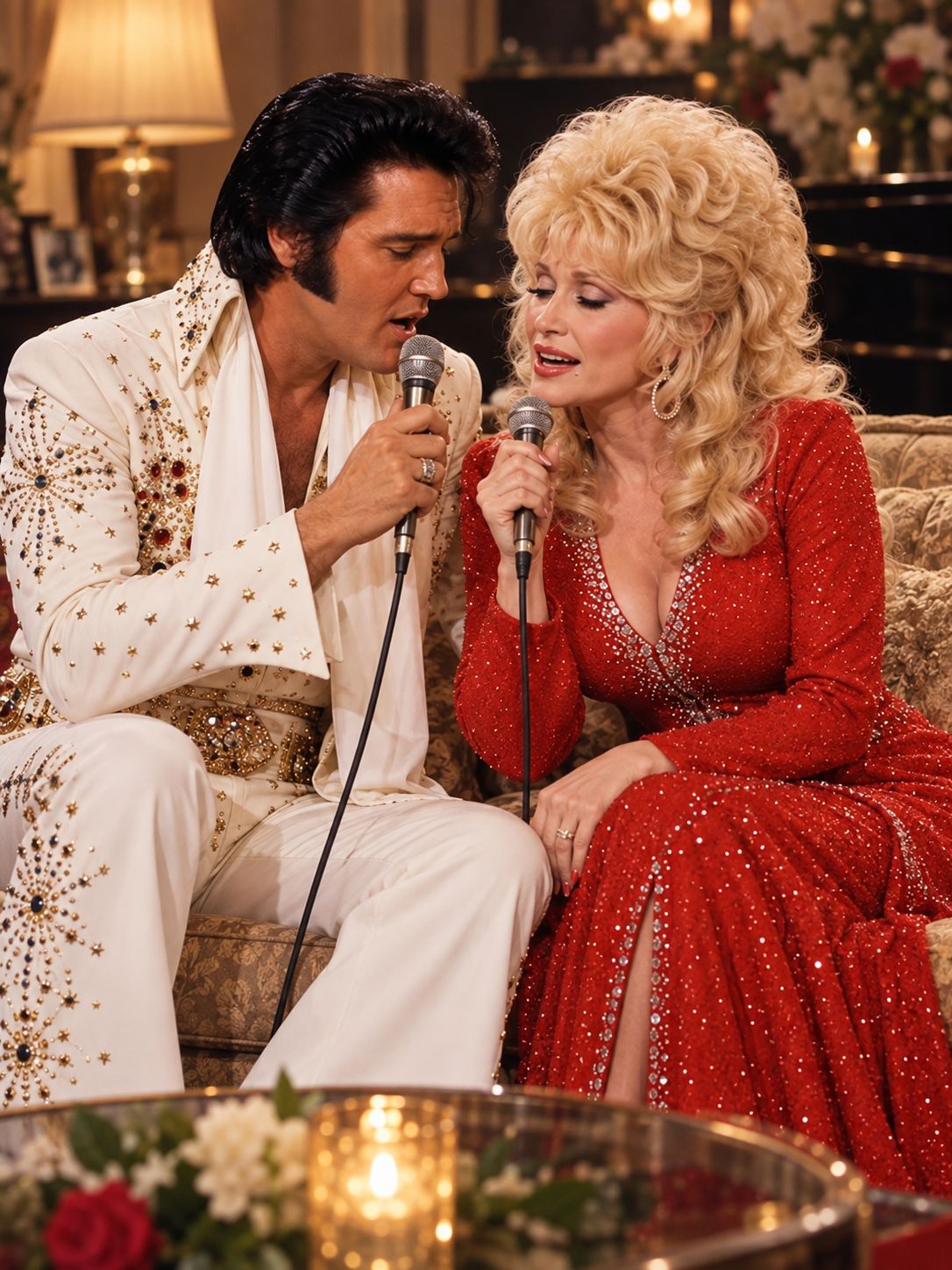
Some musical moments become immortal because millions of people were fortunate enough to witness them. Others become equally fascinating because history stopped just short of allowing them to happen. Few unrealized possibilities have inspired more imagination than Dolly Parton and Elvis Presley sharing a microphone for “I Will Always Love You.” They never recorded the song together, and no forgotten concert film exists of the two Tennessee-born icons trading verses beneath the stage lights. Yet the story behind Elvis’s interest in Dolly’s composition has endured for decades, leaving admirers with one irresistible question: What might have happened if two of America’s most recognizable voices had finally entered the same song?
The story begins not with Elvis, but with Dolly Parton, a young songwriter who understood something that would define her entire career: a song could be more valuable than the moment in which it became famous. Dolly wrote “I Will Always Love You” in the early 1970s as a deeply personal farewell, and her original recording was released in 1974. The song did not depend upon a huge orchestra or dramatic vocal display. Its strength came from restraint. Dolly sang as though she were sitting across a quiet room from someone whose importance could never be erased, even though the time had come to walk away. That mixture of gratitude, sadness, dignity, and acceptance became the emotional foundation of a composition that would eventually travel far beyond country music.
Then came the possibility of Elvis Presley.
For Dolly, the idea must have seemed extraordinary. Elvis was already far more than a successful singer. He was a cultural figure whose recordings had transformed popular music, while his interpretations of gospel, country, blues, and ballads demonstrated a sensitivity sometimes overshadowed by the mythology surrounding the King of Rock and Roll. According to Dolly’s frequently told account, Elvis wanted to record “I Will Always Love You.” She was thrilled by the prospect. Then, before the recording could take place, a business issue arose involving publishing rights. Elvis’s manager, Colonel Tom Parker, wanted a significant share of the song’s publishing as part of the arrangement. Dolly refused to surrender it.
It was a painful business decision, but also one of the most important decisions of her career. Dolly admired Elvis and wanted to hear his interpretation, yet she understood that ownership of her songs represented something greater than a single prestigious recording. The song remained hers. Elvis’s version never came.
And that is where history ends and imagination begins.
Picture a theater after the lights have dimmed. There is no enormous introduction and no need for fireworks. A piano plays the opening progression while Dolly Parton walks toward the center microphone. Instead of the elaborate spectacle associated with some of her grandest appearances, the arrangement is almost bare. She begins quietly, allowing the words to carry the emotional weight. Her familiar Appalachian tone sounds fragile but assured, suggesting that farewell does not always mean anger or regret. Sometimes it means respecting someone enough to release them.
Then, halfway through the performance, a second light slowly rises.
Elvis Presley steps forward.
The most obvious mistake would be to imagine Elvis approaching the song as though it were another arena anthem. His greatest vocal gift was not simply volume. On recordings such as his gospel performances and late-career ballads, Elvis could reduce his voice almost to a conversation before suddenly allowing it to bloom. That quality could have made “I Will Always Love You” remarkably suited to him. Rather than competing with Dolly, one can imagine Elvis answering her lines with his warm lower register, turning the song from a single farewell into a conversation between two people who understand that affection can survive separation.
The imagined contrast between their voices is precisely what makes this unrealized duet so compelling. Dolly’s voice carried mountain clarity, an unmistakable brightness shaped by the musical traditions of East Tennessee. Elvis’s voice could move from tender country phrasing to gospel intensity within a few measures. Dolly might have delivered the lyric with the perspective of its writer, while Elvis could have approached it as an interpreter—someone stepping inside another person’s story and making its emotions feel personally lived.
Near the final verse, perhaps neither singer would attempt to dominate the other. Dolly might raise her voice only slightly, while Elvis answers with one of those restrained harmonies that characterized some of his finest gospel work. The band remains behind them rather than around them. A piano, a soft guitar, perhaps a few strings. Nothing else would be necessary. The extraordinary element would not be the arrangement but the recognition that two Tennessee legends, born into very different circumstances yet shaped by many of the same Southern musical traditions, had arrived at the same emotional destination.
And when the final words came, perhaps there would be no dramatic ending at all.
They would simply stop singing.
That silence might have been the most powerful part.
The imagined duet also reminds us how different Dolly Parton and Elvis Presley were as artists and business figures. Elvis became one of the most famous performers in history, but much of the material associated with him was written by others. Dolly built her legacy not only as a performer but as an extraordinarily productive songwriter who fiercely protected the ownership of her compositions. Their near-intersection over “I Will Always Love You” therefore represents something larger than a recording that did not happen. It reveals the complicated relationship between artistry, business, ownership, and legacy.
Years later, the wisdom of Dolly’s decision became impossible to ignore. “I Will Always Love You” continued to live far beyond its original release, eventually becoming one of the most recognizable compositions associated with American popular music. Yet Dolly has never treated the Elvis story merely as a tale of lost money or missed opportunity. What gives it lasting poignancy is the personal dimension: she genuinely admired his voice and wondered how he might have interpreted the song.
Perhaps that is why the nonexistent duet remains so vivid.
We can imagine Dolly beginning alone beneath a soft spotlight. We can imagine Elvis entering during the second verse. We can imagine the audience realizing that they were witnessing something impossible to repeat. And perhaps, just before the final note disappears, we can imagine the two singers looking toward one another—not as the Queen of Country Music and the King of Rock and Roll, but simply as two Southern artists who understood what a great song could say when almost everything else had already been said.
Elvis never recorded “I Will Always Love You.” Dolly never stood beside him to sing it. The duet exists only in imagination. Yet sometimes the performances history denied us are the ones we continue hearing most clearly in our minds.