Introduction
THE TWINS WHO FOOLED MILLIONS: Can You Really Tell Robin and Maurice Gibb Apart?
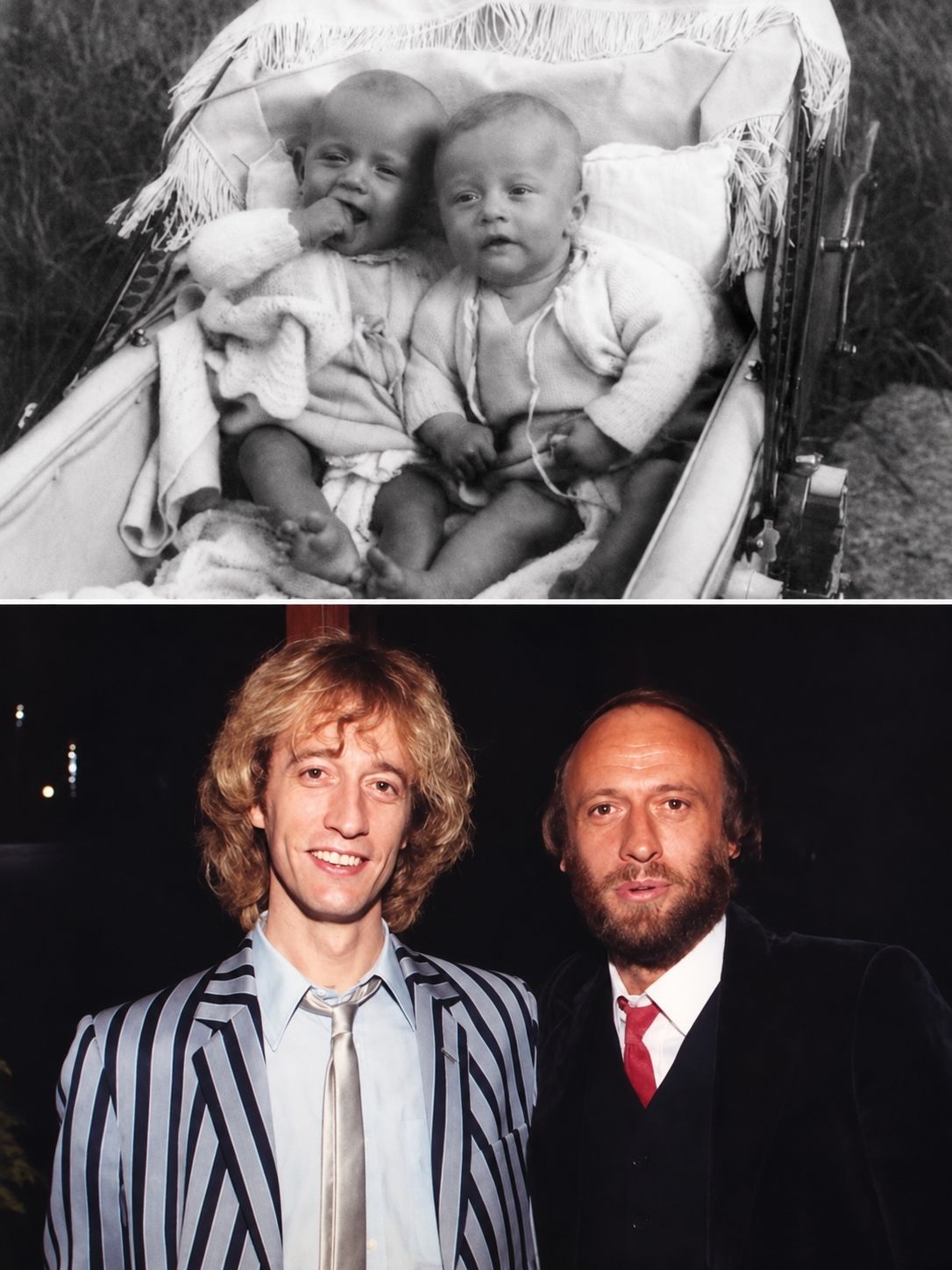
Look closely at an old photograph of the Bee Gees, especially one taken during the brothers’ younger years, and a surprisingly difficult question can arise: which one is Robin Gibb, and which one is Maurice Gibb? To longtime fans, the answer may seem obvious. Yet for casual listeners—or even devoted admirers looking at photographs from an unfamiliar period—the resemblance between the two brothers can be striking enough to cause genuine confusion.
Robin Gibb and Maurice Gibb were fraternal twins, born on December 22, 1949, only minutes apart. They were not identical twins in the strict biological sense, yet certain photographs from their youth make them appear remarkably similar. The same dark hair, similar facial structure, matching expressions, and naturally close body language can make an old family or publicity photograph feel almost like a visual puzzle.
And perhaps that is part of the fascination.
The Bee Gees were never simply three singers standing beside one another. They were brothers whose lives had been intertwined from childhood, first in England, then in Australia, and eventually on stages around the world. Barry Gibb, the eldest, often became the easiest brother to identify because of his height, later beard, and frontman image. But with Robin and Maurice, especially in the 1960s, the differences could appear much more subtle.
For many fans, the easiest clue is often Robin’s face and expression. Robin frequently carried a more delicate, almost introspective appearance in photographs. His features could seem narrower, and his expressions often reflected the same emotional sensitivity heard in his unmistakable singing voice. When Robin stepped forward to sing songs such as “Massachusetts” or “I’ve Gotta Get a Message to You,” there was something immediately recognizable about him: the concentrated expression, the stillness, and that famous vibrato that seemed to tremble with feeling.
Maurice, by contrast, often projected a more playful and relaxed presence. Over the years his appearance changed considerably through different hairstyles, facial hair, glasses, and stage fashions, sometimes making him easier to distinguish from his twin than he had been in their earliest photographs. His personality also frequently seemed to emerge visually. Maurice was known within the group for his humor, warmth, and ability to lighten tense moments, and many photographs capture a mischievous quality in his smile.
But appearance alone does not tell the whole story.
The deeper way to distinguish the twins is through what each man brought to the music.
Robin Gibb was one of the Bee Gees’ great emotional voices. His vibrato was so individual that listeners could recognize him within seconds. He had the rare ability to make a lyric sound fragile without making it weak. When Robin sang lead, the song often seemed to become more urgent, more vulnerable, and more personal.
Maurice Gibb, meanwhile, became the group’s musical anchor. A gifted multi-instrumentalist, he played bass, guitar, keyboards, and other instruments while helping shape the arrangements that surrounded the brothers’ voices. He did not always receive the same attention as the most prominent lead singer, but remove Maurice from the musical structure and much of the Bee Gees’ distinctive balance disappears.
That is what makes photographs of the twins so moving today.
When we look at them now, we are not merely trying to identify two similar faces. We are looking at two men who entered the world together, built one of popular music’s most extraordinary careers together, and spent decades creating a sound that neither could have created alone.
There is also something poignant about the way time changes the meaning of those photographs. During the height of the Bee Gees’ career, a picture of Robin and Maurice might simply have been another publicity image in a magazine. Today, after both brothers have died, the same picture can carry an entirely different emotional weight.
Maurice Gibb died in January 2003 at only 53. Robin Gibb died in May 2012 at 62. Their older brother Barry was left as the final surviving member of the famous trio, carrying memories that once belonged to three men.
And yet, photographs preserve something music does as well: they suspend time.
In an old image, Robin and Maurice remain young. Their careers are still ahead of them. The arguments, triumphs, separations, reunions, and losses have not yet happened. They are simply two brothers standing together, perhaps looking similar enough that a stranger might have to study the photograph twice.
For older listeners who followed the Bee Gees across the decades, that recognition can be deeply emotional. You may identify Robin by the eyes, Maurice by the smile, or perhaps by a hairstyle remembered from an album cover decades ago. But the longer you look, the more the exercise becomes about something greater than identification.