Introduction
Before The King Had a Crown: The Poor Mississippi Boy Whose Childhood Pain, Gospel Roots, and $12.95 Guitar Changed American Music Forever
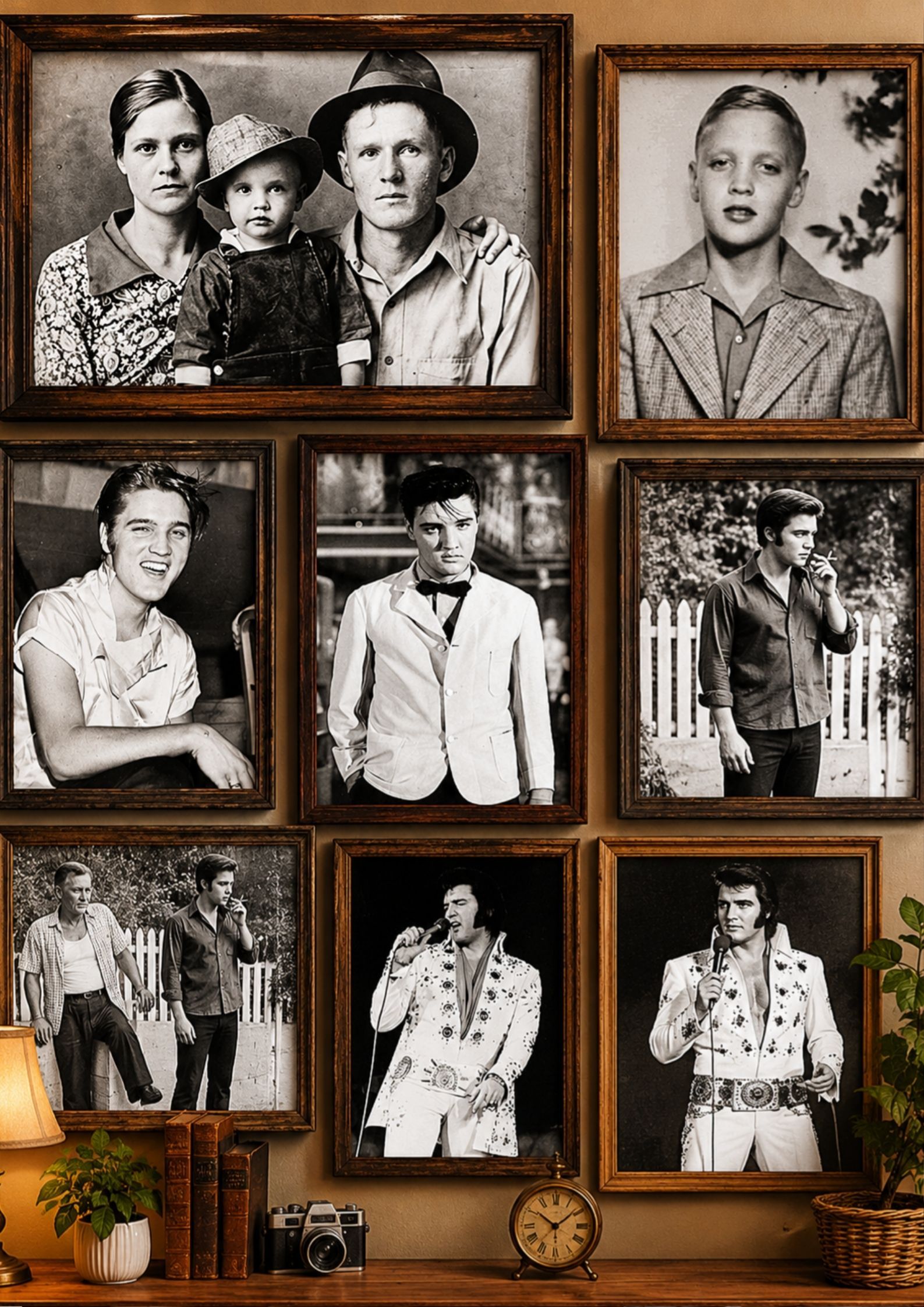
Before The King Had a Crown: The Poor Mississippi Boy Whose Childhood Pain, Gospel Roots, and $12.95 Guitar Changed American Music Forever
Before the world knew him as Elvis Presley, before the television appearances, gold records, sold-out concerts, and the mythology of The King of Rock and Roll, he was a quiet boy from Tupelo, Mississippi, growing up in a family that had very little money but an extraordinary amount of devotion. His early life was not glamorous. It was shaped by hardship, movement, church music, family loyalty, and the constant hope that tomorrow might be better than yesterday. To understand Elvis as an artist, one must first understand Elvis Presley’s childhood — because the roots of his music were planted long before fame ever found him.
Elvis was born on January 8, 1935, shortly before dawn, in a small two-room house built by his father, Vernon Presley, with help from family. His birth came with sorrow as well as blessing. His twin brother, Jessie Garon, was stillborn, while Elvis Aaron Presley survived. From that moment forward, Elvis became the only child of Vernon and Gladys Presley, and the center of their world. That early family closeness would remain one of the defining forces of his life.

From 1935 to 1948, Elvis grew up in a close-knit, working-class family in Tupelo. His parents, grandparents, aunts, uncles, and cousins lived near one another, creating a world where family ties were strong even when money was scarce. The Presleys moved from one home to another, doing their best to survive. But within those humble circumstances, Elvis absorbed sounds that would one day reshape American music.
One of the most important influences was church. Elvis and his family attended the Assembly of God Church, where music and preaching made a deep impression on him. The emotional power of gospel singing entered him early. He also heard Black blues musicians in the neighborhood and country music on the radio, creating a musical education far richer than anything a classroom could have offered. Long before he became famous for blending styles, Elvis was already living in a world where gospel, blues, and country music surrounded him.
One of the earliest public signs of his talent came on October 3, 1945, when ten-year-old Elvis stood on a chair before a microphone and sang “Old Shep” at the Mississippi-Alabama Fair and Dairy Show in Tupelo. It was a youth talent contest broadcast over WELO Radio, and Elvis won fifth prize — $5.00 in fair ride tickets. It was not a grand debut by later standards, but it mattered. It was one of the first moments when the shy boy with a guitar began stepping toward the stage.
In 1946, another small turning point occurred. Elvis wanted a bicycle, but his parents could not afford one. Instead, Gladys Presley persuaded him to accept a guitar. That first guitar, purchased from Tupelo Hardware Company for $12.95, became more than a substitute gift. It became the instrument that helped carry his voice into history. In hindsight, it is almost impossible not to feel the symbolism: a poor family could not buy a bicycle, but they unknowingly bought the beginning of a musical revolution.

By November 6, 1948, the Presley family faced another major change. Elvis played his guitar and sang “Leaf on a Tree” for his class at Milam Junior High as a farewell before the family packed their belongings into a trunk, strapped it to the roof of a 1939 Plymouth, and moved to Memphis, Tennessee, searching for a better economic life. That move would change everything.
Life in Memphis was still difficult. From 1948 to 1953, Elvis and his parents lived in public housing or low-rent homes in poor neighborhoods of north Memphis. Vernon and Gladys worked various jobs, and Elvis also worked to help support the family. He attended L.C. Humes High School, where he stood out as different from other students. He wore his hair longer than was common, slicked it back, grew sideburns, bought clothes on Beale Street, and carried himself with a quiet individuality that made him a good-natured misfit.
But Memphis also gave Elvis a deeper musical education. On Beale Street, he absorbed the blues. At downtown gospel sings, he listened to voices that crossed racial and cultural boundaries. He continued singing with his guitar, gradually shaping the sound and presence that would later shock the world.

At Humes High, Elvis nervously performed in a student talent show. To his surprise, he received more applause than anyone else, won the contest, and sang an encore. That moment of acceptance mattered deeply. For a young man who often felt different, applause became proof that his difference could become a gift.
Elvis graduated from Humes High School on June 3, 1953. Soon afterward, he worked at Parker Machinists Shop, still far from stardom. Then, that summer, he visited The Memphis Recording Service, home of the Sun label, and recorded “My Happiness” and “That’s When Your Heartaches Begin” for about $4.00, reportedly as a gift for his mother, Gladys. Sam Phillips heard something worth remembering, and assistant Marion Keisker noted him as a “Good ballad singer.”
No one fully knew it yet, but the childhood chapter was ending, and history was about to begin. The poor boy from Tupelo, shaped by hardship, church music, blues, country radio, family love, and a $12.95 guitar, was standing at the doorway of a future that would change American music forever.