Introduction
The Night Elvis Presley Said Goodbye Without Knowing It—Inside the King’s Haunting Final Concert
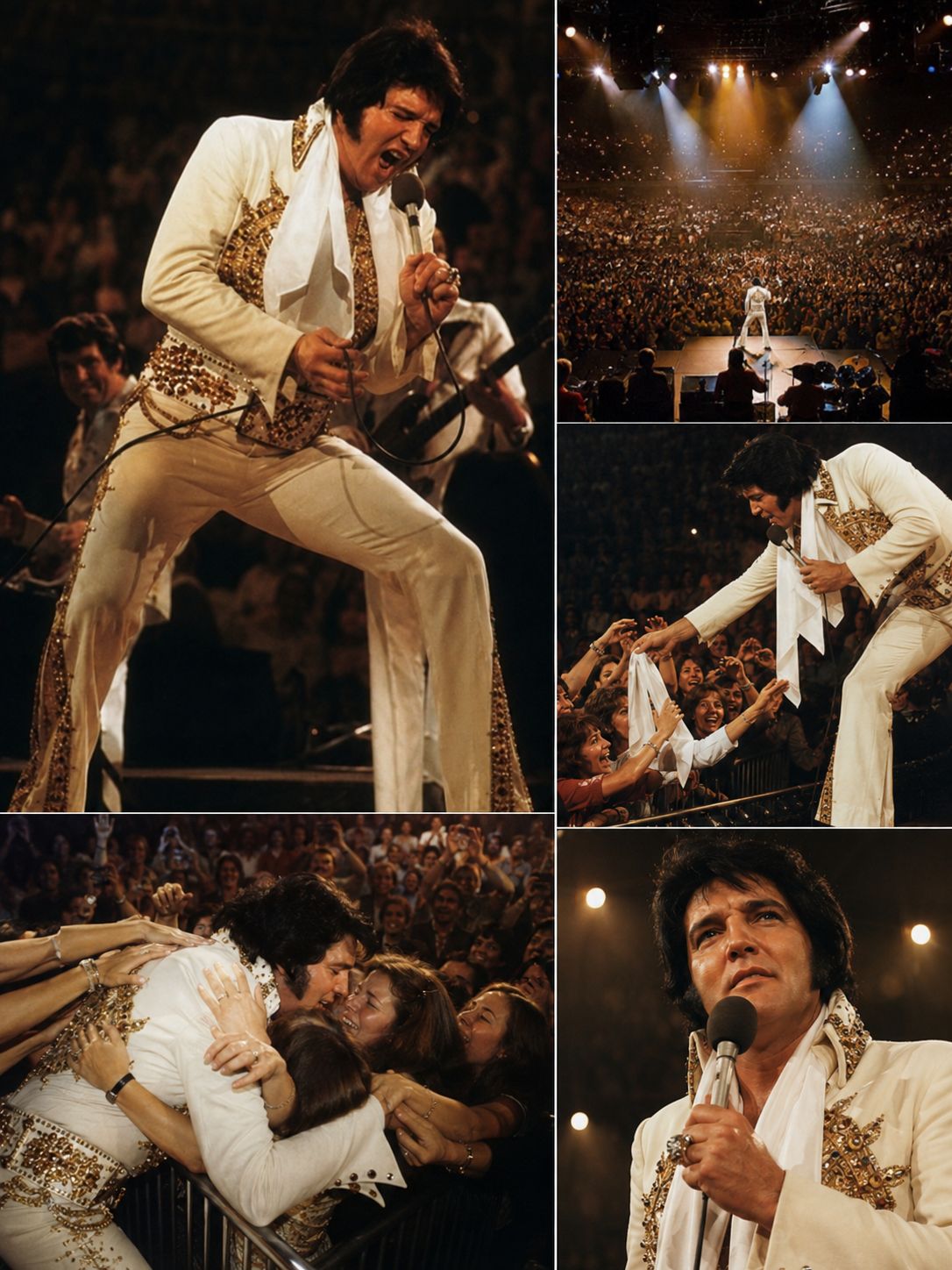
On the evening of June 26, 1977, thousands of people entered Market Square Arena in Indianapolis expecting another unforgettable night with Elvis Presley. They came carrying tickets, cameras, memories, and the familiar excitement that followed the most recognizable entertainer of his generation wherever he traveled. None of them understood that they were about to witness the final public concert of his life. There was no official farewell, no grand announcement, and no indication that history was preparing to close one of its most extraordinary chapters. It was simply another scheduled performance by a man who had spent more than two decades transforming popular music.
Elvis was only 42 years old, and additional concert dates were already being planned. To the audience, the future still seemed open. They believed there would be more tours, more recordings, and more opportunities to watch the King walk beneath the stage lights. Yet beneath that expectation was a more troubling reality. By the summer of 1977, Elvis was experiencing serious health difficulties, physical exhaustion, and the tremendous strain created by years of relentless performance. His condition could vary greatly from one evening to another, leaving those around him uncertain about which version of Elvis would appear when the curtain rose.
Still, when the music began in Indianapolis, the crowd responded with the devotion that had followed him since the 1950s. Market Square Arena held approximately 18,000 admirers that night, representing several generations of listeners. Some had discovered Elvis through his revolutionary early recordings at Sun Records. Others remembered his television appearances, Hollywood films, military return, and triumphant 1968 television special. Younger members of the audience knew him as the commanding figure in white stage clothes who had dominated Las Vegas and large American arenas throughout the 1970s.
Before Elvis appeared, comedian Jackie Kahane, his longtime opening act, attempted to entertain an audience whose anticipation was fixed entirely upon the star they had come to see. Opening for Elvis had never been an easy assignment. Crowds could become impatient, calling for the main attraction before the supporting performance had finished. On this night, Kahane reassured the Indianapolis audience that Elvis looked and sounded well. Those words would later acquire a heartbreaking significance because they were spoken only weeks before the singer’s death.
When the familiar orchestral introduction announced Elvis’s arrival, the arena erupted. He stepped onto the stage wearing a white jumpsuit decorated with gold details, an image that immediately recalled the larger-than-life performer audiences expected. Although his movements were less explosive than they had been during earlier years, his entrance still carried enormous authority. Few performers in music history could create such excitement simply by walking into view.
Elvis opened with “C.C. Rider,” a concert favorite that allowed the musicians and audience to settle into the familiar rhythm of an Elvis Presley show. His famous stage gestures appeared in more restrained form, yet moments of the old electricity remained. The voice that had once startled America was still capable of filling the arena, especially when Elvis focused upon songs requiring emotional depth rather than physical spectacle.
:max_bytes(150000):strip_icc():focal(499x0:501x2)/elvis-presley-final-performance-111324-346d9bc2fa33421ea4bfc1ec6f93ad73.jpg)
The concert included a mixture of early hits, later recordings, gospel-influenced performances, and familiar standards. By 1977, Elvis’s catalog had become so extensive that no single show could satisfy every request. Each song carried memories for different members of the audience. A number from the 1950s might return one listener to a high school dance, while a ballad from the 1960s could remind another of marriage, family, or a loved one no longer present.
One of the most revealing features of Elvis’s final years was his ability to rise above visible weariness when a song touched him deeply. His physical condition may have changed, but his instinct for communicating emotion had not disappeared. On demanding ballads, the voice could still reveal strength, tenderness, and spiritual intensity. Performances such as “Bridge Over Troubled Water” demonstrated why Elvis remained more than a figure of nostalgia. He possessed the rare ability to transform a familiar song into something that seemed connected to his own private struggles.
Critical reactions to his later concerts were often divided. Some reviewers considered the elaborate stage format dated, and others complained that the performances lacked the sharpness of his greatest years. Such judgments were not entirely unfair, but they could overlook the emotional relationship between Elvis and his audience. People did not attend merely to evaluate lighting arrangements, tempos, or technical precision. They came because Elvis had accompanied them through important periods of their lives.
For many older fans, seeing him in person was like meeting a figure connected to their own youth. His early music had arrived during a moment of enormous cultural change, challenging established categories and bringing together influences from country, gospel, blues, and rhythm and blues. By 1977, those same listeners had grown older alongside him. When they saw signs of vulnerability onstage, they were not simply watching a celebrity decline. They were confronting the passage of time itself.

The Indianapolis concert also included several personal moments. Elvis introduced members of his band and acknowledged the musicians, singers, and staff who had supported him. These introductions had become an established part of his shows, but on this final night they now seem like an accidental farewell to the people who had helped carry his music across America.
Among those present was Elvis’s father, Vernon Presley, who was brought before the audience and greeted warmly. The sight of father and son together carried particular emotional weight. Vernon had witnessed Elvis’s journey from a modest childhood in Tupelo, Mississippi, to worldwide fame. He had seen the family move to Memphis, watched Elvis make his first recordings, and endured both the triumphs and losses that followed. Neither man could have known that this would be the final time Vernon watched his son perform before a concert audience.
As the evening approached its conclusion, Elvis began “Can’t Help Falling in Love,” the song that had closed so many of his performances. The arrangement was familiar, and the audience understood that the concert was ending. Yet they had no reason to believe that this closing number was different from the hundreds that had come before it. People applauded, waved, and attempted to preserve one final image as Elvis stood beneath the lights.
Then came the farewell that would become inseparable from the memory of the evening. Elvis thanked the audience and said, “We’ll meet you again. God bless, adios.” At the time, the words sounded like an ordinary promise from a performer expecting to return. After his death on August 16, 1977, they took on the character of a final message.
The house lights rose, the crowd began leaving, and equipment was prepared for the next journey. No one announced that the King had left the stage for the last time. There was no silence of recognition because recognition had not yet arrived. Fans walked into the Indianapolis night discussing favorite songs, comparing photographs, and wondering when Elvis might return to their city.
That ordinary departure is what makes the final concert so haunting. History rarely announces itself clearly while it is happening. The audience did not know it was attending a farewell, and Elvis did not appear to believe he was giving one. The evening contained imperfections, fatigue, humor, musical power, and brief glimpses of the magnetic performer who had once changed everything. It was neither the greatest concert of his career nor the tragic collapse some later accounts have suggested. It was the final working night of a complicated and gifted artist who still understood how much his presence meant to the people before him.
Less than two months later, Elvis Presley died at Graceland, and the world returned to every available photograph, recollection, and unofficial recording from Indianapolis. Moments that had appeared routine suddenly became precious. His entrance became the last entrance. His introductions became final acknowledgments. His closing song became an unplanned benediction.
Yet the story of Elvis Presley’s last concert is not only about decline or death. It is also about the enduring bond between an artist and his listeners. Even during a difficult period, he remained capable of bringing thousands of strangers together through music. The crowd responded not merely to the legend but to the human being standing before them, vulnerable yet still determined to perform.
The curtain fell in Indianapolis, but Elvis’s voice did not disappear with it. His recordings continued to cross borders and generations, reaching listeners who had not yet been born when he gave that final bow. The arena itself would eventually vanish, but the memory of that night remains. June 26, 1977 endures as the evening when thousands watched Elvis Presley say goodbye without realizing that goodbye had truly come.