Introduction
THE FINAL NIGHT ELVIS SANG TO THE WORLD—AND THE GOODBYE NO ONE KNEW THEY WERE HEARING

Some concerts disappear almost as soon as the lights come back on. The audience returns home, the stage is dismantled, and the evening becomes one more date in a performer’s long career. Other concerts survive because they mark a cultural turning point or capture an artist at the height of extraordinary power. Then there are the rare performances that become sacred only afterward, when history reveals that an ordinary-looking evening was actually the closing chapter of a life.
That is what happened on June 26, 1977, when Elvis Presley walked onto the stage at Market Square Arena in Indianapolis. Thousands of people entered the building expecting music, excitement, and the familiar thrill that accompanied every appearance by the man still known throughout the world as the King of Rock and Roll. They carried cameras, programs, handmade signs, and personal memories tied to songs that had accompanied marriages, family journeys, military service, and years of American change.
None of them knew they were about to witness Elvis Presley’s final concert.
When the lights dimmed, the arena responded with the enormous roar that had followed Elvis for more than two decades. Musical styles had changed since the young singer from Memphis first unsettled television audiences in the 1950s. New stars had risen, and younger performers had begun shaping a different era. Yet when Elvis appeared beneath the spotlight, time seemed to fold backward. The crowd did not merely see a famous singer. They saw the man whose voice had altered the direction of popular music and whose image had become inseparable from American culture.
He arrived wearing one of the white stage suits associated with his later years, surrounded by musicians who understood both his greatness and his growing physical struggle. By the summer of 1977, Elvis was no longer the effortless young performer who had once moved with explosive confidence. Years of exhausting schedules, declining health, emotional isolation, and dependence on prescription medication had taken a visible toll.
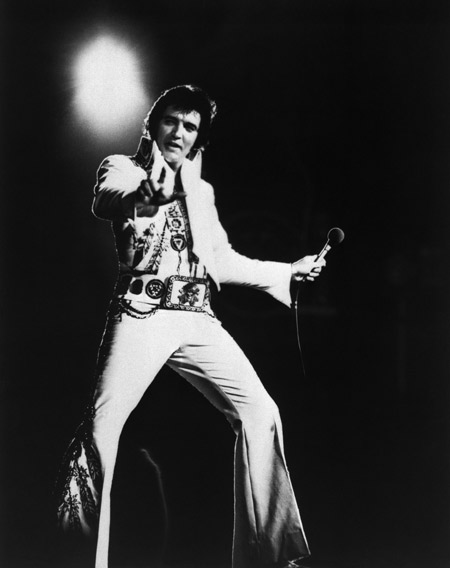
The public still wanted the legend, even as the man behind the legend was weakening.
That contradiction gives the Indianapolis concert its lasting emotional power. It was not remembered as a technically perfect performance, nor should it be presented as one. There were moments when exhaustion could be heard and seen. Yet perfection was no longer the most important measure. Elvis continued because music remained one of the few places where he could still reach people directly.
Onstage, he was surrounded by love rather than expectation alone. The applause briefly replaced isolation. The familiar melodies connected him to the young dreamer who had once entered Sun Studio with little more than hope and an unmistakable voice. Even during difficult nights, the transformation could still occur when the band began playing. Some part of the old electricity returned, imperfect but undeniable.
That evening, the audience heard songs already woven into the national memory. Each melody carried years of meaning. Older couples remembered when Elvis had first appeared on their radios. Parents stood beside children who had inherited the music rather than experienced its beginnings. For everyone in the arena, the songs belonged not only to Elvis but also to their own lives.
This was always one of his greatest gifts. Elvis could make thousands of strangers feel as though a song belonged personally to each of them.
As the concert moved toward its end, the familiar opening of “Can’t Help Falling in Love” began to fill the arena. Elvis had used the song to close performances for years, so no one had reason to believe this version would become different from all the others. Yet hindsight has transformed every note.
His voice carried tenderness, but also unmistakable weariness. The smooth control of earlier decades had softened into something more fragile. Instead of diminishing the performance, that vulnerability gave it a painful honesty. He no longer sounded like an untouchable cultural force. He sounded like a tired man offering one final piece of himself to people who had loved him for years.
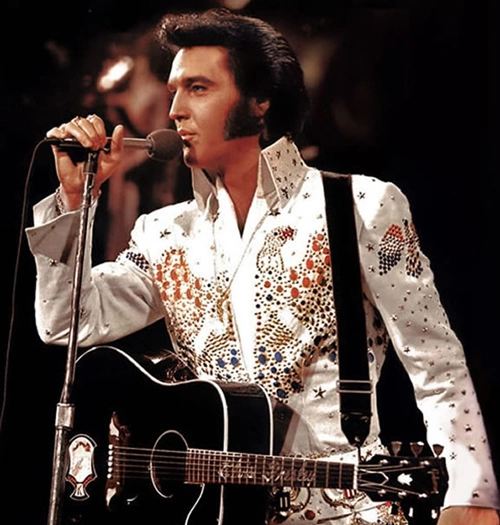
The audience could not have understood the full meaning of the moment. To them, it was the end of another concert. Elvis would leave the stage, the tour would continue, and there would surely be another opportunity to see him. Still, some who remembered the evening later described an unusual emotional atmosphere surrounding those closing minutes.
Perhaps they sensed only fatigue. Perhaps memory added meaning after tragedy arrived. History often works that way. A smile becomes unforgettable because it was the last one. A casual gesture becomes precious because it can never be repeated. Ordinary moments gain extraordinary weight only after time has taken away the possibility of another.
When the final notes faded, Elvis offered the audience his familiar gratitude. He moved across the stage, acknowledging the people who continued reaching toward him. Scarves, waves, bows, and brief moments of connection had long been part of his performances. On this night, they became the final gestures Elvis Presley would ever give a live audience.
Then he left the stage.
There was no grand announcement that an era had ended. No voice warned the crowd to remember every detail. The musicians packed their instruments, the audience moved toward the exits, and Market Square Arena slowly became quiet again.
Only seven weeks later, on August 16, 1977, Elvis Presley died at Graceland at the age of forty-two.
The news traveled around the world with astonishing speed. Radio stations interrupted regular programs. Newspapers prepared enormous headlines. Fans gathered outside Graceland, struggling to accept that the voice which had seemed permanent could suddenly fall silent.

For those who had attended the Indianapolis concert, memory immediately changed. They had not simply seen Elvis perform. They had watched his final entrance, heard his final live songs, and witnessed his last bow. The closing performance of “Can’t Help Falling in Love” was no longer a familiar ending. It had become his farewell.
Nearly five decades later, the concert remains moving precisely because it was not marked by perfection or spectacle. What survives is the humanity of the moment. Elvis was tired, physically diminished, and carrying burdens the audience could not fully see. Yet he still walked beneath the lights and gave what remained of his voice to the people waiting for him.
That decision reflects both the beauty and tragedy of his life. Elvis transformed music, influenced generations of performers, and achieved a level of fame few individuals have ever experienced. But fame also created demands from which he rarely escaped. The world celebrated the King while often overlooking the vulnerable man required to keep the crown alive.
In Indianapolis, that man continued singing.
He did not know that history would call it his final concert. The audience did not know they were hearing a goodbye. There was only the stage, the music, and the emotional exchange that had defined Elvis Presley’s relationship with his listeners from the beginning.
Perhaps that is why the evening still touches people so deeply. It reminds us that the greatest farewells are not always spoken clearly. Sometimes they arrive through a familiar melody, a tired smile, and one final bow before the lights disappear.
On June 26, 1977, Elvis Presley gave the world everything he still had to offer.
Then silence took the stage.