Introduction
THE PRAYER THAT GAVE GEORGE STRAIT HIS LONGEST-REIGNING HIT: HOW “LOVE WITHOUT END, AMEN” TURNED A FATHER’S ANGER INTO GRACE

Thirty-six years ago, George Strait reached the top of the country chart with a song that sounded simple enough to be passed from one generation to the next. There were no grand declarations, fashionable production tricks, or complicated images. Instead, “Love Without End, Amen” offered a story about fathers and sons, discipline and forgiveness, earthly families and eternal grace. Its message was so direct that many listeners felt they had known it all their lives. Yet behind those reassuring words was a difficult night in the home of songwriter Aaron Barker, when frustration, uncertainty, a guitar, and a long period of prayer came together to create one of country music’s most enduring expressions of unconditional love.
On July 7, 1990, George Strait was in the middle of the song’s remarkable five-week stay at No. 1. Released that April as the lead single from the album Livin’ It Up, it became the first Strait recording to remain at the top for more than a single week. By then, the Texas singer had already accumulated 18 No. 1 country hits, but each of them had held the position for only one week. “Love Without End, Amen” changed that pattern and became the longest-running chart-topper of his career, later matched by “I’ve Come to Expect It from You” and “One Night at a Time.” It was also the first country single to spend more than four weeks at No. 1 since Dolly Parton’s “Here You Come Again” completed a five-week run in 1977.
Those statistics are impressive, but they do not explain why the song has remained so deeply loved. Country music history is filled with successful records that eventually became artifacts of their period. “Love Without End, Amen” never felt confined to 1990. It continued to speak to parents who struggled to balance authority with tenderness, to adult children who finally understood their fathers’ difficult decisions, and to believers who recognized something sacred in the idea of love that does not disappear when someone makes a mistake.
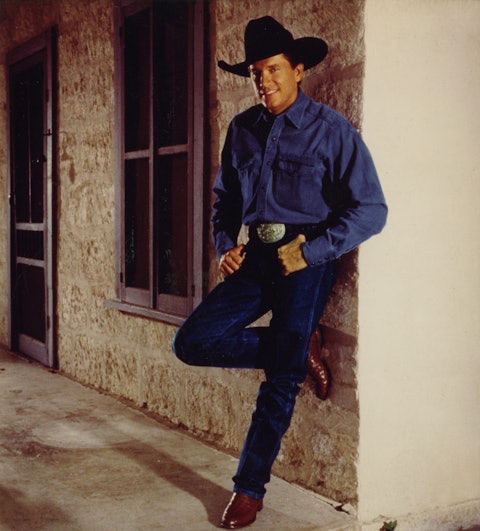
The song was written by Aaron Barker, not George Strait, but Strait’s calm and reassuring delivery made its message feel completely natural. Barker became a father shortly after turning 17 and initially imagined that he and his son might simply grow up as close companions. Because Barker’s own father had not been present in his life, having a boy of his own seemed to offer a chance to create the bond he had missed. Yet as his son reached adolescence, Barker discovered that fatherhood required more than friendship. It sometimes demanded rules, correction, and the courage to disappoint a child temporarily in order to protect him.
The defining moment came when Barker’s 16-year-old son broke several rules connected to his first car. He drove where he had been told not to go, carried passengers who were not supposed to be with him, and became involved in an accident that damaged both his vehicle and a nearby Porsche. Barker sat his son down for a serious conversation and suddenly recognized that he could no longer behave only as the boy’s friend. He had to accept the more difficult responsibility of being his father.
After his son went to bed, Barker remained awake, troubled not only by what the teenager had done but also by the strength of his own emotions. He was deeply angry, yet his love for his son had not weakened. That contradiction led him to ask a question understood by parents everywhere: How can someone make you so upset while you continue loving them so completely? Barker picked up his guitar, an instrument he described as a kind of personal therapist, and began what he called a combination of playing and praying. By approximately four in the morning, the answer had become a song.
That origin gives “Love Without End, Amen” its unusual emotional honesty. It does not present unconditional love as something effortless or sentimental. The song begins with wrongdoing and the expectation of punishment. Its narrator remembers being sent home from school after fighting, certain that his father’s anger would be severe. Instead, the father reveals a truth previously passed down to him: a father’s love for his children does not end when they fail.
In the second part of the song, the child has become a parent and faces similar trouble with his own son. The lesson is repeated, demonstrating how family wisdom can move quietly through generations. What once sounded like an unexpected act of mercy becomes a principle the narrator finally understands well enough to pass along. Discipline remains necessary, but it exists inside a love larger than the mistake.
The final verse lifts the song beyond an ordinary family story. The narrator dreams that his life has ended and that he is waiting outside Heaven, worried that his failures may prevent him from entering. Then he hears the familiar message again, now transformed into an assurance of divine compassion. The father’s love introduced in the first verse becomes an image of God’s love, connecting an imperfect parent’s experience to a larger spiritual promise. This gradual expansion—from a schoolboy, to a father, to a soul standing at Heaven’s gate—is one reason the song feels both intimate and universal.
Barker initially doubted that anyone would want to record such a personal composition. It had grown directly from a painful family moment, and he was uncertain whether the experience could belong to listeners outside his home. Yet once George Strait became its messenger, the private story reached millions. Barker later expressed gratitude that a singer of Strait’s stature had carried the song, recognizing how extraordinary it was for a story about his son to find such a trusted voice. He also played the song for his son, who understood its meaning and eventually shared it with his own children.
George Strait’s performance was essential to that success. His voice never overstates the emotion or demands that the audience respond in a particular way. He sings as though he is passing along something quietly learned through experience. That restraint allows the message to reach listeners without feeling forced. Strait has always possessed an unusual ability to make a carefully written song sound like an honest conversation, and “Love Without End, Amen” may be one of the finest examples of that gift.
For mature listeners, the record may hold an even deeper meaning today than it did in 1990. Parents who first heard it while raising young children may now be grandparents. Sons and daughters who once focused only on the child in the opening verse may have lived long enough to understand the father’s position. Some may remember parents who were stern, quiet, or unable to express affection openly, yet whose love became clearer with time. The song allows all of those perspectives to coexist.
Its continuing power also comes from the fact that it does not present fathers as flawless. Barker wrote it while questioning his own response and seeking guidance. The song was born not from certainty, but from humility. It acknowledges that parents can feel angry, frightened, and unprepared while still loving their children beyond measure. In that sense, “Love Without End, Amen” is not merely a celebration of fatherhood; it is an admission that fatherhood requires grace from everyone involved.
Thirty-six years after its historic chart run, the song remains one of the most meaningful recordings associated with George Strait. It broke a career barrier by giving him his first multi-week No. 1, but its true achievement cannot be measured in weeks or rankings. It gave countless families language for something they had felt but struggled to explain.
A difficult night began with a damaged car, a worried father, and a teenager who had crossed important boundaries. It ended with a prayer set to music. Through Aaron Barker’s honesty and George Strait’s timeless voice, that private answer became a lasting promise: mistakes may bring consequences, years may alter relationships, and life may test even the strongest family bonds, but the deepest love does not simply disappear. It is, as the title says, love without end—Amen.