Introduction
Inside the Graceland Firestorm: The $50 Million Allegations, a Family’s Grief, and the Legal Twist Few Saw Coming

For generations, Graceland has represented far more than a famous house in Memphis. It is where the public imagination still searches for Elvis Presley—in the quiet rooms, preserved costumes, family photographs, gold records, and memories of a voice that changed popular music forever. Yet the mansion has also become the symbolic center of a bitter legal struggle involving money, ownership, personal property, and some of the most painful chapters in the Presley family’s history.
The controversy began attracting widespread attention when Priscilla Presley’s former business partners, Brigitte Kruse and Kevin Fialko, filed a lawsuit in Los Angeles seeking more than $50 million. Their complaint accused Priscilla of fraud and breach of contract, alleging that she had failed to disclose an earlier agreement involving the commercial rights to her name and image. Priscilla had already filed her own case against Kruse, Fialko, and others, accusing them of financial elder abuse and attempting to take control of her finances. Each side presented an entirely different account of who had been exploited and who had been betrayed.
From the beginning, this was never merely an argument over unpaid bills or an ordinary business arrangement. It involved the name Presley, one of the most valuable and emotionally powerful names in entertainment history. Every contract, photograph, personal possession, and piece of memorabilia carried meaning because it was connected—directly or indirectly—to the man whose recordings continue to reach listeners across generations.

The dispute became considerably more sensational when the former partners alleged that Priscilla had concealed a valuable collection of jewelry and memorabilia from the Internal Revenue Service. According to their court filing, she had allegedly valued her jewelry at only $6,000 on a financial form submitted in 2023, while the plaintiffs claimed that the collection could be worth as much as $25 million. They further alleged that some of the property had been stored away from public view and that they were removed from their positions after raising concerns about the matter. These were accusations contained in litigation, however—not findings established by a judge or jury.
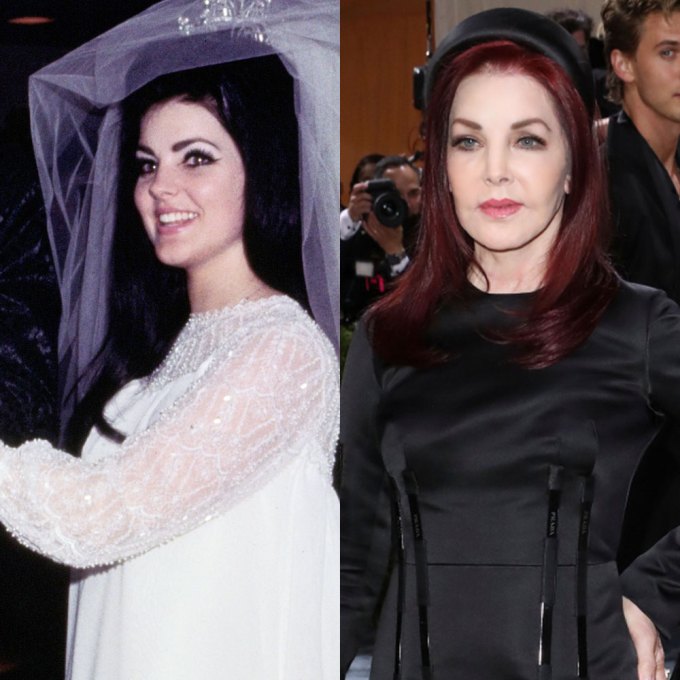
Joel Weinshanker, managing partner of Elvis Presley Enterprises, publicly disputed the suggestion that Graceland was secretly holding tens of millions of dollars’ worth of Priscilla’s possessions. He maintained that no such hidden collection existed at the estate and noted that Priscilla’s wedding dress was among the most recognizable personal items associated with her that was displayed there. His response challenged the image of Graceland as a secret storehouse filled with concealed riches.
The allegation was especially sensitive because Graceland’s archives are not an ordinary storage facility. Every item connected to Elvis carries questions of history, authenticity, ownership, and value. A jacket, ring, handwritten note, or stage costume may be emotionally priceless to admirers and financially valuable to collectors. That reality has created difficult disputes over memorabilia, including earlier questions raised by Graceland representatives about items connected to an auction business associated with Kruse. Representatives of that business defended their methods and rejected suggestions that they had knowingly handled questionable material.
Yet the financial accusations were not the most disturbing part of the lawsuit. The former partners also made an extraordinary claim involving Lisa Marie Presley’s final hours after she was hospitalized in January 2023. They alleged that Priscilla authorized the withdrawal of medical support despite an earlier health directive and suggested that financial control of family assets played a role in the decision.
Such a claim demands the greatest caution. It was an accusation advanced by parties involved in an intensely hostile business dispute, not a conclusion reached by medical authorities or a court. Priscilla’s attorney, Marty Singer, condemned it as false, malicious, and deeply hurtful, describing the case as an attempt to damage the reputation of a grieving mother. He said the allegations had no validity and expressed confidence that they would not succeed.
Lisa Marie died at the age of 54 from complications of a small bowel obstruction related to previous surgery. Her death came only two days after she attended the Golden Globe Awards, making the loss feel particularly sudden to her family and the public. Priscilla later spoke openly about the anguish of facing the medical decision at the hospital, describing it as one of the most painful days of her life.
That human reality can easily disappear beneath dramatic headlines. Before she became a name in court filings, Lisa Marie Presley was a daughter, mother, and the only child of Elvis Presley. She inherited not simply wealth and property, but the enormous responsibility of carrying a family legacy recognized throughout the world. Her life was repeatedly discussed through the language of estates, trusts, recordings, and inheritance, yet those formal words can never explain the emotional weight of being Elvis Presley’s daughter.
Following Lisa Marie’s death, Priscilla challenged a change to her daughter’s trust that had removed her as a trustee and placed Lisa Marie’s children in that role. The matter was later resolved, with Riley Keough assuming responsibility for her mother’s trust. Public statements from Priscilla and Riley have emphasized that their personal bond endured despite the legal disagreement and intense outside speculation.
For longtime Elvis admirers, the sight of Presley family members connected to competing lawsuits can feel deeply uncomfortable. Graceland was preserved so that future generations could encounter the story of a young man from Mississippi who reshaped American music. It was meant to protect memory from the passing years. When the mansion’s name appears in accusations involving taxes, contracts, and control, the mythology surrounding it collides with the difficult realities of maintaining a major cultural institution.
However, the story did not end with the original explosion of allegations.
In February 2026, Kruse and Fialko asked the court to dismiss the lawsuit that included the claim concerning the multimillion-dollar jewelry collection. The case was dropped without prejudice, which means it could potentially be filed again. The court papers did not explain whether a private settlement had been reached or whether the plaintiffs had chosen to stop pursuing the matter for another reason. Most importantly, the dismissal did not produce a judicial ruling confirming the allegations against Priscilla.
That development substantially changes how the controversy should be presented. What once appeared in television reports as an expanding legal firestorm became a case withdrawn before the accusations were tested at trial. The claims may remain part of the public record, but they should not be repeated as established truth. A court complaint tells the story one party intends to prove; it is not itself proof.
This distinction is especially important when reporting allegations involving bereavement and end-of-life decisions. Sensational language may attract attention, but it can also create permanent impressions long before evidence has been examined. Once a serious accusation enters the public imagination, the later dismissal of a case rarely receives the same dramatic coverage.
The deeper story is therefore not simply about whether jewelry was stored at Graceland or how much a collection might have been worth. It is about what happens when family sorrow, commercial interests, public memory, and legal conflict become impossible to separate. Elvis’s fame did not end in 1977. It became an inheritance—cultural, emotional, and financial—that every succeeding generation of the family has been required to manage.
Priscilla remains a complicated but undeniably significant figure in that history. She helped protect and promote Elvis’s memory during the decades after his death, while also living under constant public judgment. That history does not place her beyond legitimate legal scrutiny, but neither does it make every allegation automatically credible.
For older readers who remember Elvis as a living performer rather than a historical figure, the controversy may inspire sadness more than curiosity. The music once offered escape, hope, and excitement. Today, the Presley name is sometimes surrounded by legal documents and competing claims that seem far removed from the emotional simplicity of hearing “Love Me Tender,” “Suspicious Minds,” or “Can’t Help Falling in Love.”
Yet those songs remain stronger than the arguments. Court cases will be filed, challenged, settled, or withdrawn. Business partnerships will end, and accusations may dominate headlines for a season. Graceland, however, will continue to stand as the physical home of an artistic legacy that belongs emotionally to millions.
The latest twist offers one necessary reminder: behind every sensational filing are real people, unresolved grief, and allegations that must be treated with fairness. The story may be complicated, but the principle is simple.
Until a claim is proven, it remains a claim—and even the most famous family deserves that distinction.