Introduction
THE SONG THAT TOOK ROBIN GIBB HOME—WHEN “ELLAN VANNIN” BECAME MORE THAN MUSIC
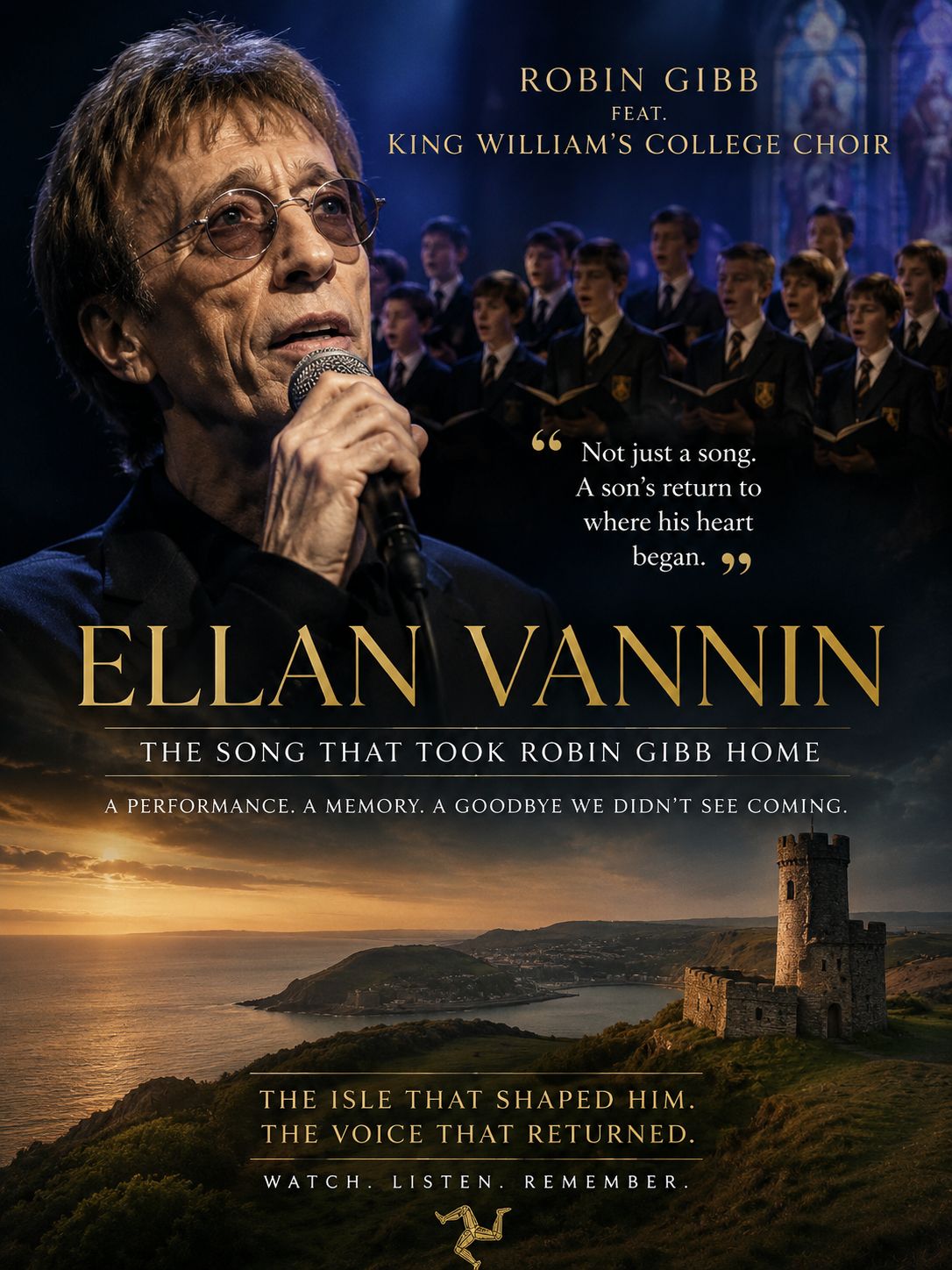
Some performances impress us with their power. Others remain because of their restraint. Robin Gibb’s rendition of “Ellan Vannin,” accompanied by the King William’s College Choir, belongs to the second and rarer category. There are no dazzling effects, no crowded dance floor, and no attempt to recreate the commercial grandeur of the Bee Gees’ most celebrated years. Instead, the performance offers something far more intimate: the sound of a man returning emotionally to the island where his life began.
To listeners familiar with Robin’s extraordinary career, the recording can feel almost startling in its simplicity. The voice heard on “Massachusetts,” “I Started a Joke,” and so many other enduring songs is immediately recognizable, yet here it carries a different responsibility. Robin is not singing about international fame or romantic uncertainty. He is singing of home, memory, belonging, and the landscape that existed before the world knew his name.
“Ellan Vannin” is the Manx-language name for the Isle of Man. The song originated as a poem written by Eliza Craven Green in 1854 and later became widely regarded as an alternative or unofficial Manx national anthem. Its verses look beyond geography toward something more personal: the deep attachment people retain for the place that formed their earliest understanding of life.
For Robin Gibb, that connection was not imagined. He and his twin brother Maurice were born in Douglas, Isle of Man, on December 22, 1949, before the Gibb family later moved to England and then Australia. The brothers’ journey would eventually lead to international recognition beyond anything their childhood world could have predicted. Yet distance did not erase the emotional significance of the island. The Isle of Man remained part of Robin’s identity, a beginning to which fame could add history but never provide a replacement.
That understanding changes the way one hears his performance. Robin does not approach “Ellan Vannin” as an outsider admiring a beautiful traditional song. He sounds like someone addressing a place held within his memory. His delivery is measured and dignified, avoiding unnecessary drama. Every phrase appears to carry the awareness that home is not merely where a person lives. It is where the first memories were formed, where family history began, and where the heart continues returning even when life travels far away.
The recording with King William’s College Choir was associated with a limited charity release produced to support Hospice Isle of Man. A 2008 enhanced CD-R edition paired Robin’s performance with interpretations of Bee Gees songs by Manx artists, and a video download was later listed for release in 2009. This charitable purpose gives the recording an additional layer of meaning. The song did not merely celebrate Robin’s birthplace; it also offered practical support to an organization caring for people and families during some of life’s most difficult moments.
The choir’s entrance is central to the emotional power of the arrangement. Their voices do not overwhelm Robin or attempt to compete with the unmistakable character of his singing. Instead, they gather around him. The youthful purity of the choir stands beside a voice already marked by decades of experience, success, struggle, reconciliation, and loss.
The contrast is deeply moving. Robin’s voice carries history; the choir represents continuity. He sings as someone who has traveled far beyond the island, while they sound like the landscape calling him back. Together, the voices create a bridge between generations—a reminder that traditions survive because the young learn the songs that older voices once carried.
It is tempting to hear the recording as a deliberate farewell, particularly because Robin died in 2012 and later listeners cannot separate his voice from the knowledge of his passing. Yet the performance should not be turned into a prophecy it was never proven to be. It was recorded years before his death and should first be understood as a tribute to the Isle of Man and a charitable act, rather than as a documented final message.
Still, music often gains new meaning after loss. A performance created in one moment can become something entirely different when heard years later. The singer does not change, but the listener does. Knowledge enters the room. Memory adds weight to phrases that once sounded simply beautiful.
That is why many admirers now hear vulnerability within Robin’s restraint. He does not push his voice toward the dramatic heights associated with some Bee Gees recordings. He allows the melody to move at the pace of reflection. The result feels less like a public declaration and more like a private recollection that an audience has been permitted to overhear.
Throughout his career, Robin Gibb possessed one of popular music’s most emotionally distinctive voices. His vibrato could suggest loneliness before a listener understood the words. On “I Started a Joke,” he made isolation sound almost universal. On “Massachusetts,” he transformed distance into longing. His voice often seemed to contain a fragile tension between belonging and separation.
“Ellan Vannin” brings those qualities back to their natural source. The longing is no longer directed toward an unnamed person or imagined destination. It is attached to the island itself, with its green hills, surrounding sea, family associations, and cultural memory. Robin is not searching for a metaphorical home. He is naming it.
For older listeners, this idea can be especially powerful. With age, home becomes increasingly difficult to define. The buildings of childhood may have changed. Parents and siblings may no longer be waiting behind familiar doors. Neighborhoods become unrecognizable, and the people who once made a place feel permanent gradually disappear.
Yet a song can restore what time has altered. A melody can return the listener to a kitchen table, a country road, a schoolyard, or the sound of a parent calling from another room. For several minutes, the past does not feel lost. It feels close enough to touch.
That is the quiet miracle inside Robin Gibb’s performance. “Ellan Vannin” becomes a vessel for remembrance. One need not have been born on the Isle of Man to understand it. Every listener possesses some version of the island—a place, a family, or a vanished period of life that still appears unexpectedly through music.
The involvement of King William’s College Choir also prevents the performance from becoming entirely sorrowful. These younger voices suggest that memory does not end with the person remembering. History is passed forward through stories, customs, recordings, and songs. Robin’s childhood world may have receded into the past, but its cultural voice continues through a generation born long after the Gibb brothers departed the island.
This sense of continuity mattered throughout the Bee Gees’ history. Barry, Robin, and Maurice built their music upon the remarkable bond of family voices. Their harmonies were not simply technical arrangements; they carried shared childhood, rivalry, affection, conflict, and survival. When one brother sang, the others understood instinctively how to support the emotional shape of the line.
In “Ellan Vannin,” the choir occupies a different but related role. They cannot replace Barry or Maurice, nor is that their purpose. They provide community around Robin’s individual memory. The song begins as the reflection of one famous son of the island and gradually becomes something larger: a collective promise that the island will continue remembering its people.
The performance also reveals how little genuine emotion depends upon spectacle. Robin had already experienced the roar of enormous crowds, international chart success, and the cultural phenomenon surrounding the Bee Gees. He had nothing left to prove through volume. What he offers here is quieter and perhaps more revealing.

He sings with the humility of someone acknowledging that fame is temporary while origins remain permanent. Awards tarnish. Fashion changes. Public attention moves toward newer names. But the place where a person first learned the meaning of family can retain its hold long after the applause has faded.
That may be why “Ellan Vannin” feels so deeply personal. It does not present Robin Gibb as an untouchable legend. It returns him to something more human: a son of the Isle of Man remembering where his story began.
The performance should not be sensationalized as a final goodbye. Its real emotional power is strong enough without invented claims. Robin was not necessarily predicting the end of his life; he was honoring the beginning of it. Yet because we now hear the song after his death, the tribute inevitably carries the tenderness of farewell.
When the final voices fade, silence enters with unusual weight. The listener is left thinking not about chart positions or celebrity mythology, but about home. About the places that raised us, the people who shaped us, and the memories we hope will survive after our own voices are gone.
Robin Gibb traveled farther than the child from Douglas could ever have imagined. But in “Ellan Vannin,” the journey turns inward.
The world-famous singer disappears for a moment.
The island’s son comes home.