Introduction
WHEN ELVIS ANSWERED FROM THE PAST: The Presley Duet That Turned “Don’t Cry Daddy” Into a Family Reunion Beyond Time
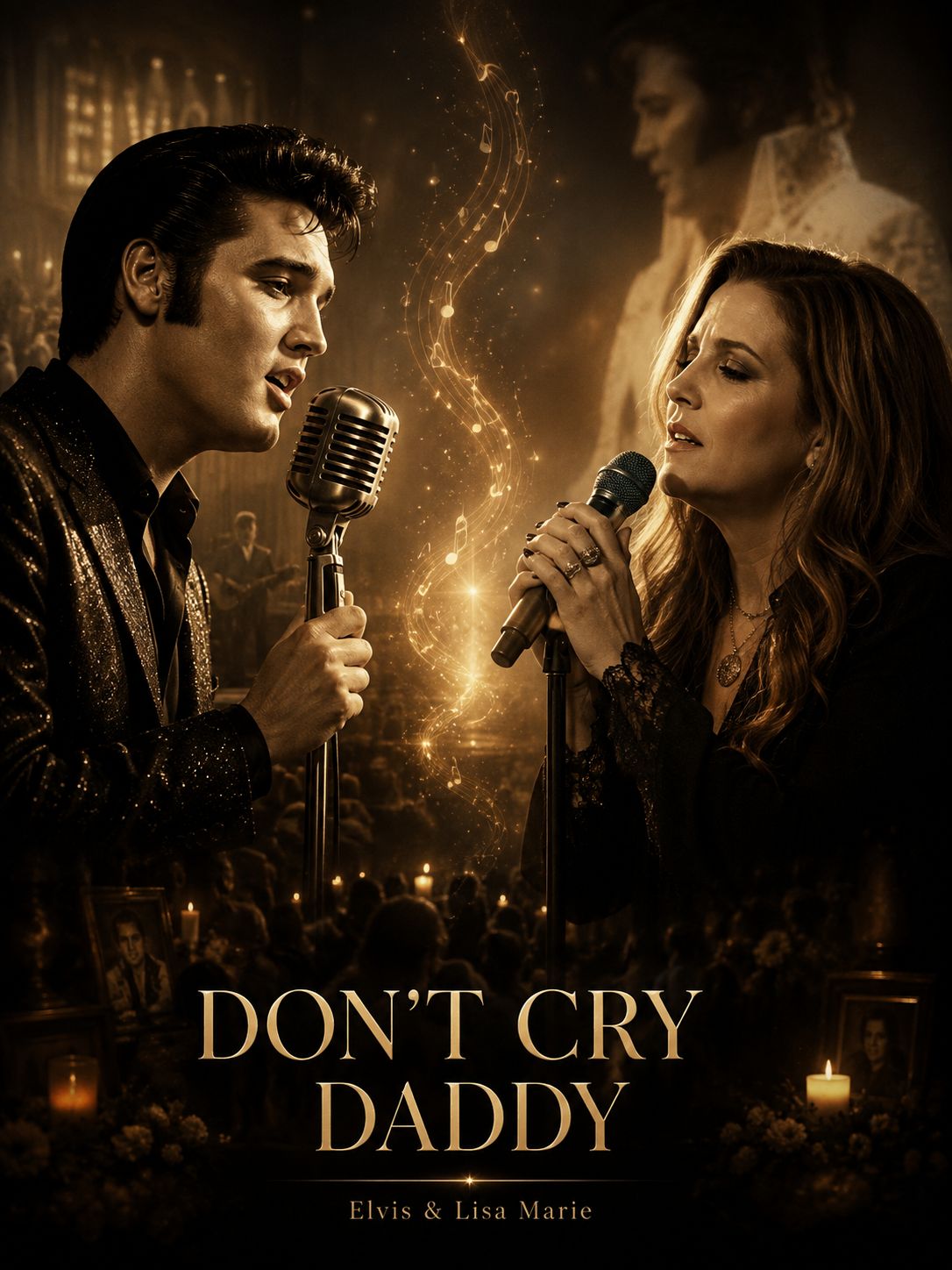
Some recordings are remembered because they reached the top of the charts, defined an era, or captured a singer at the height of his powers. Others remain because they seem to open a private door and allow listeners to witness something almost too intimate for public view. Elvis Presley and Lisa Marie Presley’s duet on “Don’t Cry Daddy” belongs to that rare second category. It does not feel like a conventional remix assembled to revive an old recording. It feels like a father and daughter finding one another across decades, separated by death but briefly reunited through the one language their family understood better than almost any other: music.
The original song was already filled with extraordinary emotional weight. When Elvis recorded “Don’t Cry Daddy” in 1969, he approached it not as the commanding performer who could dominate an arena, but as a restrained storyteller carrying the sorrow of a family attempting to survive loss. The lyric centers on children watching their father struggle after a devastating absence, asking him to remain strong even while they understand that something essential has disappeared from their home. Elvis does not turn the scene into grand theater. He sings with gentleness, allowing the sadness to remain quiet, unresolved, and deeply human.
That restraint is one reason the song continued to resonate with mature listeners. Those who have endured genuine grief understand that sorrow rarely arrives with the dramatic clarity found in films. It often appears in small gestures: an unfinished cup of coffee, a familiar chair left empty, a name that causes conversation to stop, or a person staring into silence because memory has suddenly become overwhelming. Elvis’s original performance respects that reality. His voice carries pain without demanding sympathy, and the music leaves enough space for listeners to place their own memories inside the story.
Decades later, Lisa Marie Presley entered that emotional space and added her own voice. The moment she appears, the song’s meaning changes completely. It is no longer possible to hear only fictional characters. The listener becomes aware of Elvis, frozen forever in the youthful strength of his recorded voice, and Lisa Marie, an adult daughter shaped by years her father never lived to witness. What had once been a song about an unnamed family suddenly becomes connected to one of the most closely observed families in modern entertainment history.
The achievement of the duet does not depend upon studio technology alone. Technology may have allowed the two voices to occupy the same recording, but it could not manufacture the emotional truth that makes the performance so moving. Lisa Marie does not attempt to imitate Elvis or compete with him. She enters carefully, almost as though she understands that the original recording is sacred ground. Her voice carries maturity, vulnerability, and the unmistakable weight of someone who spent a lifetime living beside an absence that the public could discuss but never fully understand.
Elvis died when Lisa Marie was still a child, leaving her with memories that belonged partly to family life and partly to world history. To millions of admirers, he remained the King of Rock and Roll, a cultural symbol preserved in photographs, concerts, films, and recordings. To Lisa Marie, however, he was also her father—the person whose private voice, habits, humor, and affection existed beyond the mythology. That difference gives the duet its unusual power. The public hears a legend returning through an old recording, while the daughter appears to hear someone she had been missing for most of her life.
When their voices meet, time seems to lose its ordinary direction. Elvis sounds immediate and heartbreakingly present, even though the recording belongs to another era. Lisa Marie sounds older, more cautious, and marked by years of experience. The father remains young while the daughter has grown beyond him, creating an emotional contradiction that listeners can feel even before they fully understand it. The harmony becomes a meeting place where the past and present briefly coexist.
Many listeners have described the duet as haunting or almost supernatural, but its power is not based on mystery alone. It comes from the recognizable human desire to speak once more with someone who is gone. Nearly everyone who has lived through significant loss has imagined such a moment. What would we say if the person returned? Would we offer gratitude, ask unanswered questions, or simply remain quiet because their presence would be enough? “Don’t Cry Daddy” transforms that impossible wish into sound, allowing Lisa Marie to stand beside her father for a few minutes in a way real life had denied them.

The recording also reveals how grief changes over time. Loss does not remain fixed in its earliest form. At first, it may feel overwhelming and impossible to contain. Later, it becomes woven into daily life, appearing unexpectedly through anniversaries, photographs, family traditions, and familiar songs. It may become quieter in public while remaining powerful in private. Lisa Marie’s performance carries that long history. She does not sound like a child experiencing the first shock of absence; she sounds like an adult who has spent decades learning how to live beside it.
After Lisa Marie Presley’s death, the duet acquired another layer of meaning that no one could have intended when it was created. Originally, listeners heard a daughter reaching backward toward her father. Now both voices belong to people who are no longer physically present, and the recording can feel like a preserved conversation taking place somewhere beyond ordinary time. The emotional direction no longer moves only from daughter to father. It seems to move between them.
This transformation makes the title “Don’t Cry Daddy” almost unbearably poignant. The words can be heard as a child comforting a grieving parent, but within the Presley story they now seem capable of traveling in several directions. They may suggest Lisa Marie addressing Elvis, Elvis somehow answering his daughter, or an entire family attempting to comfort one another across generations of loss. The song was not written specifically for their personal history, yet their history now lives inside every line.
The Presley family story has always contained a painful contrast between public triumph and private vulnerability. Elvis achieved a level of fame that permanently altered popular culture, but that fame could not protect his family from separation, grief, or the burden of expectation. Lisa Marie inherited extraordinary affection from the public, yet she also inherited questions and assumptions attached to a name larger than any individual life. Their duet strips away much of that mythology, leaving behind something simpler: a daughter singing beside the father she lost too soon.

For older listeners, this simplicity may be the most powerful element. Many people eventually discover that the deepest longing is not for another grand event or public recognition, but for one more ordinary conversation with someone absent. They wish to hear a familiar laugh, repeat a family story, or say words they once believed there would always be time to express. The duet touches that longing without offering false closure.
It does not pretend that music can repair everything. A recording cannot return the lost years, answer every question, or erase the loneliness of separation. What it can provide is a moment of connection. For the duration of the song, father and daughter occupy the same emotional room. Their voices recognize one another, and the listener is permitted to stand quietly at the edge of that reunion.
That is why the performance follows people long after the final note disappears. It does not conclude like ordinary entertainment. It leaves behind silence—the kind that encourages reflection rather than applause. Listeners may think about their own parents, children, spouses, siblings, or lifelong friends. They may remember words left unsaid and realize that love often survives most powerfully through what people continue carrying.
The duet between Elvis and Lisa Marie Presley is heartbreaking because it offers neither a complete goodbye nor a permanent reunion. It gives us something more fragile: a few minutes in which distance seems temporarily defeated. Elvis’s voice reaches forward from 1969, Lisa Marie’s voice reaches backward through memory, and together they create a family moment that life itself could never provide.
Some recordings are heard and then forgotten. This one remains because it feels less like a production than a private promise preserved in music. It reminds us that voices may outlive the people who created them, and that a song can become a meeting place for those whom time has separated.
When Elvis and Lisa Marie sing “Don’t Cry Daddy” together, the result does not sound like the past being repackaged. It sounds like love finding a way to answer—even after the people behind the voices are gone.