Introduction
The “Confession” That Never Happened: How Bob Joyce Became the Center of Elvis Presley’s Most Persistent Mystery
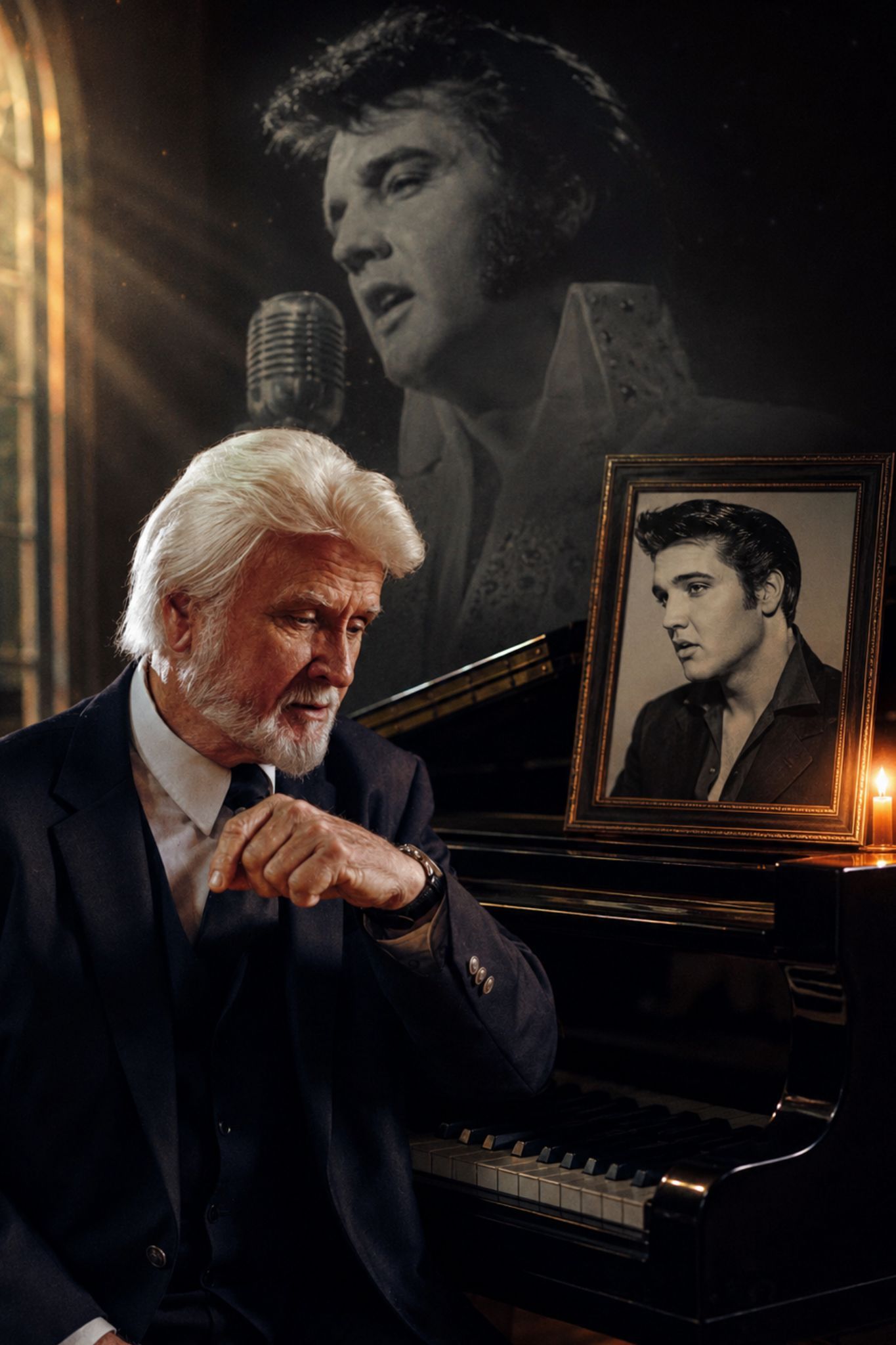
For nearly half a century, the world has struggled to accept one of music history’s most painful endings. Elvis Presley, the young man from Tupelo whose voice transformed popular culture, died at Graceland on August 16, 1977, when he was only 42 years old. The official record has remained consistent, yet the emotional questions surrounding his death have never completely disappeared. Every few years, a photograph, an unfamiliar recording, or an unexplained figure inspires another generation of admirers to ask the same extraordinary question: did Elvis truly die, or did the King quietly escape the unbearable pressures of fame? Graceland’s official biography records Elvis’s birth on January 8, 1935, and his death at his Memphis home in 1977.
The mystery has now returned through the dramatic online claim “It’s Over! Bob Joyce Confirms the Truth About Elvis Presley at 89!” Videos carrying versions of that headline promise a final confession, as though decades of speculation have suddenly reached an astonishing conclusion. They invite viewers to believe that Pastor Bob Joyce, an Arkansas minister known for his deep gospel voice, has finally acknowledged a hidden connection to Elvis. The title is powerful because it creates urgency, certainty, and the impression that history has been overturned. Yet when the dramatic wording is separated from the available evidence, the supposed confirmation becomes much more difficult to find.
The first problem appears in the headline itself. Elvis would not have been 89 in 2026. Born in January 1935, he would have turned 91. Bob Joyce’s official website identifies him as Robert Wayne Joyce, born on June 19, 1952, which means he turned 74 in June 2026. The two men are separated by more than seventeen years, with different documented names, birth dates, family histories, and life experiences. Those dates alone do not answer every imaginative question raised by conspiracy theorists, but they expose a major weakness in the viral claim.
Still, the fascination surrounding Bob Joyce is not difficult to understand. He possesses a rich, resonant singing voice, particularly when performing gospel music. His delivery can sound warm, reflective, and emotionally powerful. At certain moments, listeners believe they hear a familiar tone associated with Elvis’s later sacred recordings. They study Joyce’s smile, facial expressions, posture, hand movements, and pauses between musical phrases. Old photographs of Elvis are placed beside newer images of Joyce, inviting viewers to search for similarities that might otherwise have gone unnoticed.
The gospel connection strengthens the emotional appeal of the theory. Elvis had a profound relationship with sacred music, and all three of his competitive Grammy victories were awarded for gospel performances. Gospel was not a minor side project within his career; it was one of the musical foundations that shaped his voice and offered him comfort away from the demands of popular entertainment. Because Bob Joyce also sings gospel with conviction, some listeners interpret the shared tradition as a hidden personal clue. Graceland’s official records confirm that Elvis received three Grammys and that all three were for gospel music.
Yet resemblance is not identification. Many singers shaped by Southern gospel traditions share particular vocal qualities: sustained lower notes, carefully controlled vibrato, emotional phrasing, and a solemn manner of delivering spiritual songs. A listener who approaches Bob Joyce expecting to hear Elvis may naturally focus upon every similarity while overlooking the many differences. Once an audience becomes emotionally invested in a theory, ordinary coincidences can begin to feel like carefully placed evidence.

This changes the meaning of the phrase “Bob Joyce confirms the truth.” What Bob Joyce’s official material confirms is that he identifies himself as Bob Joyce. It does not contain an authenticated declaration that he is Elvis Presley, nor does it offer verified documentation connecting the two identities. The explosive confession promised by viral headlines is absent from the official record.
That absence matters because digital media can create an illusion of certainty. A clip may begin in the middle of a sentence, removing the words that explain its true meaning. A recording can be slowed, sharpened, or combined with another voice. Photographs can be selected according to lighting, angle, and expression until two unrelated individuals appear unusually similar. Dramatic music and authoritative narration can then guide viewers toward a conclusion before they have examined the original material.
Artificial intelligence has made this problem even more serious. A convincing voice can be generated from a small collection of recordings. A speaker’s mouth can be altered to match words he never said. Separate sentences can be rearranged into a false confession. Bob Joyce’s official website specifically warns that edited and AI-created videos have been used to suggest that he claimed another identity.
For older viewers, this new environment can be particularly unsettling. Many grew up during a period when filmed speech generally meant that the person shown had actually spoken those words. Today, seeing and hearing are no longer sufficient. A responsible viewer must ask where the complete recording originated, whether the source is officially connected to the speaker, and whether independent evidence supports the claim.
The historical account of Elvis Presley’s death remains clear. Elvis Presley Enterprises states that he died at Graceland on August 16, 1977, at the age of 42. His death was followed by public mourning, a funeral, the administration of his estate, and the continuing preservation of his home and legacy. No reliable DNA analysis, authenticated document, or direct confession has overturned that record.
Why, then, does the Bob Joyce theory continue to attract believers?
The answer may have less to do with forensic evidence than with the emotional power of Elvis Presley’s legacy. Elvis was never merely a singer to the people who grew up hearing his records. He represented youth, change, possibility, confidence, spiritual longing, and an American dream that seemed almost impossible before he achieved it. His songs became attached to marriages, family celebrations, long journeys, military service, Sunday mornings, and memories of loved ones who have since passed away.
Words such as “confirmed,” “finally,” “confession,” and “it’s over” are particularly effective because they create emotional closure. They suggest that the audience is about to witness the final scene of a mystery. Yet the promised conclusion often dissolves into familiar comparisons, recycled photographs, and carefully edited fragments. The viewer reaches the end without hearing a complete, verified statement from Bob Joyce identifying himself as Elvis Presley.
The responsible conclusion is therefore less sensational but far more compelling. Bob Joyce is a gospel-singing minister with his own documented identity. Elvis Presley was born in 1935 and died at Graceland in 1977. Joyce’s official representatives reject the claim that he has presented himself as another person and warn that manipulated videos have distorted his message.
This conclusion does not diminish either man. Bob Joyce deserves to be recognized for his own ministry and musical work rather than treated as a disguise worn by someone else. Elvis deserves to be remembered through his authentic voice, documented life, remarkable performances, and enduring influence—not through headlines that exploit the grief of devoted admirers.
So, is the Elvis mystery finally over?
For those searching for verified proof that Bob Joyce is Elvis Presley, there is no credible confirmation. The ages do not match, the official biographies remain separate, and the alleged confession cannot be found in Joyce’s verified statements. The evidence points not toward a hidden identity but toward the extraordinary power of online repetition.
The larger mystery, however, may never disappear. As long as Elvis’s records continue to play, people will examine photographs, compare voices, and search for one final secret capable of changing the ending. The King’s influence was so immense that an ordinary death still seems too small to contain it.
Perhaps the truest answer is also the simplest. Elvis Presley did not need to survive under another name in order to remain alive in culture. He returns whenever a gospel harmony fills a quiet room, whenever an old recording awakens a family memory, and whenever a new listener encounters that unmistakable voice for the first time.
The viral confession may never have happened.
But the legacy is real—and that is why the world still refuses to let Elvis go.