Introduction
THE NIGHT AMERICA TRIED TO DESTROY THE BEE GEES—AND THE FOUR EXTRAORDINARY COMEBACKS THAT PROVED THEIR MUSIC COULD NOT BE KILLED
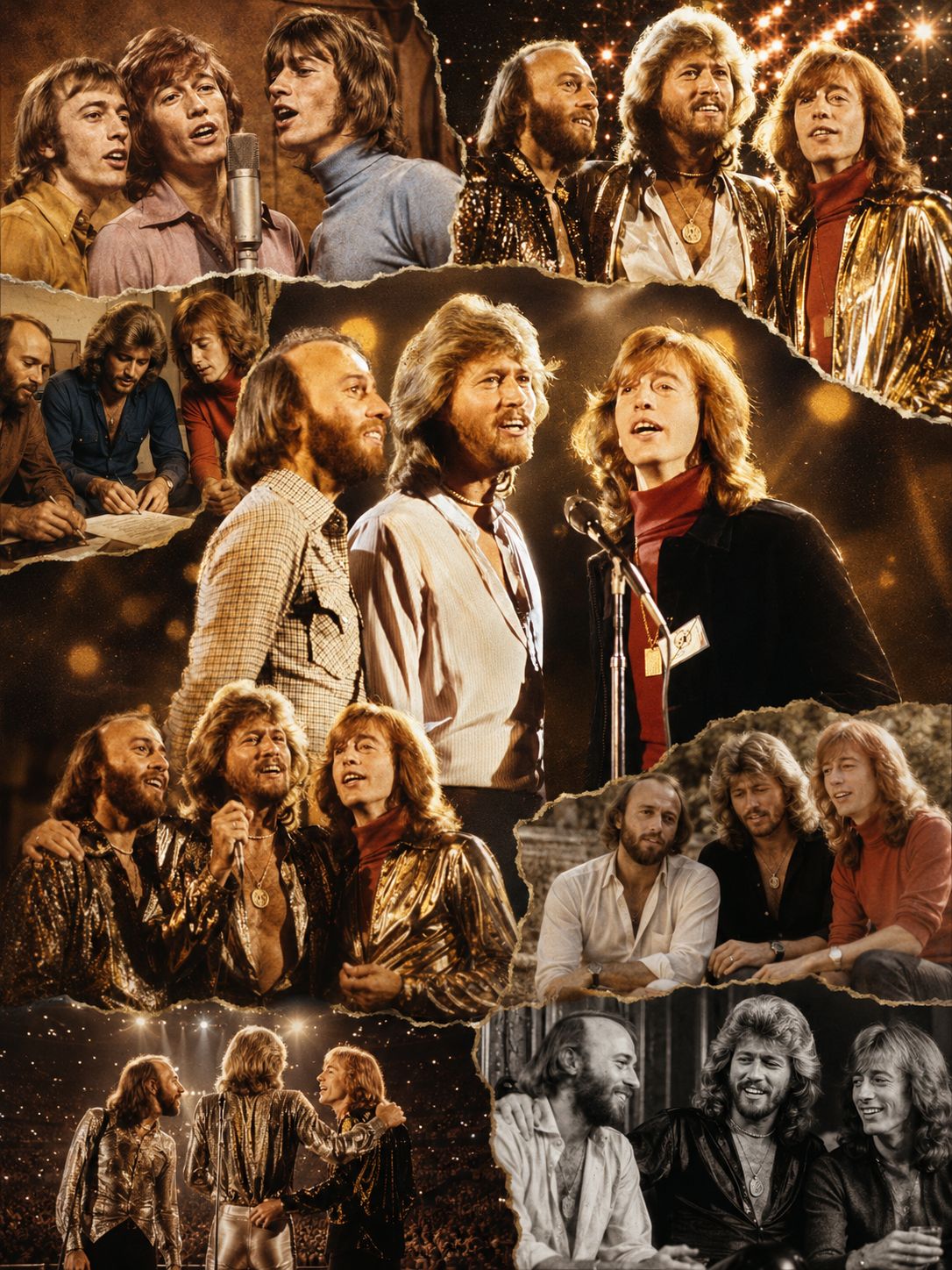
On July 12, 1979, American popular culture appeared to turn against one of its own greatest success stories. Inside Chicago’s Comiskey Park, thousands gathered for an event promoted as Disco Demolition Night, where piles of records were collected, carried onto the field, and destroyed in an explosion intended to symbolize the death of disco. What began as a radio promotion quickly descended into disorder as spectators rushed onto the field, security struggled to regain control, and a celebration of musical resentment became a disturbing public spectacle. Beneath the smoke and noise was something larger than dissatisfaction with a fashionable sound. It was a rejection of an entire era, and standing at the center of that rejection were Barry, Robin, and Maurice Gibb.
Only a year earlier, the Bee Gees had seemed untouchable. Their songs dominated radio, their voices defined the international charts, and the phenomenal success of the Saturday Night Fever soundtrack had transformed three brothers into symbols of a worldwide cultural movement. At one extraordinary point, the Bee Gees had written, performed, or produced several of America’s biggest songs simultaneously. Their harmonies were everywhere, their songwriting seemed limitless, and their commercial power was so immense that they no longer appeared to be merely a successful band. They had become one of the central forces shaping the sound of an age.
Then the atmosphere changed with astonishing speed. The same industry that had celebrated them began treating their success as an embarrassment. Radio stations organized Bee Gees-free weekends, critics dismissed them as representatives of a fading craze, and sections of the public mocked the clothing, voices, and imagery that had recently been admired. Stores became reluctant to promote their records, while programmers feared that playing them would make a station appear outdated. The brothers who had helped create some of the decade’s most carefully constructed popular music suddenly became convenient targets for everything listeners disliked about disco.
It would be easy to describe this as the familiar story of a musical fashion rising too high and collapsing under its own weight. Yet such an explanation misses what made the Bee Gees’ journey so remarkable. Disco Demolition Night did not destroy them because it was not the first time their career had appeared to be finished. Long before the white suits, high vocals, and dance rhythms, the Gibb brothers had already endured rivalry, separation, commercial decline, and the painful experience of watching audiences move on without them. Their greatest talent was not simply harmony or songwriting. It was reinvention.
When Barry, Robin, and Maurice arrived in Britain from Australia during the late 1960s, they bore little resemblance to the performers later associated with disco. Their early international recordings were rich in melancholy, orchestral arrangements, narrative detail, and close three-part harmony. Songs such as “New York Mining Disaster 1941,” “To Love Somebody,” and “I’ve Gotta Get a Message to You” revealed young writers with an unusually mature understanding of longing and dramatic tension. Their music could sound intimate and grand at the same time, combining emotional vulnerability with melodies strong enough to remain in the listener’s memory after a single hearing.
Their rise was so sudden that comparisons with the Beatles followed almost immediately. Radio programmers reportedly wondered whether one of the Bee Gees’ earliest releases might be the work of the Beatles operating under another name. Such speculation showed how accomplished the brothers already sounded, but rapid fame also intensified their differences. Barry Gibb possessed the instincts of a frontman and a commanding songwriter. Robin Gibb had a distinctive, trembling voice that gave many of their early recordings their haunting character. Maurice Gibb, musically versatile and emotionally positioned between his brothers, often became the figure trying to preserve balance.

By 1969, disagreements about leadership, recognition, and musical direction had become impossible to contain. Robin left the group, the brothers stopped working together, and the first celebrated era of the Bee Gees came to an abrupt end. To observers, they seemed like another young act that had reached international fame before developing the strength to manage it. Their story might have ended there, remembered through a handful of late-1960s classics and speculation about what could have been.
The brothers eventually discovered, however, that individual pride could not replace the creative force they possessed together. They reunited, repaired enough of their relationship to begin recording again, and achieved an American number-one single with “How Can You Mend a Broken Heart?” The title could almost have described their own return. Its restrained arrangement, sorrowful melody, and emotional directness demonstrated that the Bee Gees had survived their first collapse and emerged with greater maturity.
That victory did not secure their future. By the early 1970s, popular taste had moved toward heavier rock, progressive music, and more theatrical forms of performance. The Bee Gees’ elegant ballads began to appear unfashionable, and their commercial position weakened dramatically. The group that had once been treated as a rival to Britain’s most important bands found itself performing in modest venues before audiences more interested in dinner than discovery. They had not yet reached thirty, but the music business was already treating them like a nostalgic attraction.
Their next transformation began in the United States, where a move toward the rhythmic traditions of American soul and R&B gave them a new creative direction. Working in Miami, the brothers developed a stronger emphasis on rhythm, bass, and movement. During the recording of “Nights on Broadway,” Barry was encouraged to explore the upper range of his voice. The result was the now-famous falsetto, not as a novelty but as an expressive instrument capable of urgency, power, and emotional intensity.
With “Jive Talkin’” in 1975, the Bee Gees returned to the top of the charts in a form few listeners could have predicted. The track carried a sharp, propulsive groove reportedly inspired in part by the rhythmic sound of their car traveling across a bridge in Miami. It announced that the brothers had not simply updated their style. They had rebuilt their musical identity.
The arrival of Saturday Night Fever transformed that successful reinvention into a cultural phenomenon. The film’s soundtrack brought “Stayin’ Alive,” “Night Fever,” and “How Deep Is Your Love” to an enormous worldwide audience. Each song demonstrated a different side of the brothers’ craft: rhythmic precision, melodic elegance, emotional warmth, and an instinctive understanding of how harmony could elevate a composition. The soundtrack remained at the top of the American album chart for months, and the Bee Gees became inseparable from the era they had helped define.
That association brought both glory and danger. The brothers had never considered themselves exclusively a disco band, yet the media presented them as its undisputed rulers. When public enthusiasm turned into hostility, the Bee Gees became the most visible targets. Their earlier ballads, orchestral recordings, and decades of songwriting were temporarily forgotten. America saw only the white suits, the falsetto, and the dance-floor image repeated endlessly across television and magazines.
Most groups would have been destroyed by such a reversal. The Bee Gees responded by disappearing from the foreground while allowing their melodies to remain everywhere. During the 1980s, they wrote and produced major recordings for other performers, including Barbra Streisand’s “Woman in Love,” Kenny Rogers and Dolly Parton’s “Islands in the Stream,” Dionne Warwick’s “Heartbreaker,” and Diana Ross’s “Chain Reaction.” Audiences who believed they had rejected the Bee Gees continued singing Bee Gees compositions without always realizing who had created them.
This was perhaps their most intelligent reinvention. They understood that the public might resist their image, but it could not resist the quality of their songwriting. By stepping behind other voices, the brothers bypassed the hostility surrounding their name and quietly reestablished themselves as some of the most reliable craftsmen in popular music. They proved that their success had never depended entirely upon fashion. Beneath every change of style was a deep knowledge of melody, structure, harmony, and emotional storytelling.
The final test was whether they could return under their own name. In 1987, “You Win Again” became a major success across Britain and Europe, introducing the Bee Gees to another generation with a forceful, contemporary sound. American radio remained cautious, but the international response demonstrated that the old backlash had lost much of its power. Two years later, “One” returned them to the American Top 10, confirming that the boycott was finally weakening.
The Bee Gees had now survived four distinct lives: their rise as orchestral pop visionaries, their reunion after personal division, their transformation into global rhythm-driven superstars, and their return as respected contemporary songwriters and performers. Each chapter could have sustained an entire career. Together, they formed one of the most extraordinary stories of endurance in modern music.
Disco Demolition Night is often remembered as the night disco died, but history offers a more revealing conclusion. Records could be burned, radio formats could change, and public opinion could turn cruelly overnight, yet none of those forces could erase the melodies the Gibb brothers had placed into the world. The industry tried to reduce them to a passing fashion. The Bee Gees answered by writing songs that outlived the fashion, the backlash, and the people who declared them finished.
Their story is therefore not about the death of disco. It is about the survival of artistry. Barry, Robin, and Maurice Gibb were knocked down by division, changing tastes, ridicule, and commercial rejection, but each collapse forced them to discover another dimension of their talent. They did not merely return from failure. They returned differently, carrying new sounds while preserving the unmistakable harmony that had united them from childhood.
The night America tried to bury the Bee Gees became only another dramatic chapter in a much greater story. The smoke eventually cleared from Comiskey Park, the anger faded, and the records people tried to destroy became cherished classics. The three brothers remained what they had always been beneath every costume and category: remarkable songwriters whose music could be challenged, misunderstood, and temporarily rejected—but never truly silenced.