Introduction
The Night Country Music Stood Still: George Strait and Miranda Lambert Turned “Run” Into a Meeting of Generations
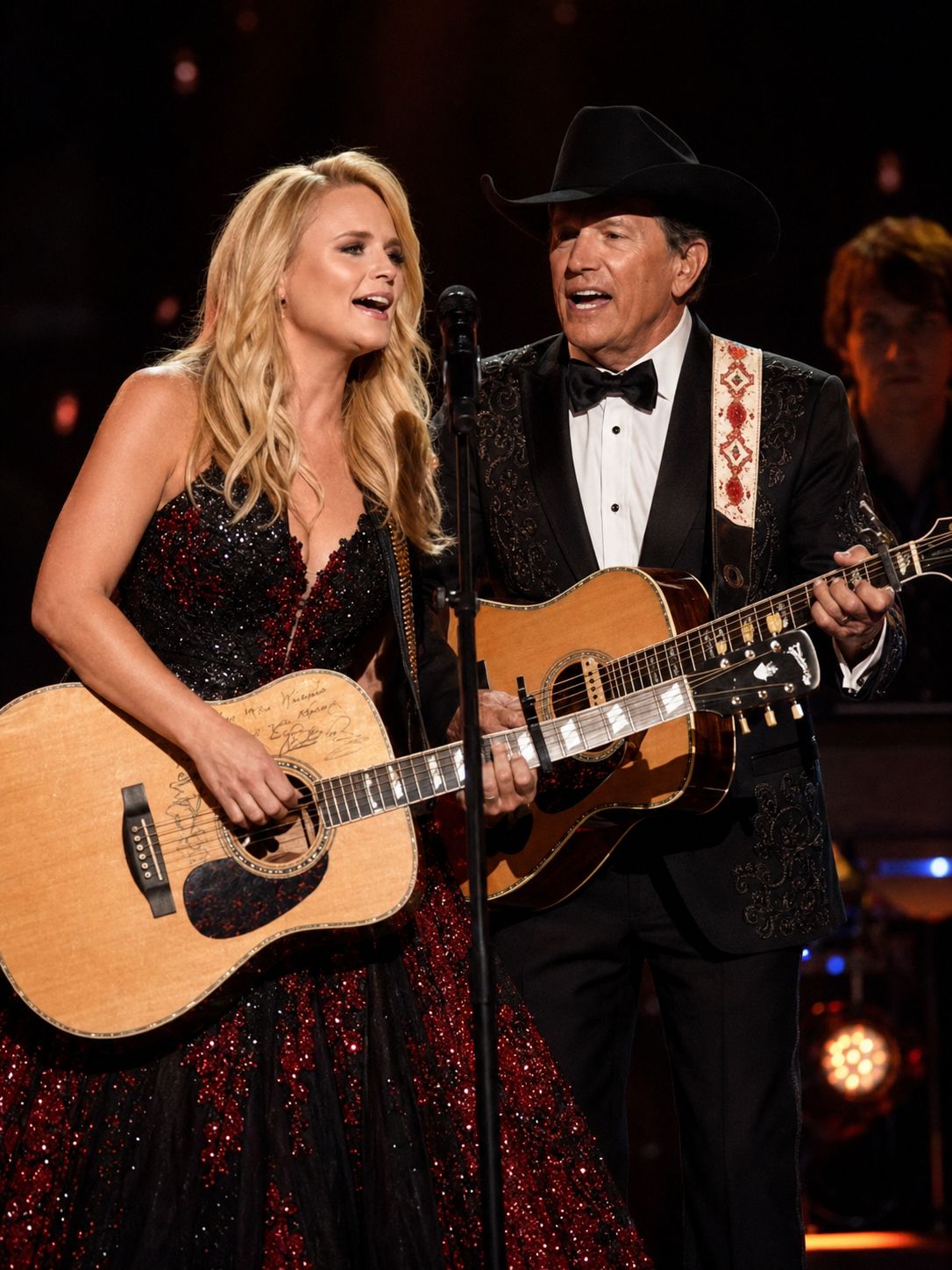
There are country performances that entertain an audience, and then there are rare moments that seem to preserve the entire history of the genre within a single song. When George Strait and Miranda Lambert stood together beneath the lights to perform “Run,” the result was far greater than an ordinary celebrity duet. It became a meeting between two generations of Texas country music, one represented by Strait’s quiet authority and the other by Lambert’s emotional intensity. Nothing about the performance required elaborate staging or theatrical distractions. Two unmistakable voices, a beautifully written song, and a shared respect for country tradition were enough to make the room feel as though time had briefly stopped.
One of their most widely remembered performances of the song took place on April 7, 2019, during the 54th Academy of Country Music Awards at the MGM Grand Garden Arena in Las Vegas. The duet was presented as part of the ceremony’s “ACM Flashbacks,” a series designed to bring classic country songs back into the spotlight through meaningful collaborations. The Academy of Country Music described Strait as a 24-time ACM winner and Lambert as the most-awarded artist in ACM history at that time, making their appearance more than a convenient pairing of two popular performers. It brought together two artists whose careers had already become important chapters in the history of country music.
The song itself carries a history that deserves to be understood correctly. “Run” was written by Tony Lane and Anthony Smith, not by Miranda Lambert, and George Strait recorded it for his 2001 album The Road Less Traveled. The song’s restrained production, haunting melody, and urgent message helped it become one of the most distinctive recordings in Strait’s catalog. Lambert would later release her own entirely different song titled “Run,” but the ballad she performed beside Strait belongs to his musical history and to the gifted songwriters who created it.

At the center of Strait’s “Run” is a plea that feels both simple and enormous. The narrator is asking someone to leave everything behind and find a way back to him, whether by airplane, bus, train, or any road still open. The song does not explain every detail of the separation, and that uncertainty is part of its power. Listeners are invited to imagine the distance, the mistake, and the unfinished conversation for themselves. Like many of the finest country songs, it leaves enough space for people to place their own memories inside the story.
George Strait’s delivery has always been defined by restraint. He rarely appears to chase a dramatic moment because he understands that the words can carry their own emotional weight. When he sings “Run,” his voice remains calm, measured, and dependable, yet there is unmistakable longing beneath that control. He sounds like a man who has already considered every possibility and has finally reached the point where only one request remains. That balance between dignity and desperation is difficult to achieve, but Strait has spent decades making such emotional precision appear effortless.
When Miranda Lambert enters the song, the emotional atmosphere changes without disturbing its foundation. Her voice brings a weathered warmth and a sharper sense of urgency, allowing the listener to hear the story from a slightly different emotional distance. Strait sounds like the person sending the message across the miles, while Lambert seems to understand what it means to receive it. Their interpretations do not compete with each other. Instead, they reveal different sides of the same ache.

That contrast is what made the collaboration so compelling. Strait’s calm authority provided the performance with stability, while Lambert’s expressive grit brought a visible sense of emotional movement. His phrasing felt timeless and carefully controlled; hers felt immediate, searching, and deeply personal. When their voices joined, the song seemed to expand beyond the experience of one narrator. It became a conversation between absence and return, between an older tradition and the generation that inherited it.
The chemistry between the two artists did not suddenly appear at the 2019 awards ceremony. Lambert had already joined Strait during the final concert of his Cowboy Rides Away Tour at AT&T Stadium in 2014, where they performed both “Run” and “How ’Bout Them Cowgirls.” Their live version of “Run” was subsequently included on The Cowboy Rides Away: Live from AT&T Stadium, preserving the collaboration as part of Strait’s official concert catalog.
Their shared Texas heritage also gave the performance an added sense of authenticity. Strait emerged as a defining figure of neotraditional country music, building his reputation through carefully chosen songs, an understated stage presence, and unwavering respect for the form. Lambert arrived in a later era, when country artists were expected to navigate changing radio formats, digital audiences, and a more visibly competitive entertainment culture. Yet her songwriting instincts and musical identity remained strongly connected to the emotional directness of classic country.
For older listeners, Strait represents a period when a performer could command an arena without appearing to demand attention. His power came from consistency, musical judgment, and the trust he developed with audiences over many years. Lambert represents proof that the same storytelling tradition can survive within a more modern sound. She may bring a different energy to the stage, but she understands that country music ultimately depends upon believable characters, recognizable emotions, and words that sound as though they have been lived rather than merely performed.
:max_bytes(150000):strip_icc():focal(939x554:941x556)/george-norma-strait-1-ca550a8557b145888c53b16e37f22898.jpg)
This is why their rendition of “Run” mattered beyond the excitement of seeing two famous singers together. It demonstrated that tradition does not have to remain frozen in the past to be protected. A classic song can be revisited by a younger artist without losing its original character, provided that the performance is approached with respect. Lambert did not attempt to overpower Strait or transform the song into something unrecognizable. She entered its world, listened to its emotional language, and added her own experience to the story.
The arrangement also reminded audiences that country music does not always need excess to create magnitude. The performance drew its strength from pacing, phrasing, and the subtle movement between two voices. Every pause seemed meaningful, and every harmony suggested something the lyrics did not directly say. The musicians supported the story rather than crowding it, giving the singers enough room to communicate with the audience.
By the final passage, the duet had become less about individual fame and more about continuity. The audience was not simply watching the King of Country Music perform beside one of modern country’s most honored artists. They were witnessing a tradition being passed forward without ceremony or announcement. Strait remained unmistakably himself, Lambert remained unmistakably herself, and the song became the bridge between them.
Country music has always survived through moments like this. Styles change, technology advances, and new performers eventually replace familiar names on the radio, but the genre’s deepest purpose remains remarkably stable. It gives ordinary emotions a voice and turns private memories into shared experiences. George Strait and Miranda Lambert’s performance of “Run” honored that purpose with uncommon grace.
When the final note disappeared, nothing needed to be explained. Strait had brought the weight of a monumental career, Lambert had brought the passion of a generation shaped by his example, and together they had allowed a beloved song to breathe again. It was not simply a duet between two stars. It was a masterclass in country storytelling, a meeting of past and present, and a reminder that the greatest songs never truly belong to one moment in time.