Introduction
THE BORDER COLONEL PARKER COULD NEVER CROSS: The Secret That Kept Elvis Presley From the World
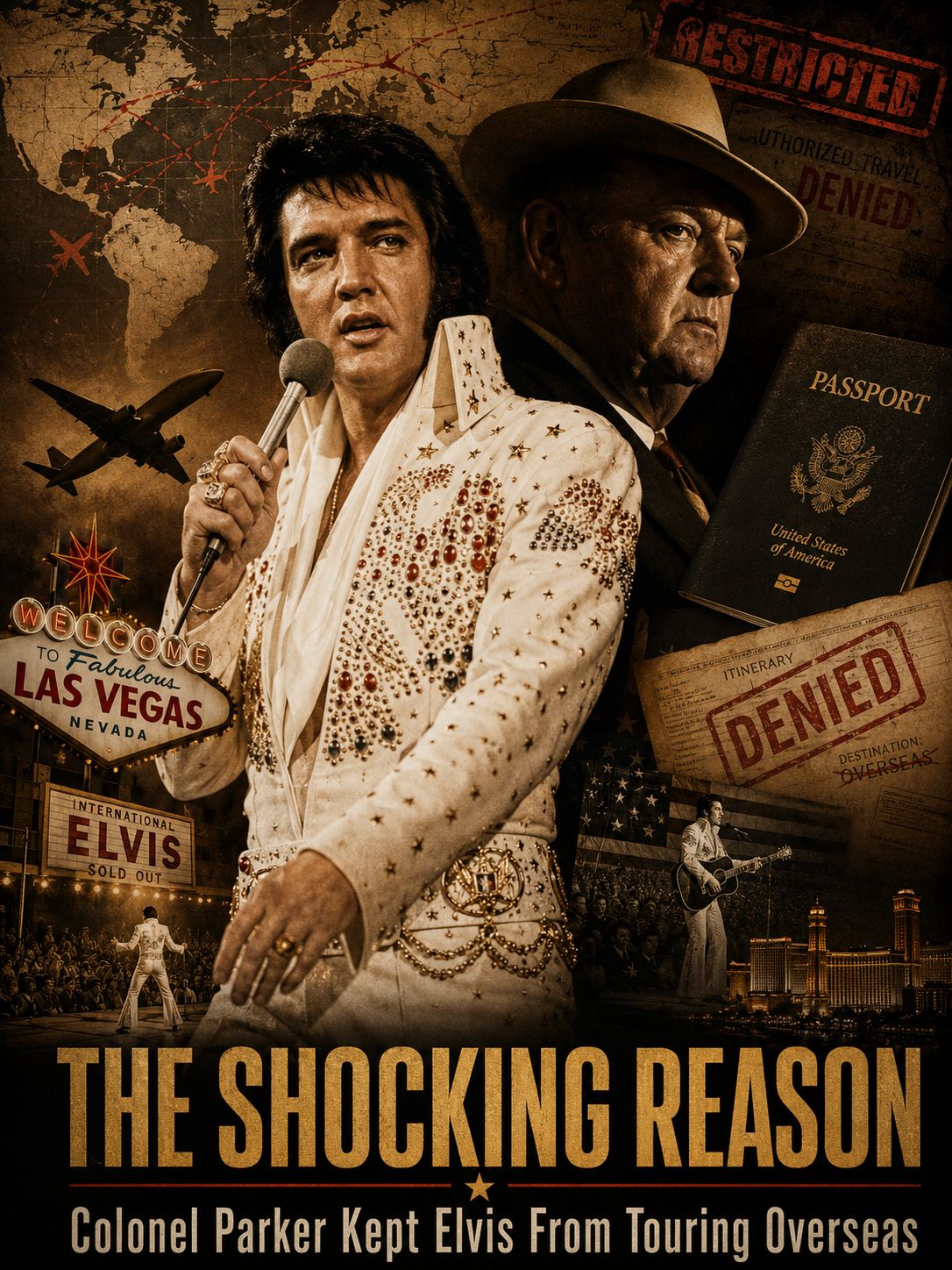
Imagine becoming one of the most recognizable human beings on earth while remaining unable to meet most of the people who made you famous. By the middle of the 1960s, Elvis Presley was no longer merely a successful American singer. He had become an international symbol whose voice crossed borders more easily than he ever could. His records reached homes in Britain, Germany, Japan, Australia and across South America. His films filled theaters far beyond the United States, while his photographs appeared in magazines printed in languages he could not speak. Millions of people knew his face, copied his movements and dreamed of seeing him in person. Yet throughout his extraordinary career, Elvis never mounted a true overseas concert tour.
That absence remains one of the strangest contradictions in popular-music history. The man whose influence became worldwide continued to perform almost entirely within the United States, apart from several Canadian appearances early in his career. He never walked onto a concert stage in London, Paris, Rome, Tokyo, Sydney, Dublin or Berlin. European and Asian promoters reportedly expressed interest, enormous audiences were waiting, and the financial possibilities would have been remarkable. Nevertheless, every potential international tour seemed to disappear before it could become reality.
For years, the explanations sounded ordinary enough. There were film commitments, recording obligations, security concerns and the immense logistical demands of transporting Elvis Presley’s stage production overseas. International touring was more complicated in the 1960s and early 1970s than it is today. Moving musicians, equipment, costumes and security personnel across borders required careful preparation. Yet those practical difficulties do not entirely explain why an artist of Elvis’s importance never completed even one major overseas engagement.

At the center of the mystery stood Colonel Tom Parker, the powerful manager who had guided Elvis from regional popularity to unprecedented fame. Parker often presented their partnership in simple business terms. Elvis performed, Parker handled the negotiations, and each man supposedly took care of his own responsibilities. From the outside, it appeared to be an efficient arrangement between an extraordinary entertainer and an unusually determined manager.
The truth was more complicated. Parker was not simply an agent who booked performances and reviewed contracts. He controlled nearly every major commercial decision surrounding Elvis’s career. He negotiated recording agreements, movie deals, merchandising arrangements and concert appearances. He understood promotion with remarkable instinct, and he knew how to transform public curiosity into enormous revenue. Parker helped build the machinery that made Elvis a global phenomenon, but the same machinery gradually became a cage.
Their relationship contained elements of loyalty, dependence, fear and financial necessity. Parker needed Elvis because the singer was the foundation of his fortune and authority. Elvis, meanwhile, had been taught to believe that Parker was the only man capable of managing an empire of such size. Removing the Colonel would have meant confronting contracts, debts, employees and business structures that Elvis did not fully understand. The more successful the partnership became, the more difficult it was for either man to escape it.

This dependency became especially important whenever the subject of an international Elvis Presley tour was raised. Parker always appeared to have an explanation. The timing was not right. The security arrangements were insufficient. A better offer would arrive later. A future tour was supposedly being discussed. The possibility remained permanently close enough to create hope but never close enough to become real.
The most persuasive explanation lies not in Elvis’s schedule but in Parker’s hidden past. The man known throughout America as Colonel Tom Parker had been born Andreas Cornelis van Kuijk in Breda, the Netherlands, in 1909. He entered the United States when he was young and reinvented himself through the rough world of carnivals, traveling shows and entertainment promotion. Over time, the Dutch immigrant created an identity that appeared thoroughly American.
The title “Colonel” was not a military rank. It was an honorary title associated with political connections in the American South. Parker embraced it because it gave him an appearance of authority, respectability and permanence. The title became part of his carefully constructed character, helping him distance himself from the young Dutchman he had once been.
More significantly, Parker apparently never completed the immigration process that would have given him secure legal status and a normal American passport. This meant that leaving the United States could have created serious complications. An overseas journey might have exposed questions about his identity, immigration history and ability to return. For a man who had built his power through control, uncertainty at an international border would have represented an unacceptable risk.
This is why the lost overseas tours cannot be dismissed as simple scheduling failures. Parker could have allowed Elvis to travel without him, but doing so would have reduced his control over negotiations and exposed the singer to advisers, promoters and business opportunities outside Parker’s carefully managed world. An international tour might have allowed Elvis to recognize how valuable he truly was and how many professional possibilities existed beyond his manager’s influence.
Elvis reportedly wanted to experience the audiences that had supported him from afar. He understood that his music had become part of people’s lives throughout the world, and he was curious about places he had seen only in photographs, films and letters from admirers. For a performer whose greatest gift was connecting emotionally with a crowd, the inability to stand before those international listeners must have been deeply frustrating.

The lost tours also changed the shape of Elvis Presley’s legacy. Imagine Elvis singing gospel music in London, performing before a vast crowd in Tokyo or bringing his 1970s concert production to Australia. Such events would not merely have generated money. They could have renewed him artistically, challenged him emotionally and removed him from the repetitive cycle of American arenas and lengthy Las Vegas residencies.
Las Vegas was profitable and convenient for Parker. It kept Elvis in one controlled location, surrounded by familiar employees and operating within an established commercial arrangement. Yet the routine eventually became exhausting. Elvis repeated similar performances night after night while Parker continued negotiating deals designed to maximize immediate income. The singer who had once represented rebellion and movement was increasingly confined to a schedule that served everyone around him but may not have served his deeper artistic needs.
It would be too simple to blame every disappointment in Elvis’s life on Colonel Parker. Elvis was an adult who made his own decisions, enjoyed extraordinary privileges and sometimes resisted advice even when it was offered sincerely. He remained capable of challenging Parker but rarely followed those moments of anger with permanent action. Loyalty, habit and financial confusion repeatedly pulled him back into the same arrangement.
Parker also deserves recognition for his undeniable promotional intelligence. He helped introduce Elvis to a national audience, understood the value of television and created merchandising opportunities long before such strategies became standard in the music industry. Without Parker, Elvis might still have become a major star, but his rise may not have occurred with the same speed or scale.
Nevertheless, the overseas question reveals the darker side of Parker’s management. The interests of the manager and the dreams of the artist were no longer the same. Parker’s need to protect his identity appears to have influenced decisions that limited the career of the most important performer he represented. Elvis’s global audience was sacrificed, at least partly, to preserve the security of the man standing behind the curtain.
The tragedy is not simply that millions of admirers never saw Elvis in concert. It is that Elvis himself never experienced their welcome. He never heard a London audience sing his songs back to him. He never witnessed the excitement of Japanese fans who had followed his career for decades. He never discovered how stepping outside America might have changed his understanding of his own importance.
Colonel Tom Parker’s hidden identity did not create Elvis’s talent, but it may have helped determine the boundaries within which that talent was allowed to operate. The world belonged to Elvis, yet he remained confined to a remarkably small part of it. His records crossed every ocean while the man himself stayed behind.
That is the unsettling truth at the heart of this story. The greatest barrier between Elvis Presley and the international stage may not have been security, scheduling or transportation. It may have been one undocumented man’s fear of crossing a border and discovering that the identity he had constructed could no longer protect him. Parker built the throne, but in protecting his own secret, he may also have ensured that the King would never truly see the kingdom that loved him.