Introduction
THE VOICE THAT WOULDN’T DIE: NEARLY 50 YEARS AFTER ELVIS, BOB JOYCE REAWAKENED A MYSTERY THE INTERNET STILL CAN’T LET GO
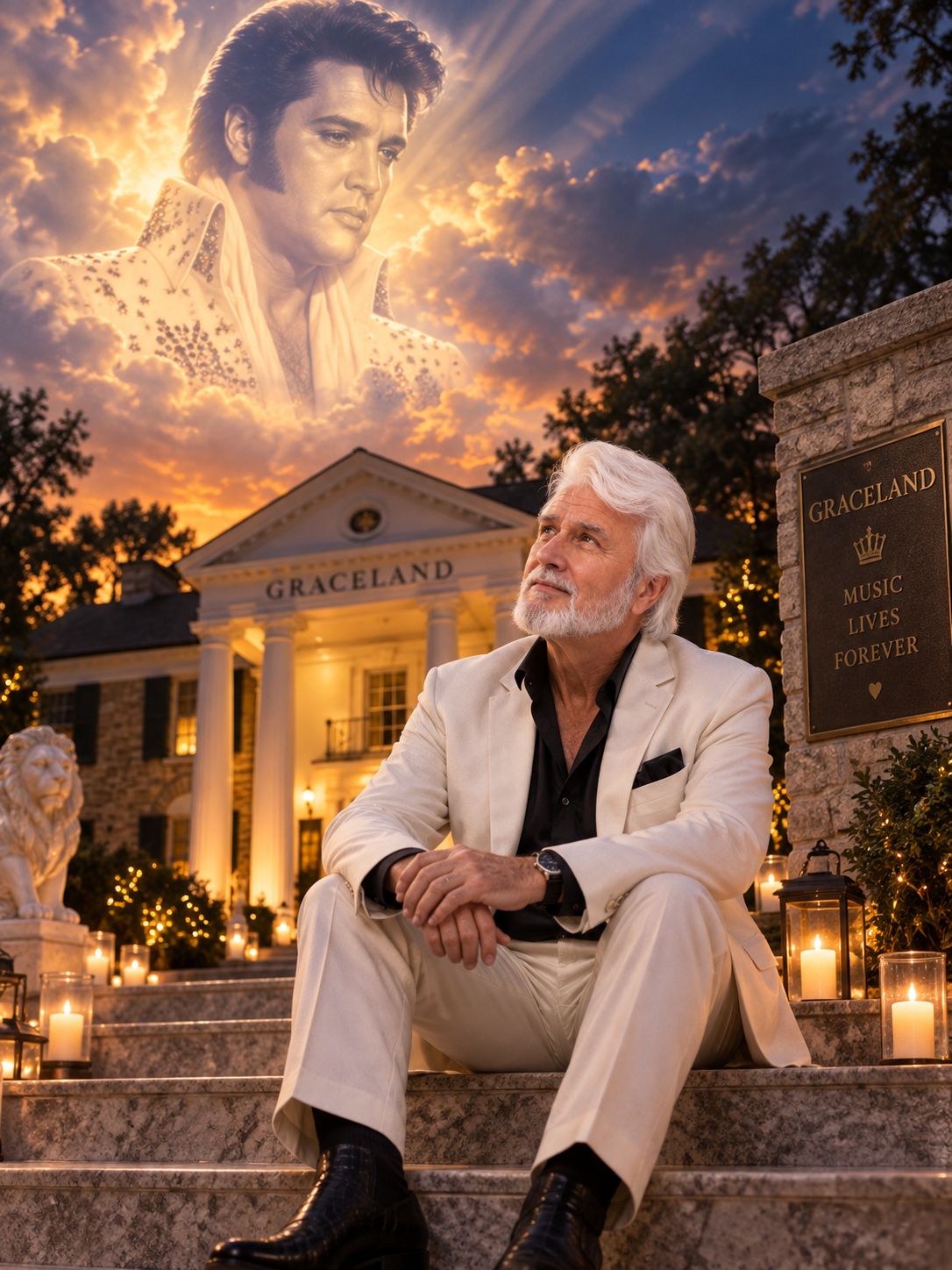
Memphis, August 1977. The gates of Graceland became the center of a worldwide farewell. Elvis Presley, only 42 years old, had died at his Memphis home on August 16, and within hours the news had traveled around the world. Two days later came the funeral. For history, the facts appeared painfully final: one of the most recognizable voices of the twentieth century was gone. Graceland and Elvis Presley Enterprises continue to record his death on that date, after what they describe as heart failure.
But legends rarely disappear as neatly as official timelines suggest.
For generations of listeners, Elvis was more than a recording artist. He belonged to youth, family radios, Saturday nights, military memories, first dances, heartbreaks, jukeboxes, and a particular vision of America that seemed to change when he walked onto a stage. When someone becomes connected to so many personal memories, accepting his absence can become strangely difficult.
Nearly half a century later, that difficulty found an unexpected new character.
His name was Pastor Bob Joyce.
Far from Graceland, in Benton, Arkansas, Joyce became known through sermons and gospel performances at Household of Faith Church. His official church materials identify him as Robert Wayne Joyce, born June 19, 1952, ordained in 1981 and married to his wife Willena since 1975. Today he continues preaching and leading music at the Arkansas congregation.
Then people heard him sing.
For some Elvis admirers watching online, the reaction was immediate.
There was something in the depth of the voice.
Something in a phrase.
Something in the way certain notes seemed to settle into the room.
Videos began circulating. Comparisons multiplied. Faces were placed beside faces. Voices were analyzed by enthusiastic listeners. Old Elvis mysteries were revived, and before long one of the strangest modern chapters of Presley folklore had taken shape.
:max_bytes(150000):strip_icc()/Riley-Keough-Elvis-022723-3b144c05ea8f4b5aa5b793f0f434a905.jpg)
Could Bob Joyce somehow be Elvis Presley?
It is an extraordinary question.
It is also one for which the available evidence gives a clear answer.
Bob Joyce is not Elvis Presley.
Joyce’s own official website states that he has never claimed to be another person and warns that videos have been edited—including with newer artificial-intelligence techniques—to create misleading impressions. His ministry explicitly distances itself from groups and accounts making comparisons between Joyce and other people.
The basic biographical record also creates an obvious contradiction. Elvis was born in 1935; Joyce’s official biography gives his birth year as 1952. Elvis would have been 42 in 1977. Joyce would have been 25. Graceland documents Elvis’s death and funeral in August 1977, while Joyce has a separate documented life and ministry.
And yet the theory refuses to disappear.
Perhaps that is where the story becomes more interesting.
Because the enduring fascination with Bob Joyce and Elvis may tell us less about Bob Joyce than it tells us about what Elvis Presley still represents.
Listen to an Elvis recording today and something unusual happens. The technology may belong to another era, but the voice does not feel trapped there. The opening of a familiar song can instantly collapse fifty years. A listener who was seventeen in 1968 may suddenly remember the room where the radio stood. Someone who watched the ’68 Comeback Special may remember not merely Elvis, but who was sitting beside them.
Music does that.
It preserves time in ways photographs cannot.
A photograph tells you that someone was once young.
A recording allows you to hear them young again.
That may explain why a voice carrying even a resemblance to Elvis can produce such a powerful response.
For some listeners, hearing Bob Joyce sing gospel does not simply trigger curiosity. It triggers recognition—or the emotional sensation of recognition. And emotion can be extraordinarily persuasive, particularly when it touches a figure whose death has generated myths for decades.