Introduction
The Quiet Voice That Changed Country Music Forever: Remembering Don Williams, the Gentle Giant Who Made Simplicity Sound Timeless
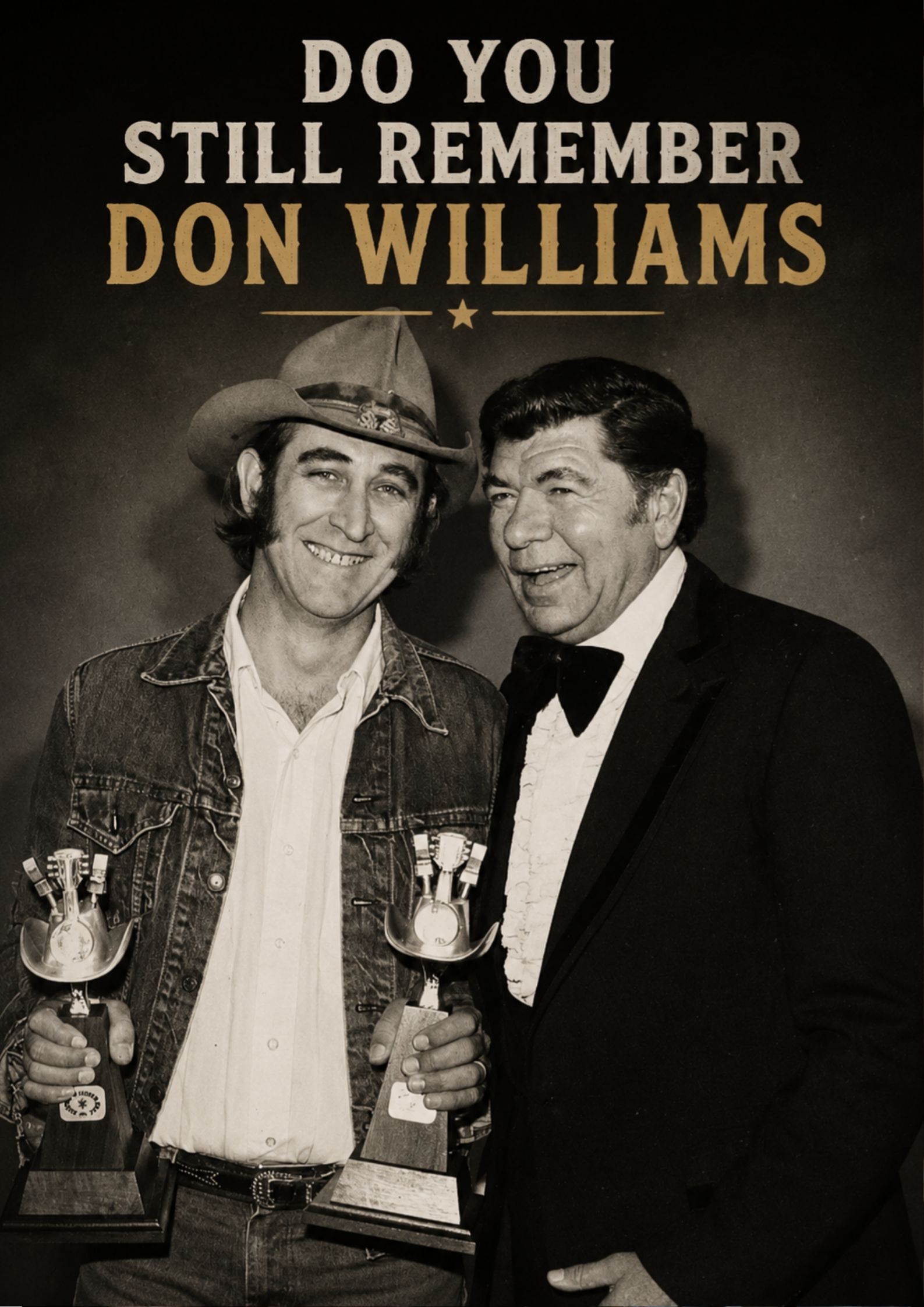
In the history of country music, some artists become famous because they command attention the moment they walk into a room. Others leave their mark more quietly, allowing their songs, their character, and their consistency to speak for them over time. Don Williams belonged to the second group. He never needed to overpower an audience with drama or noise. Instead, he built one of the most respected careers in country music history through calm sincerity, emotional honesty, and a voice so warm and steady that listeners often described it as comforting. That is why the story of The Life and Legacy of Don Williams: Country Music’s Gentle Giant continues to resonate deeply with audiences today.
To understand Don Williams, one must first understand where he came from. Born Donald Ray Williams in Floydada, Texas, in 1939, he grew up in a modest working-class environment shaped by discipline, humility, and family values. His father worked as a farm laborer, and his mother introduced him to the guitar — an act that would quietly change the course of country music history. Long before fame arrived, Williams was simply a young man in Texas learning how music could connect people.
As a teenager attending Gregory-Portland High School, Williams already displayed leadership qualities, serving as vice president of his freshman class while also performing in local bands around the Corpus Christi area. Those early years mattered because they shaped the grounded personality that fans would later admire. Even after becoming a star, Don Williams never seemed disconnected from ordinary life. He remained approachable, calm, and deeply human.

Before country audiences fully discovered him, Williams explored folk music through a duo called The Strangers Two, later joining with Susan Taylor to form the Pozo Seco Singers in 1964. During the height of the folk-pop movement, the group found success with the hit “Time.” Their harmonies drew attention, but even then, listeners noticed something special about Williams’s rich baritone voice. It carried a natural ease that made people lean in rather than simply listen from a distance.
When the group disbanded in 1970, Williams faced a crossroads familiar to many musicians. Instead of immediately finding stardom, he worked at his father’s furniture store before eventually moving toward songwriting in Nashville with Jack Clement’s Jack Music publishing company. That chapter of his story reveals an important truth about his career: nothing about Don Williams’s success felt rushed. He built it patiently, step by step, through craft and persistence.
His early recordings soon revealed an artist with uncommon emotional intelligence. Songs like “The Shelter of Your Eyes” and “Come Early Morning” introduced audiences to a singer who understood tenderness without sentimentality. Then came “We Should Be Together,” his first major Top 5 hit, followed by “I Wouldn’t Want to Live If You Didn’t Love Me,” which became his first Number 1 country song in 1974.
What followed was one of the most remarkable runs in country music history. Between 1974 and 1991, Don Williams achieved an extraordinary string of chart success, producing fifty-six charting songs and seventeen Number 1 hits. Yet statistics alone cannot explain his influence. His greatness was not only measured in awards or chart positions. It was measured in trust. Listeners trusted him because his music never felt dishonest.
At a time when many performers relied on larger-than-life personas, Williams embraced simplicity. His songs spoke about love, loneliness, aging, memory, and quiet resilience. He sang for ordinary people living ordinary lives — and he treated those lives with dignity. That is why songs such as “Tulsa Time,” “Amanda,” “Good Ole Boys Like Me,” and “Lord, I Hope This Day Is Good” still hold emotional power decades later.
The nickname “Gentle Giant” suited him perfectly. Physically tall and vocally commanding, Williams nevertheless projected kindness rather than ego. His stage presence was relaxed, almost conversational. Audiences did not feel they were watching a celebrity trying to impress them. They felt they were spending an evening with someone who understood life’s joys and disappointments.
For older listeners especially, Don Williams’s legacy represents something increasingly rare in modern entertainment: steadiness. He did not chase trends, controversies, or reinvention for attention. He remained faithful to the emotional truth at the center of his music. In doing so, he created songs that aged gracefully alongside the people who loved them.
Even after his passing in 2017, the emotional connection between Don Williams and his audience remains remarkably strong. His music continues to provide comfort during difficult seasons, companionship during lonely moments, and peace in an increasingly restless world. Younger artists still study his phrasing, his restraint, and his ability to communicate profound feeling without excess.
In the end, The Life and Legacy of Don Williams: Country Music’s Gentle Giant is not merely the story of a successful singer. It is the story of a man who proved that gentleness can endure in a loud world. Through humility, consistency, and timeless songs, Don Williams gave country music something priceless: quiet wisdom wrapped in melody.
And perhaps that is why his voice still matters today. It does not demand attention. It earns remembrance.