Introduction
The Forgotten Bee Gees Ballad That Makes Time Stand Still—Why “Dearest” Feels More Heartbreaking Now Than It Did in 1971

The Forgotten Bee Gees Ballad That Makes Time Stand Still—Why “Dearest” Feels More Heartbreaking Now Than It Did in 1971
Long before the bright stage costumes, soaring falsettos, and dance rhythms that would make them one of the most recognizable groups in popular music, the Bee Gees were three young brothers learning how to express life’s most fragile emotions through harmony. Their early recordings possessed a quiet intensity that did not depend on spectacle. They sang about distance, memory, regret, and the fear of losing someone before the right words could be spoken. Hidden among those recordings is “Dearest,” a tender song from the 1971 album Trafalgar that is gradually finding its way back into the hearts of listeners.
“Dearest” was never designed to command a crowded arena or transform a celebration into a dance floor. It belongs to a smaller and more private setting. It is the kind of song that seems most powerful when heard alone, late in the evening, when the room is quiet and the listener is no longer distracted by the ordinary demands of the day. Its emotional force comes not from dramatic production but from the delicate way Barry, Robin, and Maurice Gibb bring their voices together.
The song was written by Barry and Robin Gibb, yet its deepest identity emerges through the family connection shared by all three brothers. Their harmonies do not sound like three unrelated singers carefully matching notes. They sound like one emotional voice divided among three people. Each brother brings a different tone, but those differences seem to disappear when they unite. The result is what longtime admirers often describe as blood harmony—a musical understanding developed through childhood, shared memory, instinct, and years of listening to one another.
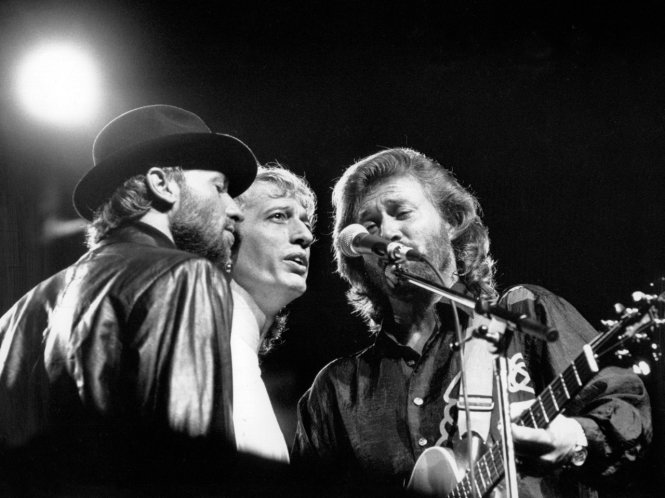
That harmony is what gives “Dearest” its remarkable ability to reach across time. The recording may come from 1971, but its sorrow does not feel locked inside that year. It speaks to anyone who has remembered a person after too much time has passed, revisited an old conversation, or wished that a relationship could briefly return to the way it once was. The language is gentle, but the emotions beneath it are enormous.
By the time Trafalgar was released, the Bee Gees had already experienced success, conflict, separation, and reunion. They were still young men, yet their music often sounded far older than their years. Perhaps this was because their lives had changed so rapidly. They had moved across countries, entered the music industry as children, and learned that fame could bring admiration without necessarily bringing security or peace. These experiences gave their ballads a seriousness that distinguished them from many of their contemporaries.
“Dearest” reflects that maturity. It does not attempt to impress the listener with vocal display or complex instrumentation. Instead, it trusts the melody and allows the harmonies to carry the meaning. There is a sense of restraint throughout the performance, as though the brothers understood that certain emotions become less believable when they are announced too loudly.
For older listeners, this restraint may be one of the song’s greatest strengths. Life teaches that grief and longing are not always dramatic. They often arrive quietly. They appear through an old photograph, a familiar name, or a melody heard unexpectedly on the radio. “Dearest” belongs to that private world of remembrance. It does not tell listeners how to feel. It creates enough space for them to bring their own memories into the song.
The renewed interest in this overlooked recording also encourages a broader reconsideration of the Bee Gees’ early catalog. Popular history frequently reduces great artists to the period of their largest commercial success. For the Bee Gees, that often means focusing almost entirely on the later decade when their voices, production style, and rhythmic innovations dominated the international charts. Those recordings remain important, but they represent only one part of an unusually rich career.
Before that celebrated transformation, the brothers were already exceptional songwriters and interpreters of emotion. Albums such as Trafalgar revealed their ability to create intimate dramas within a few minutes. Their melodies could be elegant without becoming distant, while their lyrics carried a sense of uncertainty that made the songs feel human. They understood that a ballad does not require a complicated story when the central emotion is true.
“Dearest” is a particularly moving example because it now exists within a history the young brothers could never have imagined. When the track was recorded, Barry, Robin, and Maurice were together, standing at the beginning of decades of music still waiting to be created. They could not know the triumphs, arguments, reunions, illnesses, and losses that the future would bring. To them, it was simply another song made during an active and uncertain period.
Today, the recording carries a different weight.
With Maurice and Robin no longer present, Barry remains the brother who must carry the earthly memories of their remarkable journey. That reality changes the way listeners hear the early harmonies. The voices remain perfectly preserved, but the family standing behind them has been altered forever. Every shared note has become evidence of a bond that time could challenge but never erase.
When “Dearest” begins, however, those later losses briefly disappear. The three brothers are young again. They stand together in the studio, listening for one another’s breathing and entering each phrase with the instinctive precision that made their sound unique. Music suspends ordinary time, allowing listeners to encounter the brothers not as figures separated by history, but as a living family joined in song.
This is one of the enduring miracles of recorded music. A voice does not age once it has been captured. A harmony does not know that decades have passed. The needle falls, the recording begins, and suddenly the distance between 1971 and the present becomes almost impossible to measure. Listeners who were young when Trafalgar first appeared can return to an earlier part of their own lives, while younger audiences can discover a Bee Gees far removed from the image they may already know.
The song’s quiet return also demonstrates that great music does not always need to be rediscovered through charts or major publicity campaigns. Sometimes one listener shares a recording with another. A forgotten album is played again. A song that once lived in the shadow of better-known hits suddenly finds the person who needs it. Its audience grows not through noise, but through recognition.
That process seems especially appropriate for “Dearest.” The song itself does not demand attention. It waits patiently. It offers no grand announcement and carries no need to prove its importance. It simply begins, allows the brothers’ voices to join, and trusts the listener to understand.
The Bee Gees were frequently underestimated because their career contained so many transformations. Some audiences knew them primarily as writers of sorrowful ballads. Others discovered them through rhythm and falsetto. Still others encountered their compositions through famous performers for whom the brothers wrote major songs. Yet beneath every stylistic change was the same essential foundation: three brothers with an extraordinary understanding of melody and harmony.
“Dearest” brings that foundation into focus. It reminds us that before the enormous stages and international recognition, their greatest instrument was one another. Barry could provide strength and melodic direction. Robin could introduce an unmistakable fragility that made every word feel urgent. Maurice could hold the harmony together with warmth and musical intelligence. Separate, they were gifted. Together, they created something that seemed to exist beyond ordinary technique.
There is also a lesson within the song’s revival. Cultural memory often favors the loudest victories, but the quieter works may reveal more about an artist’s heart. A famous hit tells us what captured the public at a particular moment. A deep cut can tell us what the musicians were thinking when they were not trying to satisfy the entire world.
“Dearest” feels less like a performance for strangers and more like a private emotional document. Its beauty lies in the impression that the brothers are singing toward something they cannot fully reach. That quality has become more poignant with age because listeners now understand how much the Gibb family would eventually endure.
Yet the song should not be heard only as a memorial. It also represents the joy of three voices discovering how naturally they belong together. Beneath the sadness is the confidence of artists who understand their shared gift. The harmony may break the heart, but it also restores something. It reminds us that love, memory, and family can remain present through sound even after time has changed everything else.
More than five decades after its release, “Dearest” proves that a song does not need to dominate its era in order to survive it. Some recordings wait quietly for history to catch up with them. They return when listeners have acquired enough experience to understand what the young voices were already trying to say.
The Bee Gees would later change popular music on a worldwide scale, but this intimate 1971 ballad preserves another side of their greatness. It captures Barry, Robin, and Maurice Gibb standing shoulder to shoulder, blending not merely their voices but their shared history into one unforgettable sound.
For a few minutes, no brother has been lost, no final performance has occurred, and no decades have passed. They are together again—and their harmony still knows exactly where the human heart is most fragile.