Introduction
Elvis Presley and Johnny Cash: The Untold Story of Two American Legends Who Recognized Greatness in Each Other
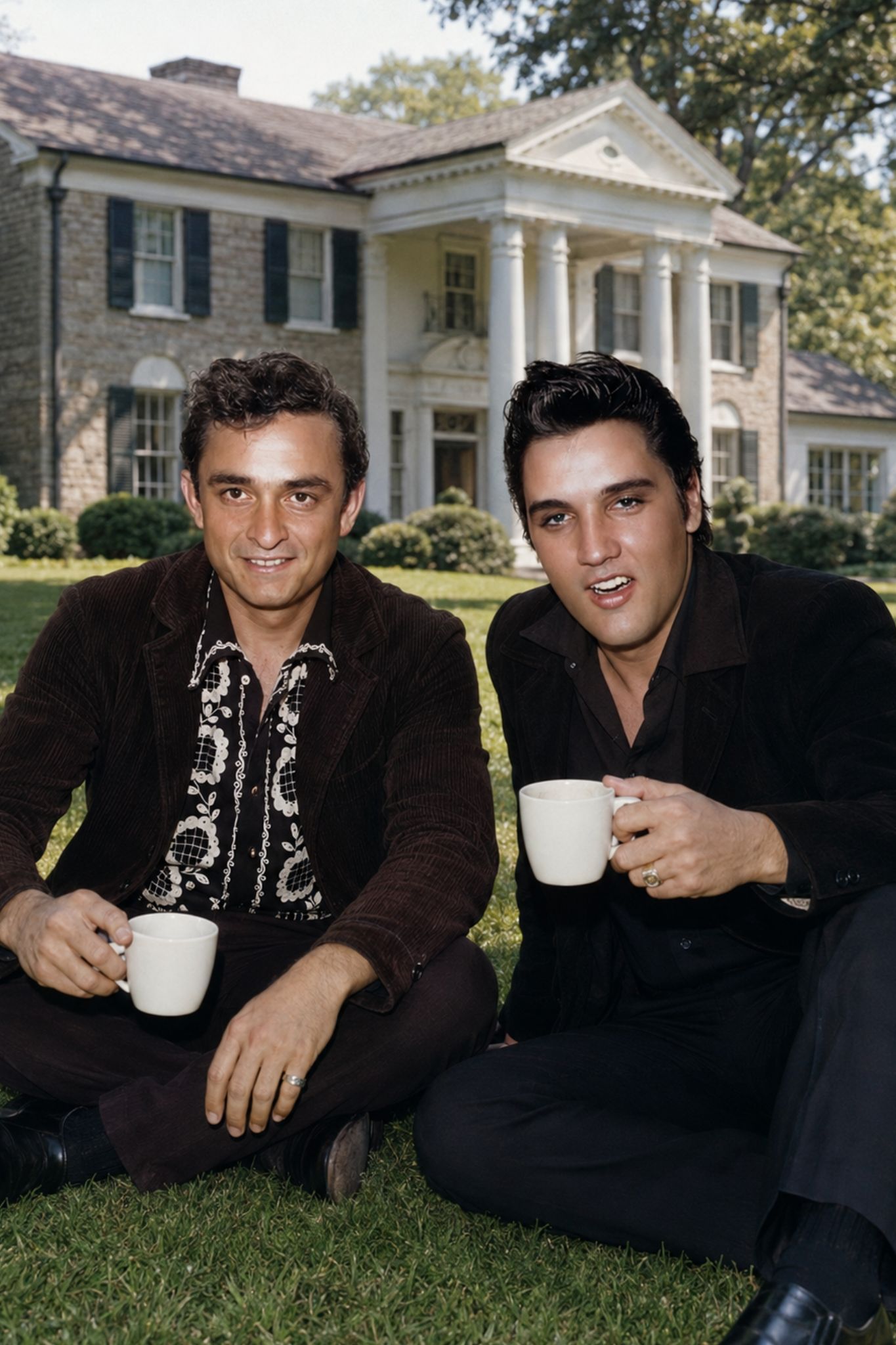
Long before Elvis Presley became the King of Rock and Roll and Johnny Cash emerged as the Man in Black, they were two ambitious young Southerners standing at the edge of a musical revolution. Neither could have fully understood how profoundly his voice would alter American culture. Yet both were drawn to the same modest building in Memphis, where producer Sam Phillips was searching for sounds that the established music industry had overlooked. Their friendship was never a carefully managed publicity campaign or a dramatic partnership created for the stage. It was a relationship formed through shared beginnings, mutual admiration, and an understanding of what it meant to rise from ordinary circumstances into extraordinary fame.
The story begins at Sun Studio, located at 706 Union Avenue in Memphis, Tennessee. The building was small, but the music created inside it would travel around the world. In July 1954, a 19-year-old Elvis recorded “That’s All Right,” transforming an old blues number into something urgent, youthful, and difficult to classify. It was neither traditional country nor conventional rhythm and blues. It carried elements of both, joined by Elvis’s remarkable instinct for rhythm and interpretation.
Johnny Cash arrived at Sun with a different sound and personality. Where Elvis appeared restless and explosive, Cash possessed a deep, steady voice that seemed to carry the weight of hard roads, church hymns, family memories, and moral struggle. His early recordings, including “Cry! Cry! Cry!” and “Folsom Prison Blues,” established him as an artist whose music was direct, economical, and unmistakably his own. Sam Phillips recognized that Cash did not need elaborate arrangements. He needed space for that commanding voice and the firm, train-like rhythm of the Tennessee Two.

Although Elvis and Cash developed separate musical identities, they recognized something important in each other. Cash remembered seeing Elvis perform during the early days, when the young singer had only a small collection of recorded material and was still learning how to command an audience. The surroundings were modest, and the crowds were nothing like the thousands who would later fill arenas. Yet Cash noticed Elvis’s natural charisma, his sense of rhythm, and the unusual way he could transform a familiar song into a personal statement.
Cash was not easily impressed by surface glamour. He valued authenticity, and he recognized it in Elvis before the world understood what it was witnessing. Beneath the nervous energy and youthful enthusiasm, there was a performer with extraordinary instincts. Elvis did not simply sing a melody. He inhabited it, reshaped it, and communicated it physically as well as vocally. Cash later described him as one of the greatest performers he had ever seen, praising both his singing ability and his remarkable command of a crowd.
Elvis, in return, respected Johnny Cash’s honesty and originality. Cash’s music carried a gravity that differed from Elvis’s early rockabilly excitement, but Elvis understood its power. During the 1950s, he reportedly performed or referred to Cash’s songs while traveling, helping introduce that dark, memorable voice to people beyond Cash’s growing audience. Elvis also spoke warmly about Cash to fellow musicians, predicting that the world would one day know his name.
That mutual confidence mattered because neither man began his career with certainty. The record industry was changing, but its gatekeepers remained cautious. Elvis was often considered too unusual for established categories, while Cash’s stark arrangements and solemn delivery did not resemble the polished country productions favored by many executives. Both men succeeded because they possessed something more valuable than conformity: a sound that could not be mistaken for anyone else’s.
Their connection became forever associated with one of the most famous afternoons in American recording history. On December 4, 1956, Elvis visited Sun Studio while Carl Perkins was working on new material, with a young Jerry Lee Lewis playing piano. The musicians began singing together informally, moving through gospel standards, country songs, and popular numbers. Johnny Cash was also present at the studio that day, although accounts differ regarding how long he stayed and how much he participated in the recorded singing.
The gathering was later promoted as the Million Dollar Quartet, a name that captured the astonishing reality of four future legends occupying the same room before history had fully measured their importance. The session was not planned as a commercial album. It was a spontaneous meeting of musicians who shared common roots and understood the same musical language. Gospel songs were especially important because they connected the performers to childhood, church, family, and the Southern communities that shaped them.
A celebrated photograph from that day shows Elvis Presley, Johnny Cash, Carl Perkins, and Jerry Lee Lewis gathered around the piano. It remains one of the defining images of twentieth-century music. They appear young, confident, and relaxed, unaware that generations of listeners would later study the photograph as if it captured the exact moment when several separate histories briefly became one.
Despite that legendary meeting, Elvis and Cash were not inseparable companions. Their friendship should not be exaggerated into something it was not. They did not spend every year of their careers touring or recording together, and they did not maintain constant contact as fame carried them in different directions. Their bond was based less on daily companionship than on shared history and enduring respect.
Elvis moved from Sun Records to RCA Victor and quickly became an international phenomenon. His life expanded into motion pictures, television appearances, military service, Las Vegas engagements, and enormous concert tours. Cash remained closely connected to country music while also crossing into folk, rock, gospel, and social commentary. His career brought triumphs, setbacks, spiritual renewal, and some of the most influential live recordings ever released.
As the years passed, the contrast between them became more visible. Elvis represented dazzling spectacle and unprecedented celebrity. Cash cultivated a restrained image built around black clothing, plain language, and songs about prisoners, workers, wanderers, and people standing outside respectable society. Yet beneath those different public identities were men formed by similar experiences. Both grew up with limited means. Both were deeply influenced by Southern gospel music. Both loved their families, remembered hardship, and understood that music could reach people ignored by polite society.
Cash remained especially attached to the Elvis he had known in the 1950s. That early Elvis was not yet surrounded by layers of mythology. He was a young man excited by music, devoted to his mother, and astonished by the speed with which his life was changing. Cash admired the raw urgency of those first Sun recordings because they preserved the moment before Elvis became an institution.
As Elvis’s fame grew, his private world became increasingly difficult to enter. Cash understood that pressure and did not attempt to force himself into Elvis’s inner circle. Their contact became less frequent, but the respect remained. This distance was not necessarily evidence of hostility or rivalry. It reflected the realities of two enormous careers and the isolation that often accompanies fame.
When Elvis died on August 16, 1977, Cash felt the loss deeply. Later that year, he honored Elvis during a television Christmas special alongside musicians connected to the Sun Records story. The tribute did not rely on spectacle. It drew upon the gospel tradition that had shaped all of them, remembering Elvis not merely as a cultural phenomenon but as a fellow musician whose spiritual roots had remained important throughout his life.
Cash continued speaking generously about Elvis long after his death. He did not dismiss him as a manufactured celebrity or reduce him to a collection of famous gestures. He remembered a gifted singer with tremendous rhythm, instinct, and stage presence. More importantly, he remembered the young performer who had stood in small rooms before the world had decided to call him a king.
The friendship between Elvis Presley and Johnny Cash therefore carries a quieter meaning than many sensational stories suggest. It was not built around rivalry, jealousy, or constant collaboration. It was a bond shaped by Sun Records, Southern roots, gospel traditions, and the recognition of authentic talent. Each man understood that the other possessed a rare gift, even though they expressed it in remarkably different ways.
Their story also reminds us that musical revolutions are rarely created by one person alone. The rise of rock and roll depended upon artists who crossed boundaries, borrowed from traditions around them, and brought new audiences together. Elvis and Cash stood at the center of that transformation, alongside Carl Perkins, Jerry Lee Lewis, Roy Orbison, and many other pioneers whose work emerged from Memphis and the surrounding South.
Today, the photograph of the Million Dollar Quartet appears almost too perfect to be real. Four young men stand together before their individual legends have fully formed. Yet perhaps the most important part of the image is not their future fame. It is the atmosphere of shared discovery. They were musicians listening to one another, exchanging songs, and enjoying traditions older than any of them.
Elvis Presley and Johnny Cash ultimately followed separate roads, but those roads began close together. Their friendship survived not because it was constantly displayed, but because it was rooted in memory and respect. They knew each other before the monuments, before the carefully protected images, and before history placed crowns and titles upon them. For a brief and remarkable period, they were simply two young musicians in Memphis who heard greatness in one another—and were proven right.