Introduction
THE SONG ELVIS LEFT BEHIND: How “Can’t Help Falling in Love” Became a Bridge Between Graceland and a New Presley Generation
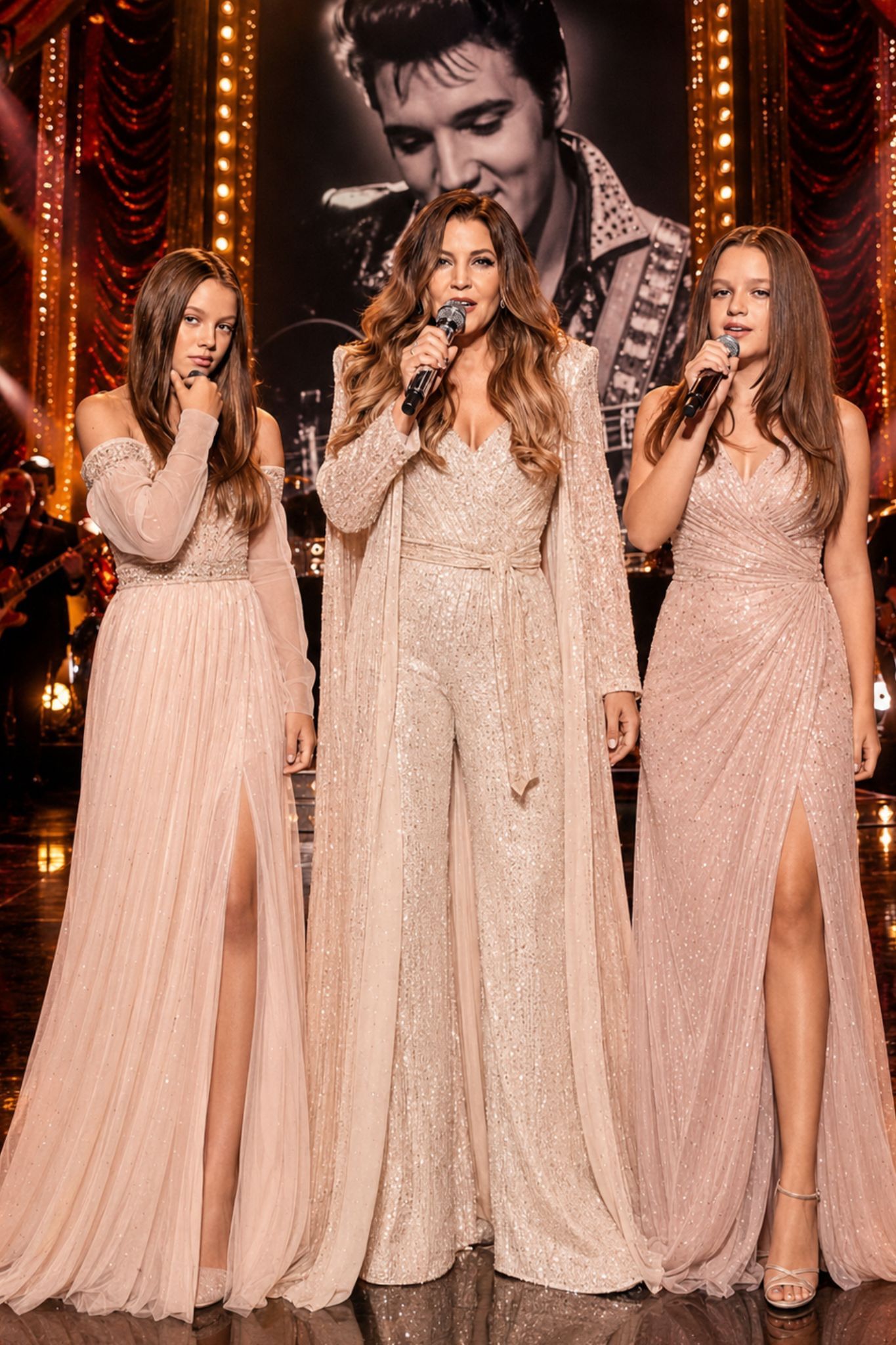
Some songs survive because they were great hits. Others survive because they become attached to moments people cannot bear to forget. Elvis Presley’s “Can’t Help Falling in Love” belongs firmly to the second category. More than six decades after Elvis recorded it, the song has traveled far beyond the film for which it was created. It has followed families through weddings, anniversaries, farewells, old photographs, quiet evenings, and memories of people no longer sitting beside us. Within the larger story of the Presley family, it carries an even more poignant significance: the voice belongs to a man who became an international legend, while the generations now protecting his memory were born into a world in which that voice already belonged to history.
Elvis recorded “Can’t Help Falling in Love” on March 23, 1961, in Hollywood for the motion picture Blue Hawaii, with Hugo Peretti, Luigi Creatore, and George David Weiss credited as the songwriters. At the time, there was no reason to know that this gentle ballad would eventually become one of the most enduring recordings associated with his name. Elvis was still young, enormously famous, and surrounded by an industry moving at extraordinary speed. Movies, recording sessions, publicity appearances, and new releases followed one another relentlessly. Yet this particular song possessed something that publicity could never manufacture: simplicity.

That simplicity became its strength. Elvis did not need the explosive energy of his early rock-and-roll recordings to command attention. Here, his voice was measured and warm, allowing the melody to carry a feeling of sincerity that has survived changing fashions in popular music. The recording became part of the Blue Hawaii soundtrack, but it eventually escaped the boundaries of the film entirely. It became a song people chose for important moments in their own lives, which is perhaps the highest form of immortality a recording can achieve. A hit belongs initially to the performer; a standard eventually belongs to everyone who attaches a memory to it.
For Elvis himself, the song acquired another remarkable role. During the later period of his career, “Can’t Help Falling in Love” became closely associated with the conclusion of his concerts. It closed his celebrated 1973 Aloha from Hawaii performance, and it was also the final song he performed at his last concert in Indianapolis on June 26, 1977. That history gives the recording a meaning its writers could never have anticipated in 1961. What began as a motion-picture ballad ultimately became, for countless admirers, the sound of Elvis saying goodnight.
The loss of Lisa Marie Presley in 2023 gave that idea still greater emotional weight. She had spent her entire life carrying the unusual distinction of being Elvis Presley’s only child, living simultaneously with intensely personal memories of her father and the knowledge that millions of people felt a connection to him. After her passing, her eldest daughter, Riley Keough, assumed an important responsibility in the preservation of the family legacy. Graceland’s official history states that Riley is sole trustee for the interests held for herself and her sisters Harper and Finley, including ownership connected with Graceland Mansion, its original grounds, and Elvis’s personal effects. Riley has also spoken publicly about wanting simply to preserve Graceland as the family home.
That responsibility makes the story larger than celebrity inheritance. Graceland is both a public landmark and a private family home, and Elvis is both an American cultural figure and a grandfather whose descendants live with the consequences of extraordinary fame. For the public, protecting the mansion means preserving music history. For the family, it also means safeguarding something far more intimate: rooms where birthdays happened, photographs were taken, conversations unfolded, and people they loved once walked through the doors.
That may explain why this particular song remains so powerful. Elvis recorded hundreds of songs and gave performances of astonishing energy, yet “Can’t Help Falling in Love” possesses a quiet quality that seems resistant to time. It does not need the spectacle of Las Vegas or the grandeur of a stadium to succeed. A few familiar notes are enough to bring people back to places and people they thought they had left behind.
For the Presley family, that power must carry an entirely different dimension. The world hears Elvis Presley, the King of Rock and Roll. His descendants can also hear a voice belonging to their own family tree. Every recording provides something time otherwise refuses to give them: the sound of a person who came before them, preserved forever in the present tense.
Perhaps that is the real reason Elvis’s legacy continues to cross generations. It is not merely because the world refuses to forget a famous entertainer. It is because music has a remarkable ability to turn memory into something living. Elvis Presley left the stage in 1977, but his voice never did. It traveled forward through records and films, through Graceland and family stories, through Lisa Marie and now toward Riley, Harper, Finley, and generations still to come.
And whenever those opening notes of “Can’t Help Falling in Love” begin again, the distance between 1961 and today suddenly feels remarkably small. For three minutes, history stops being history. A young Elvis sings again, families remember again, and a legacy that should have belonged to another century quietly finds its way into the next generation.