Introduction
WHEN COUNTRY MUSIC CAME HOME TO SAY GOODBYE — GEORGE STRAIT, CARRIE UNDERWOOD, LUKE COMBS AND LAINEY WILSON HONORED ALAN JACKSON’S FINAL ROAD SHOW
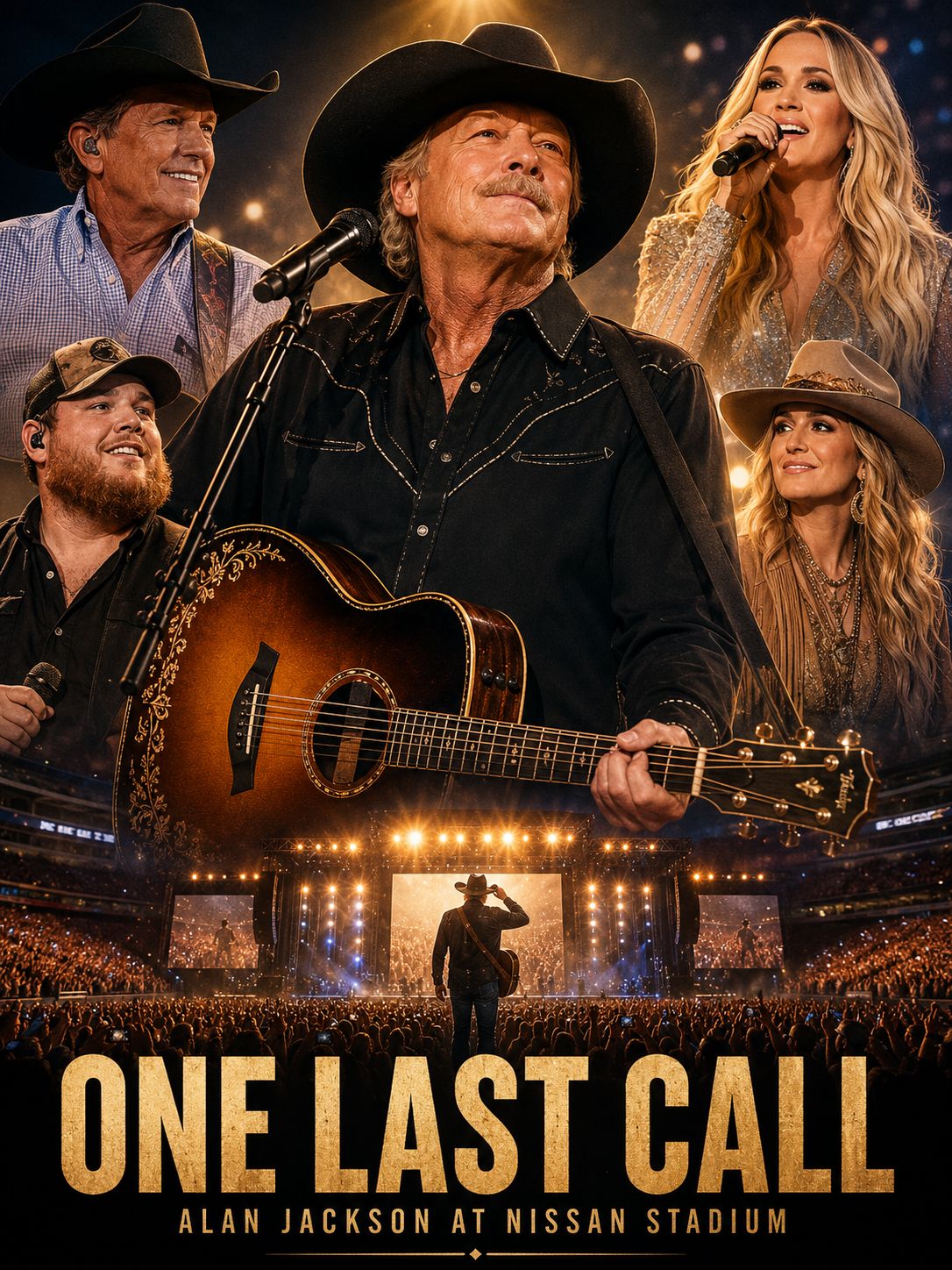
Some concerts are remembered for their production, their volume, or the number of famous names printed on the program. Others become unforgettable because everyone present understands that a chapter of history is closing before their eyes. On June 27, 2026, Nashville’s Nissan Stadium became the setting for such a night as Alan Jackson brought his decades-long touring career to an emotional conclusion with Last Call: One More for the Road – The Finale. Surrounded by his family, devoted listeners, and an extraordinary gathering of country artists, Jackson did not simply perform one more concert. He received a heartfelt farewell from the musical community he had influenced for more than three decades.
More than 80,000 people representing 32 countries reportedly gathered for the celebration, demonstrating just how widely Jackson’s music had traveled from its traditional country roots. Fans arrived from across the United States and from distant parts of the world, carrying memories of songs that had accompanied weddings, family drives, difficult goodbyes, and ordinary evenings at home. Although the stadium was enormous, the occasion often felt unexpectedly personal. Each familiar melody seemed to belong not only to Jackson but also to the listeners who had carried it through important chapters of their own lives.
The evening’s remarkable lineup revealed the respect Alan Jackson commands across several generations of country music. George Strait, Carrie Underwood, Luke Combs, Lainey Wilson, Miranda Lambert, Luke Bryan, Eric Church, Riley Green, Cody Johnson, Thomas Rhett, Little Big Town, Jake Owen, Jon Pardi, and Lee Ann Womack were among the artists assembled to honor his career. Members of Jackson’s extended family, including Adam Wright, Big City Brian Wright, and Carlisle Wright, also participated, giving the gathering the warmth of a family celebration as well as the stature of a major national event.
What made this collection of stars so meaningful was that they did not appear merely as celebrities filling a concert schedule. Many stood before the crowd as admirers whose own musical journeys had been shaped by Jackson’s example. Carrie Underwood recalled that an Alan Jackson performance at the Tulsa State Fair in 1994 had been her first concert, before singing “Everything I Love.” Her presence connected the young girl who once watched from the audience with the celebrated artist now standing onstage to thank one of her earliest inspirations.
Luke Combs chose “Hard Hat and a Hammer,” a song honoring working people and the quiet dignity of honest labor. It was an especially fitting selection because Jackson’s music has always spoken naturally to listeners whose lives rarely appear beneath bright entertainment-industry lights. His songs recognized farmers, mechanics, truck drivers, parents, small-town families, and people who built their lives through responsibility rather than public attention. Combs approached the material with the respect of a younger performer acknowledging the path Jackson helped preserve.
Lainey Wilson brought energy to the celebration with “Tall, Tall Trees,” while Miranda Lambert offered “Dallas.” Thomas Rhett performed “Small Town Southern Man,” and Eric Church stripped “Someday” down to voice and acoustic guitar. These different interpretations showed the extraordinary range of Jackson’s catalog. His work can fill a stadium, support an intimate acoustic performance, bring listeners to their feet, or leave them quietly reflecting on the passing of time.
The appearance of George Strait carried particular emotional significance. Strait and Jackson represent two of the strongest pillars of traditional country music, artists whose careers demonstrated that restraint, storytelling, and unmistakable authenticity could survive changing fashions. Neither man ever needed excessive theatrics to command an audience. A cowboy hat, a dependable band, a carefully chosen song, and a voice listeners trusted were enough. Seeing them share this farewell stage felt like witnessing two great guardians of country tradition acknowledge a bond built through music, longevity, and mutual respect. George joined Jackson during the evening for duet performances, adding further weight to an already historic occasion.
For Alan Jackson, this finale represented the end of a touring journey that had carried his music across North America and into Australia, Brazil, Europe, and other parts of the world. His Last Call: One More for the Road tour had played to sold-out and capacity audiences before reaching its Nashville conclusion. The final event itself had sold out during the presale, after approximately half a million people registered for the opportunity to purchase tickets.
Yet the night was not built entirely around nostalgia. It also reflected Jackson’s desire to turn his farewell into support for others. From every ticket sold, one dollar was donated to the CMT Research Foundation, with a donor providing an additional two-dollar match. The foundation supports research related to Charcot-Marie-Tooth disease, the inherited neurological condition Jackson publicly disclosed he had been living with. The charitable purpose gave the celebration another layer of meaning: an evening looking back upon a remarkable career was also helping to create hope for people facing the future.
When Jackson finally took control of the stage, the evening shifted from tribute to testimony. He performed songs that had become woven into the fabric of country music, including “Gone Country,” “Livin’ on Love,” “Where Were You (When the World Stopped Turning),” and the joyous “Chattahoochee.” Fireworks accompanied the closing celebration, but the deepest emotion came from recognizing the human story beneath the spectacle. The singer standing before the crowd had traveled a long road, and everyone understood that this would be the last full-length concert of his touring career.
Jackson’s music has endured because it rarely speaks down to its audience or attempts to impress listeners through unnecessary complexity. His greatest recordings feel like conversations. He sings about love that grows stronger through ordinary years, about communities changing around the people who call them home, and about memories whose importance becomes clearer with age. His calm delivery allows the listener to enter each story without being told exactly what to feel.
That quality made Nissan Stadium an appropriate place for his farewell. The crowd was vast, yet Jackson’s songs continued to feel as though they were being sung directly to individuals. A husband could hear his marriage inside “Remember When.” A parent might recognize the passage of family life. Someone grieving could find comfort in a melody that had accompanied an earlier loss. The strength of Jackson’s work has always rested in this ability to make millions of people believe a song understands them personally.
The concert also showed that Alan Jackson’s influence belongs to more than one generation. George Strait represented a fellow master from an era grounded in traditional country values. Carrie Underwood reflected the artists who came of age while Jackson was already a major star. Luke Combs and Lainey Wilson demonstrated how his emphasis on honest storytelling continues to reach contemporary performers. Their different voices formed a living timeline of country music, joined together by the songs of the man they had come to honor.
Although the evening marked the conclusion of Jackson’s touring career, it was not presented as the disappearance of the artist himself. Jackson and the concert’s host reminded the audience that leaving the road did not necessarily mean abandoning songwriting or recording. The finale closed one demanding chapter while leaving open the possibility that his creative voice would continue to be heard in other forms.
By the end of the night, the applause belonged to more than a successful entertainer. It belonged to a man who had remained faithful to his musical identity, respected his listeners, and carried traditional country storytelling into stadiums around the world. It also belonged to the songs themselves—the quiet ballads, lively anthems, and thoughtful reflections that had become part of countless private histories.
George Strait, Carrie Underwood, Luke Combs, Lainey Wilson, and their fellow performers did not gather merely to say goodbye to Alan Jackson. They gathered to demonstrate what his music had built. His career created connections between generations, between performers and listeners, and between personal memories and a shared American musical tradition.
When the final fireworks faded above Nissan Stadium, one road had reached its end. Yet the songs remained, carried home by more than 80,000 people and preserved in the voices of the artists who had come to honor him. Alan Jackson may have taken his last touring bow, but the country music family he helped shape made one truth unmistakable: a genuine legacy does not leave the stage when the singer does.